For the stated single elementary step and constant reaction volume,The equal magnitudes follow from the unit stoichiometric coefficients. In the buffered case this hydroxide consumption is balanced by buffer chemistry; the measured total hydroxide concentration can then remain constant.
At , in the usual dilute-solution thermodynamic activity approximation. Therefore A: ; B: ; C: . These are initial concentrations; only C is actively buffered at its stated value.
Let and .
- A: OH starts in 100-fold excess, so its consumption changes its concentration by at most about 1%. Set : , a pseudo-first-order reaction law.
- B: initially . Stoichiometry preserves while hydroxide dominates water autoionization, giving . It is not pseudo-first-order reaction merely because its initial pH equals C's.
- C: adequate buffer capacity keeps constant despite consumption: , again pseudo-first-order reaction. Assume buffer components do not react with MeX or change the effective rate constant appreciably.
B: integrate :For completeness, unbuffered unequal initial concentrations obey , , and the exact expression isIt approaches the equimolar second-order expression as and the excess-hydroxide exponential when depletion is negligible.
Set :The corresponding numerical concentration factors are approximately , and , each divided by . Thus A is about 100 times faster than C at this conversion, while B takes about times as long as C because its hydroxide is depleted.
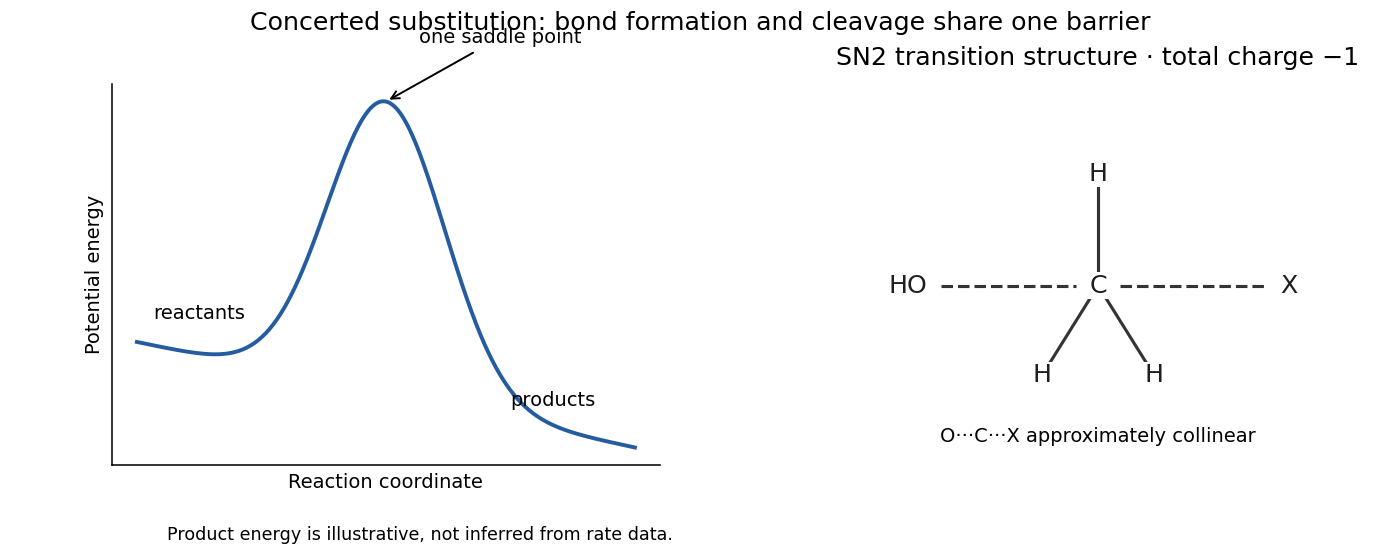
Single-barrier substitution profile and the trigonal-bipyramidal SN2 transition structure
. Details. 
Draw one maximum for the concerted SN2 reaction step, with no intermediate minimum. Its transition structure iswith O-C forming and C-X breaking, both shown as partial bonds. O-C-X is approximately linear, and the three C-H bonds lie in the equatorial plane. The overall charge is , distributed over the entering and leaving groups.
The sketch illustrates an exergonic case; the elementary-step description alone does not supply a numerical reaction energy or determine the product-reactant energy difference for every possible X.
A transition structure is a saddle point on the potential-energy surface: motion along the reaction coordinate lowers energy in either direction. It has one unstable vibrational direction and no intermediate residence basin.
An intermediate is a local minimum, separated from neighboring states by barriers, with a finite lifetime. It may be short-lived, but that does not make it a transition structure. The elementary SN2 reaction step has a transition structure and no distinct bonded intermediate.
Articles by others on the same topic
There are currently no matching articles.