Carbon dioxide is linear, with two equivalent C–O bonds of formal bond order two; its Homo is predominantly oxygen nonbonding and its LUMO is C–O antibonding. The carbon uses two opposite hybrids for its sigma bonds and two perpendicular p atomic orbitals for pi bonding. A localized picture assigns each terminal oxygen an sigma/lone-pair framework and one p orbital for its local pi bond.
In a symmetry-adapted description, each of the two perpendicular sets of oxygen and carbon p functions forms bonding, oxygen-centred nonbonding and antibonding combinations. The occupied nonbonding pair is labelled and the lowest empty pi pair . The latter has appreciable amplitude at carbon, explaining its electrophilic reactivity. Hybridization of a terminal atom with only one bonded neighbour is a choice of localized basis, not an independently measurable bond angle; an alternative oxygen plus p basis can represent the same delocalized system.
There are 16 valence electrons: four in the two sigma bonds, four in the two net pi bonds, and eight in the remaining oxygen lone-pair combinations. These local electron counts and the delocalized orbital description are alternative bookkeeping schemes, not additional electrons.
Ozone is bent, with two equivalent O–O bonds of approximate bond order . Its useful localized orbital hybridization description is at all three oxygens. Two hybrids at the central oxygen form sigma bonds and a third contains a lone pair; the three perpendicular p orbitals form a three-centre four-electron pi bond.
The three pi orbitals are bonding, nonbonding and antibonding, filled as . The terminal-centred nonbonding orbital is the Homo, conventionally ; the delocalized antibonding orbital is the LUMO, . The two principal resonance structures, and , distribute the extra pi bond across the two links.
The 18 valence electrons comprise four sigma-bond electrons, ten in five sigma-framework lone pairs, and four in the pi system. This gives a paired ground-state model. More accurate treatments include electron correlation; the simple bond-order picture is not an exact charge-density calculation.[ref]
The central carbon in carbon dioxide has two bonding directions and no lone pair, whereas the central oxygen in ozone has two bonding directions and one lone pair. In the VSEPR model, carbon dioxide therefore has a linear arrangement; ozone has an approximately trigonal-planar electron-domain arrangement but a bent atomic skeleton. Multiple bonding occupies one direction for this geometrical count. The extra central-oxygen lone pair, rather than a different number of atomic nuclei, creates the difference.
The product is carbonic acid, . The oxygen lone pair Homo of water donates into the carbon-centred component of the carbon dioxide LUMO. Draw an electron-pair arrow from the water oxygen to carbon and a second from one C=O pi bond onto its oxygen:The first step bends the original linear electrophile and gives carbon three oxygen neighbours; carbon is approximately trigonal planar in the resulting carbonate framework. Proton transfer from the oxonium oxygen to the negatively charged oxygen produces the neutral acid. In real water, solvent molecules relay that proton rather than requiring a strained isolated intramolecular transfer. The forward mechanism does not assert that most dissolved carbon dioxide is present as carbonic acid at equilibrium.
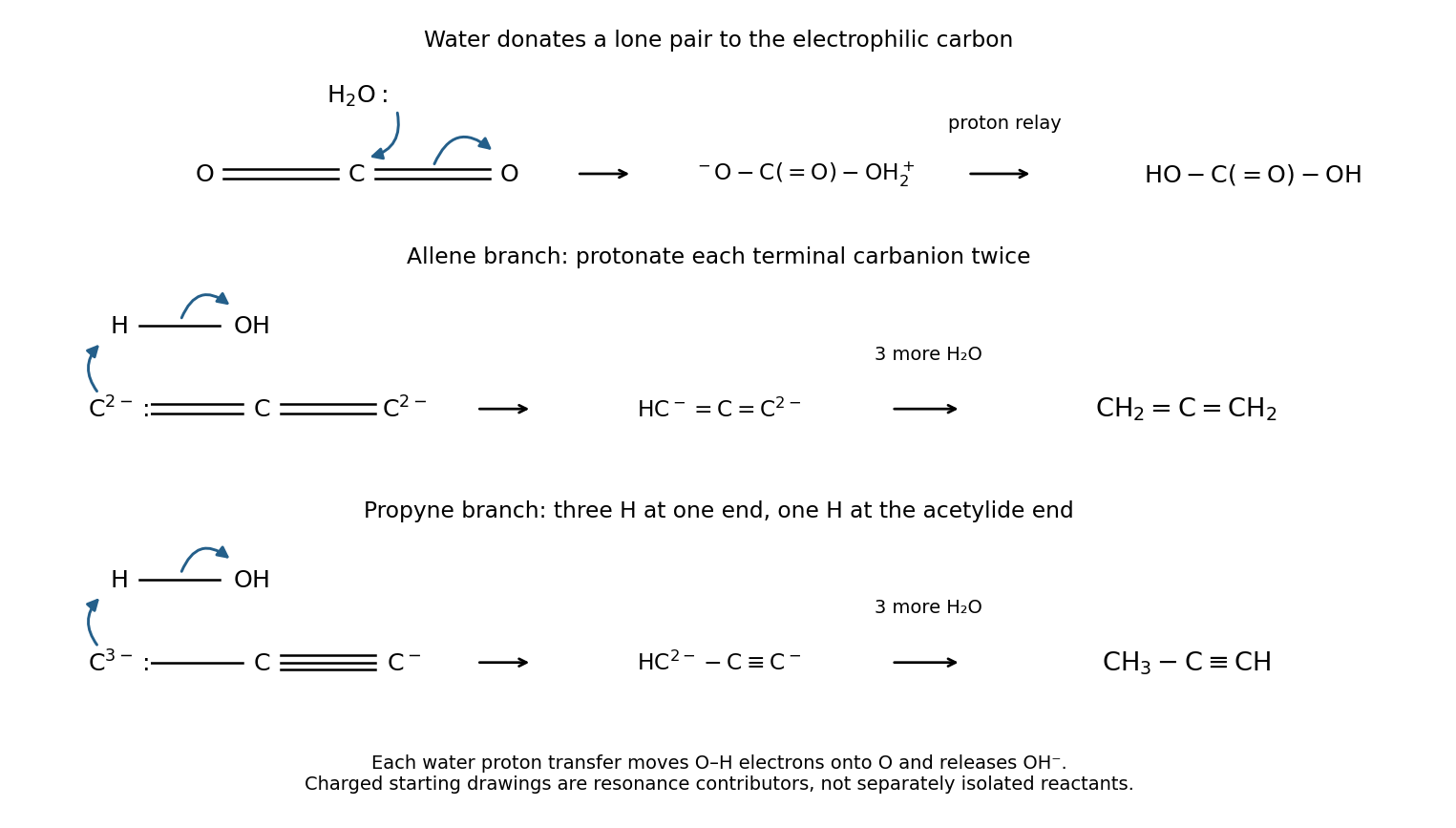
Original electron-pair arrows for carbon dioxide hydration and protonation routes from the tricarbide ion
. Details. 
The elementary valence-MO model gives . Each carbon supplies four valence electrons, so fill eight electrons in the ordering appropriate to the lighter second-row diatomics:The two orbitals are degenerate, as are the two orbitals. The bonding and antibonding occupations cancel; four net p-bonding electrons remain, giving . Mixing between sigma orbitals of compatible symmetry places the occupied pair below the empty p-derived orbital in this diagram. All occupied orbitals are paired.
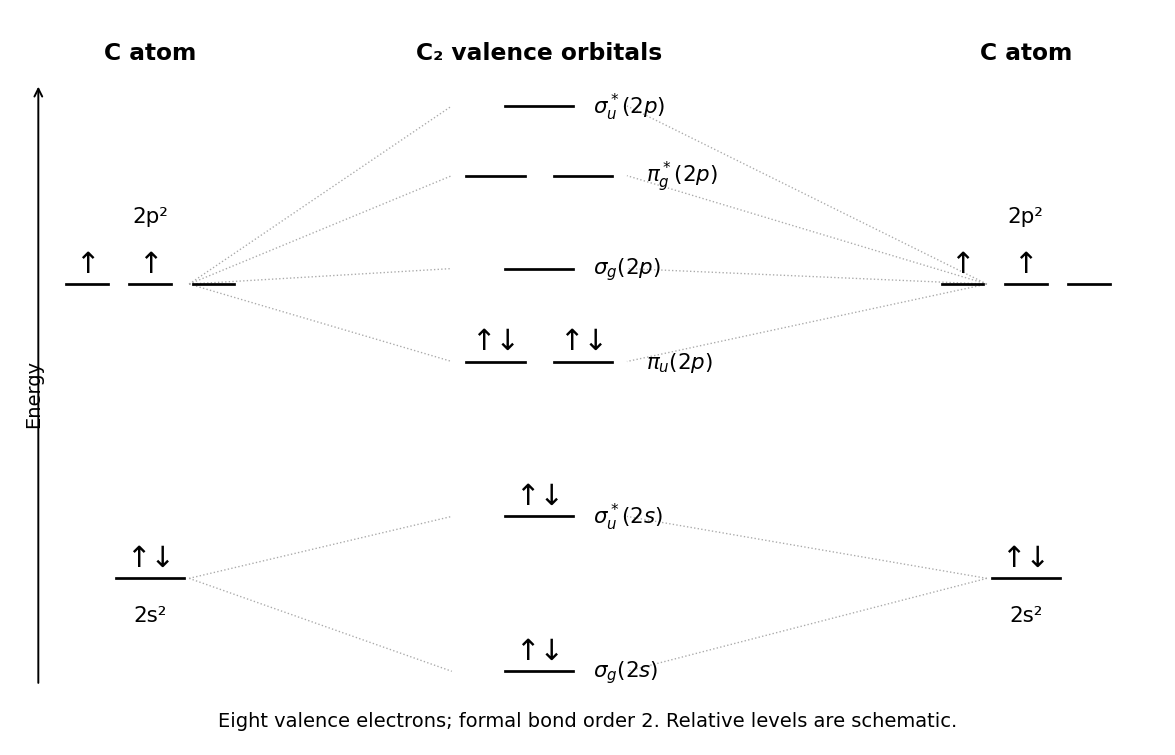
Original valence molecular orbital energy diagram for carbon dimer, with atomic inputs and symmetry labels
. Details. 
The omitted orbitals form filled and levels. Their contributions to the formal bond order cancel, and their low energies and small spatial extent make them largely core-like. Omitting them simplifies this valence diagram without claiming they do not exist or have exactly no effect on molecular energies.
The acetylide has ten valence electrons, two more than neutral . They fill the p-derived sigma bonding orbital, giving the formal configuration above the cancelling pair. Its bond order is three, with the Lewis structure and a lone pair at each end; each carbon is approximately hybridized.
The tricarbide has valence electrons and is isoelectronic with carbon dioxide. The cumulene contributor has a central carbon, two sigma bonds and two perpendicular pi bonds. The end carbons each have two lone pairs and can be described with an localized basis. Its two C–C bonds have formal order two in this model; the central C–C–C angle is . Other resonance contributors help describe its protonation chemistry.
The extra electron associated with trivalent lanthanum weakens the C–C bond by occupying states with C–C antibonding character. Calcium gives the ten-valence-electron acetylide description , with formal bond order three, consistent with the short pm distance.
A fully ionic count for gives . The eleventh valence electron then enters a orbital, giving the simple estimate . This explains the longer pm bond. In the actual solid that electron is not necessarily localized on an isolated radical: metal–carbon mixing and band delocalization make “triple bond plus partial antibonding occupation” more appropriate than an exact isolated-ion bond order. Bond length alone does not determine a unique numerical bond order.
The intended ordinary-carbide comparison is energetic: the smaller, more strongly polarizing can stabilize a different balance of lattice energy and carbon-anion bonding from the larger . Stabilization of the highly charged group competes with acetylide formation; electron counting alone does not require the same carbide stoichiometries for both metals. Ionic size and charge density provide a qualitative explanation, not a complete phase-stability calculation.
The literal claim that calcium has only one carbide is too broad. Primary calculations and high-pressure synthesis have established additional calcium carbides, including and ; known calcium-carbide chemistry also includes . Thus the conventional comparison must be limited to the familiar salt-like compounds and conditions intended here, rather than treated as a prohibition on other calcium–carbon compositions.[ref]
Investigation of exotic stable calcium carbides using theory and experiment by Yan-Ling Li and others. 2015, abstract, Ca2C3 section and experimental synthesis
The two carbon skeletons are allene, , and propyne, . “Linear” describes the three-carbon skeleton; it does not mean every hydrogen lies on the same line.
For allene, use the contributor . A terminal lone pair attacks a water hydrogen while the O–H pair returns to oxygen, giving and hydroxide. Repeat at the still-dianionic end, then protonate each remaining terminal carbanion. The four successive proton transfers givewith two hydrogens placed on each terminal carbon in this branch.
For propyne, the resonance contributor makes the alternative electron flow clear. Three successive protonations of the singly bonded terminal carbon convert its three lone pairs into C–H bonds; protonation of the acetylide end gives . These are formal protonation pathways for the multiply charged anion, not a claim that the highly charged resonance contributors are separately isolable species. Each transfer produces ; overallAllene has one proton resonance integrating to 4H, ideally a singlet because its four hydrogens are chemically equivalent. Proton-decoupled carbon NMR has two resonances, in ratio two terminal carbons to one central carbon: approximately and ppm, respectively. The unusually downfield central cumulene carbon is not a carbonyl.
Propyne has two proton resonances, integrating 3H near – ppm and 1H near – ppm. If the small four-bond coupling is resolved, they are a methyl doublet and an acetylenic quartet; if unresolved, each can look like a singlet. Proton-decoupled carbon NMR has three resonances: one methyl carbon near ppm and two distinct sp carbons around – ppm. These are approximate predictions, not supplied measured shifts.
Articles by others on the same topic
There are currently no matching articles.