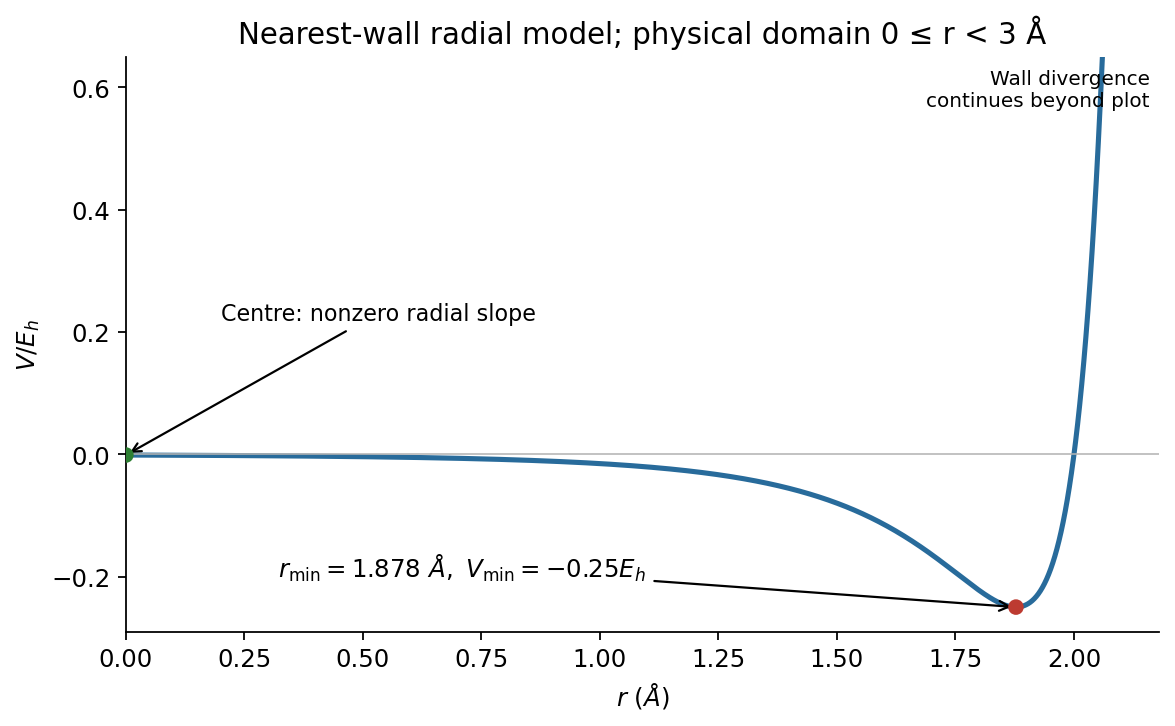
The minimum is at with depth ; the model is not a smooth physical potential at the cage centre. Put and . Thenso is the minimum. ThereforewhileThe positive inverse-twelfth-power term mimics short-range overlap repulsion, while the negative inverse-sixth-power term mimics London dispersion force. These powers are used in the Lennard-Jones potential; they are not a microscopic derivation for an atom inside a carbon cage.
The relevant domain is . As the atom approaches the wall the model diverges positively, which is qualitatively sensible. However, the energy depends only on the nearest radial wall distance and omits all the other cage atoms. More decisively, : a radial function of the Cartesian position must have zero first radial derivative at the centre to be differentiable there. The model produces a cusp and a nonvanishing directional force as the centre is approached. An off-centre minimum is not by itself forbidden, but this centre behaviour is inconsistent with a smooth symmetric cage potential.

Articles by others on the same topic
There are currently no matching articles.