Natural broadening is about times narrower than the thermal Doppler width and is negligible for this comparison. The supplied Doppler broadening formula is a half width at half maximum. Using the integer molecular mass ,For an excited-state population lifetime , the radiating amplitude decays as . Its Lorentzian line shape has natural linewidthEquivalently, compare full widths and . Using the same linewidth convention in both expressions matters more than the small isotope-mass correction. This estimate assumes that the lower state's lifetime is long and leaves any pressure broadening as a separate contribution.
The Stokes vibrational band has O, Q and S branches, with , respectively. Here denotes end-over-end rotational angular momentum; treating electronic fine structure as unresolved gives the usual elementary rotor calculation. The absolute incident wavenumber isand energy conservation for Stokes Raman scattering givesFor the actual ground state, only odd have nonzero nuclear-spin statistical weight. Thus the lowest initial levels are for O and for Q and S. Ignoring the small change in upon vibration, the lines are:
The odd- restriction follows from the zero nuclear spin and exchange symmetry of ; the electronic spin splits each such into several levels without changing this simplified branch-centre calculation.[ref]
O2 A-band line parameters to support atmospheric remote sensing Part II by David A. Long and others. Section 3, manuscript page 4: only odd lower-state N has nonzero statistical weight for oxygen-16 and oxygen-18
If the phrase simplest approximation is instead taken to discard nuclear-spin statistics as well, a fictitious unrestricted rotor gives O at and S at , with Q still at . Those even- lines are not physical ground-state lines.
The terms are , and . Closed molecular orbital shells contribute no net spin angular momentum or axial orbital projection, so only the two equivalent electrons need be coupled. Their individual projections are .
Putting both electrons in the same projection gives and forces opposite spins by the Pauli exclusion principle, yielding . With one electron in each projection, the spin-adapted symmetric and antisymmetric spatial combinations give a singlet and a triplet . Their reflection parities are and , respectively. Both open-shell electrons are gerade, so their product is gerade. The dimensions exhaust the microstates. By Hund's rules, the triplet is the lowest term, and is the lower singlet.
The terms are , , , , and . The active configuration is . Each nearly filled shell has the angular-momentum possibilities of one hole, so coupling two distinguishable hole sets gives or with or .
For , the two arrangements of opposite projections combine with either reflection parity, hence both and . Unlike the equivalent-electron case in part (a), neither spatial combination is excluded for either spin: the holes belong to different orbital shells. The inversion parity is . Counting degeneracies gives , equal to the choices of the two holes.
Only is electric-dipole allowed within the listed terms. For a diatomic molecule, the electric-dipole selection rule requires , , and . The lower singlet of part (a) is . Every candidate from the same configuration fails the inversion rule, while the terms of part (b) require . Triplet destinations fail the spin rule. The surviving transition uses the axial dipole component, so it is a parallel electronic transition. Weak spin-orbit or other intensity-borrowing transitions are outside this leading electric-dipole classification.
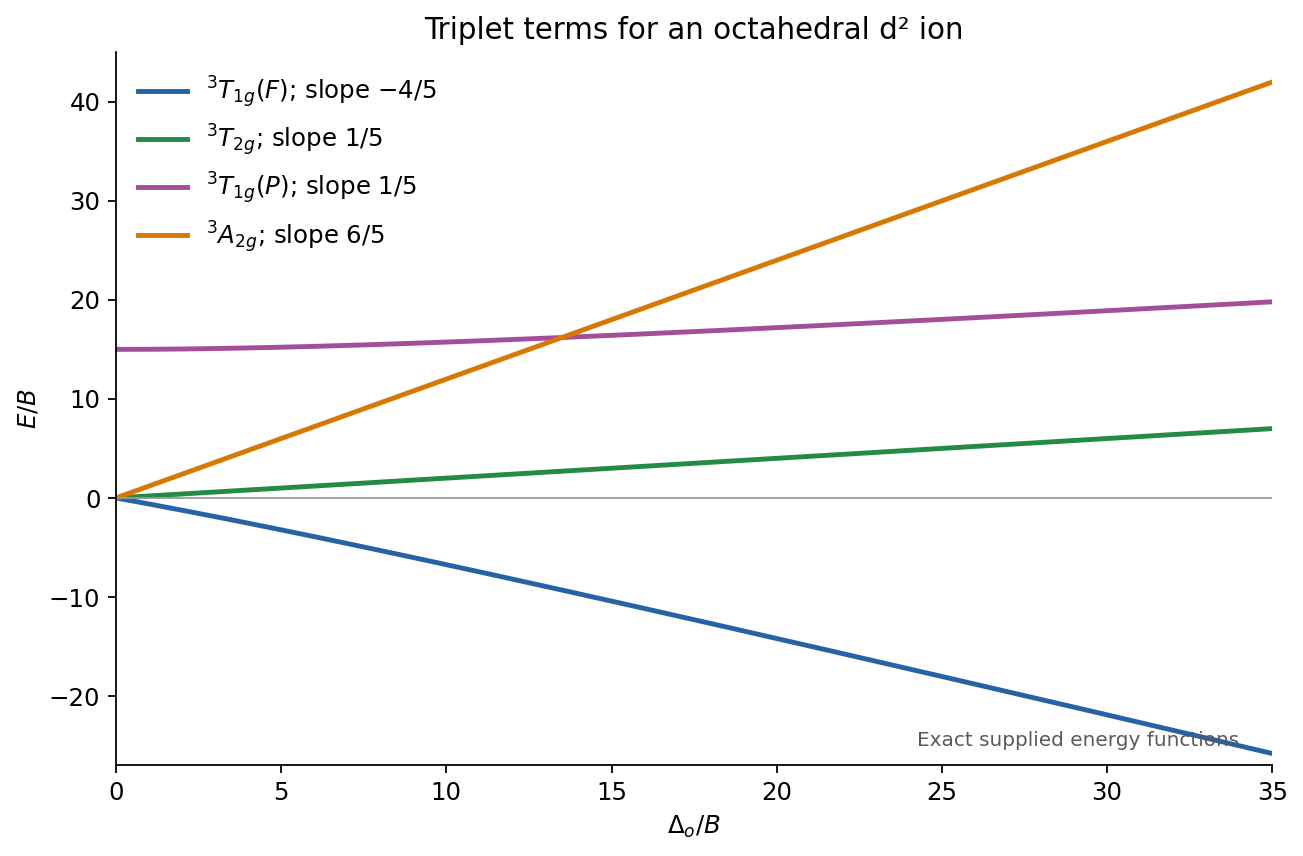
For positive , expand the common radical asSubstitution into the stated crystal field theory energies givesThe leading straight-line asymptotes retain the terms linear in and constant in . The terms show from which side the interacting levels approach them.
For , the corresponding asymptotic expansion isHenceAt zero field, converge to the atomic term and to at . The branch therefore has zero initial slope; its high-field slope is not zero.
The descending line is ; the low rising line is ; the steep line is ; and the branch starting at is . Their high-field slopes, in the same order, areThese are slopes of the supplied absolute term energies relative to their chosen reference, not slopes of transition energies measured upward from the ground state. The two states share a symmetry and mix, whereas the crossing of and the upper branch is allowed because they have different irreducible representations.
and . The Hückel method gives benzene's occupied frontier level as and its unoccupied frontier level as . ThereforeUsing the Koopmans' theorem approximation for the ionization energy, , gives and the stated parameters. This calibration neglects orbital relaxation, electron correlation and any distinction between a measured optical excitation and an independent-particle orbital gap.
The model predicts . For a uniform ten-site cyclic Hückel method model,Ten pi electrons fill with two electrons per orbital. The Homo is the degenerate pair, soThis is the prediction for the stipulated planar conjugated ring. It does not assert that an unconstrained all-cis ten-membered ring actually adopts a strain-free planar geometry.
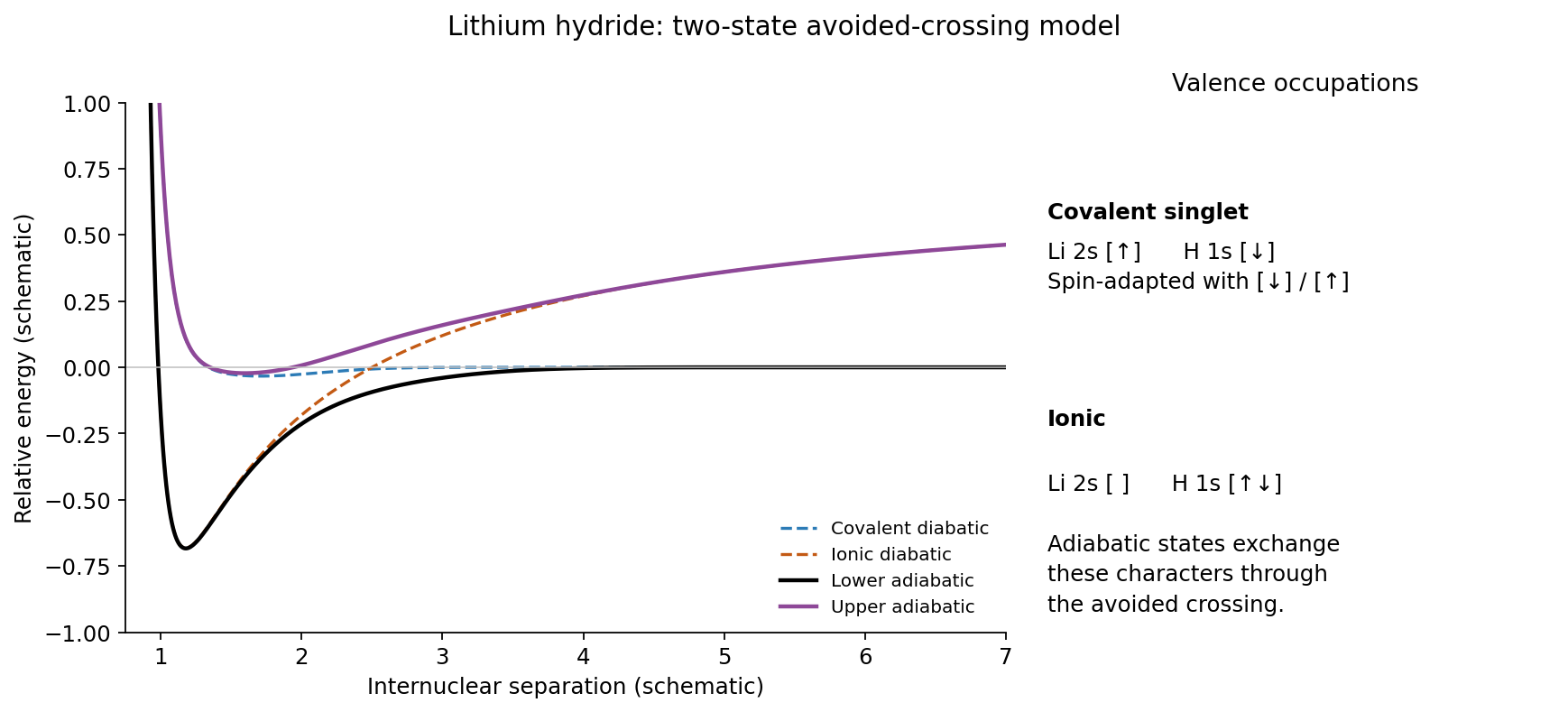
The ionic and covalent diabatic curves cross; coupling replaces the crossing by an avoided crossing of the adiabatic curves. Take the separated neutral atoms as the zero of valence energy. A covalent diabatic state has one electron in a lithium-centred orbital and one in a hydrogen-centred orbital, coupled to an overall singlet. An ionic diabatic state has an empty lithium valence orbital and a doubly occupied hydrogen orbital.
At large internuclear separation , the ionic limit lies above the neutral one by . At smaller , its attractive Coulomb term lowers it; short-range repulsion eventually raises both curves. A two-state Hamiltonian givesWhere the diabatic energies would coincide, nonzero coupling opens a gap . The lower adiabatic state changes continuously from predominantly ionic character near the bond minimum to predominantly neutral covalent character at dissociation. The upper state exchanges character in the opposite direction. Near the crossing both are mixtures, so a sketch assigning a fixed charge pattern to an entire adiabatic curve would miss the important physics.
Each site has a pi-electron population , and each adjacent pi bond order is . The two carbon sites supply one pi electron each and the nitrogen lone pair supplies two, giving four electrons in two occupied molecular orbitals. Orthogonality to the given Homo and LUMO fixes the remaining occupied normalized orbital, up to overall sign, asFor doubly occupied orbitals, the Hückel orbital charge density and Hückel pi bond order follow fromThe diagonal sums to four electrons. The negative is an off-diagonal density-matrix element between nonadjacent sites, not an additional directly connected chemical bond.
Relative to neutral pi contributions , the pi-system charges are : electron density has moved from nitrogen toward the two carbon sites. Thus the physical electric dipole moment vector points from the midpoint of the carbon pair toward nitrogen along the molecular symmetry bisector. The conventional chemical dipole arrow, with a crossed positive tail, points oppositely: from nitrogen toward the carbon pair. This is only the pi contribution, not a prediction of the full sigma-plus-pi molecular dipole.
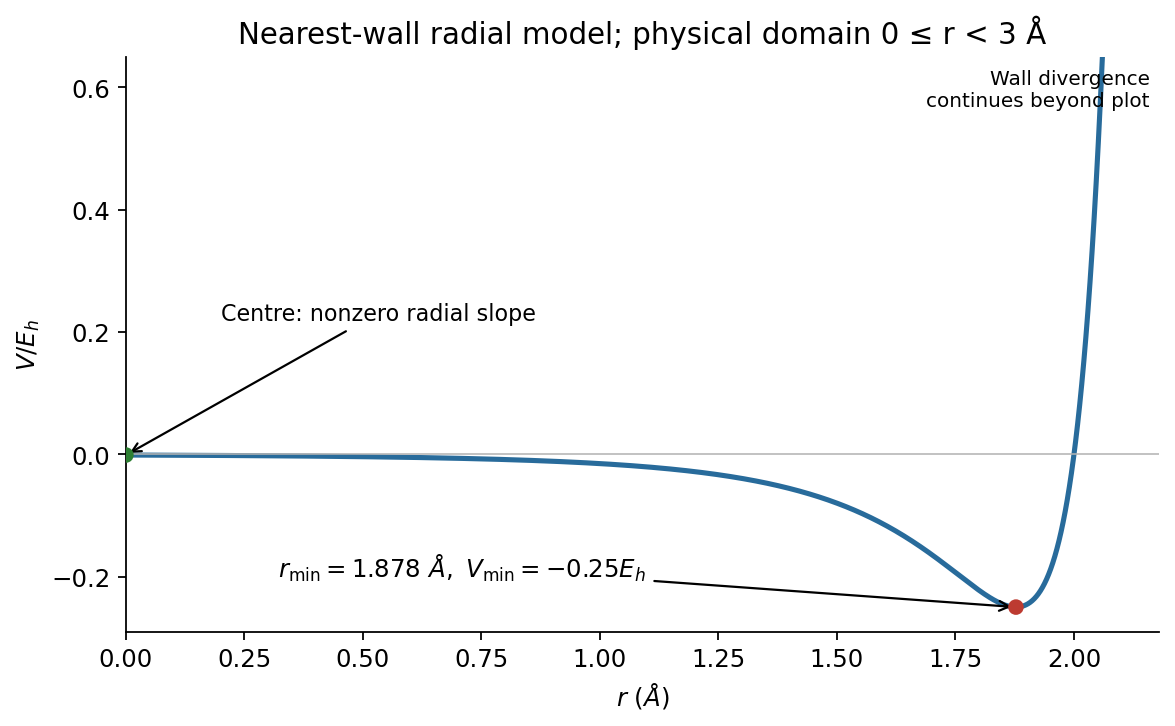
The minimum is at with depth ; the model is not a smooth physical potential at the cage centre. Put and . Thenso is the minimum. ThereforewhileThe positive inverse-twelfth-power term mimics short-range overlap repulsion, while the negative inverse-sixth-power term mimics London dispersion force. These powers are used in the Lennard-Jones potential; they are not a microscopic derivation for an atom inside a carbon cage.
The relevant domain is . As the atom approaches the wall the model diverges positively, which is qualitatively sensible. However, the energy depends only on the nearest radial wall distance and omits all the other cage atoms. More decisively, : a radial function of the Cartesian position must have zero first radial derivative at the centre to be differentiable there. The model produces a cusp and a nonvanishing directional force as the centre is approached. An off-centre minimum is not by itself forbidden, but this centre behaviour is inconsistent with a smooth symmetric cage potential.


Articles by others on the same topic
There are currently no matching articles.