The two course covers share one question body. Questions occupy physical pages 424–440 of the public bundle; the printed question numbers run from 13 to 24.
Natural broadening is about times narrower than the thermal Doppler width and is negligible for this comparison. The supplied Doppler broadening formula is a half width at half maximum. Using the integer molecular mass ,For an excited-state population lifetime , the radiating amplitude decays as . Its Lorentzian line shape has natural linewidthEquivalently, compare full widths and . Using the same linewidth convention in both expressions matters more than the small isotope-mass correction. This estimate assumes that the lower state's lifetime is long and leaves any pressure broadening as a separate contribution.
The Stokes vibrational band has O, Q and S branches, with , respectively. Here denotes end-over-end rotational angular momentum; treating electronic fine structure as unresolved gives the usual elementary rotor calculation. The absolute incident wavenumber isand energy conservation for Stokes Raman scattering givesFor the actual ground state, only odd have nonzero nuclear-spin statistical weight. Thus the lowest initial levels are for O and for Q and S. Ignoring the small change in upon vibration, the lines are:
The odd- restriction follows from the zero nuclear spin and exchange symmetry of ; the electronic spin splits each such into several levels without changing this simplified branch-centre calculation.[ref]
O2 A-band line parameters to support atmospheric remote sensing Part II by David A. Long and others. Section 3, manuscript page 4: only odd lower-state N has nonzero statistical weight for oxygen-16 and oxygen-18
If the phrase simplest approximation is instead taken to discard nuclear-spin statistics as well, a fictitious unrestricted rotor gives O at and S at , with Q still at . Those even- lines are not physical ground-state lines.
The terms are , and . Closed molecular orbital shells contribute no net spin angular momentum or axial orbital projection, so only the two equivalent electrons need be coupled. Their individual projections are .
Putting both electrons in the same projection gives and forces opposite spins by the Pauli exclusion principle, yielding . With one electron in each projection, the spin-adapted symmetric and antisymmetric spatial combinations give a singlet and a triplet . Their reflection parities are and , respectively. Both open-shell electrons are gerade, so their product is gerade. The dimensions exhaust the microstates. By Hund's rules, the triplet is the lowest term, and is the lower singlet.
The terms are , , , , and . The active configuration is . Each nearly filled shell has the angular-momentum possibilities of one hole, so coupling two distinguishable hole sets gives or with or .
For , the two arrangements of opposite projections combine with either reflection parity, hence both and . Unlike the equivalent-electron case in part (a), neither spatial combination is excluded for either spin: the holes belong to different orbital shells. The inversion parity is . Counting degeneracies gives , equal to the choices of the two holes.
Only is electric-dipole allowed within the listed terms. For a diatomic molecule, the electric-dipole selection rule requires , , and . The lower singlet of part (a) is . Every candidate from the same configuration fails the inversion rule, while the terms of part (b) require . Triplet destinations fail the spin rule. The surviving transition uses the axial dipole component, so it is a parallel electronic transition. Weak spin-orbit or other intensity-borrowing transitions are outside this leading electric-dipole classification.
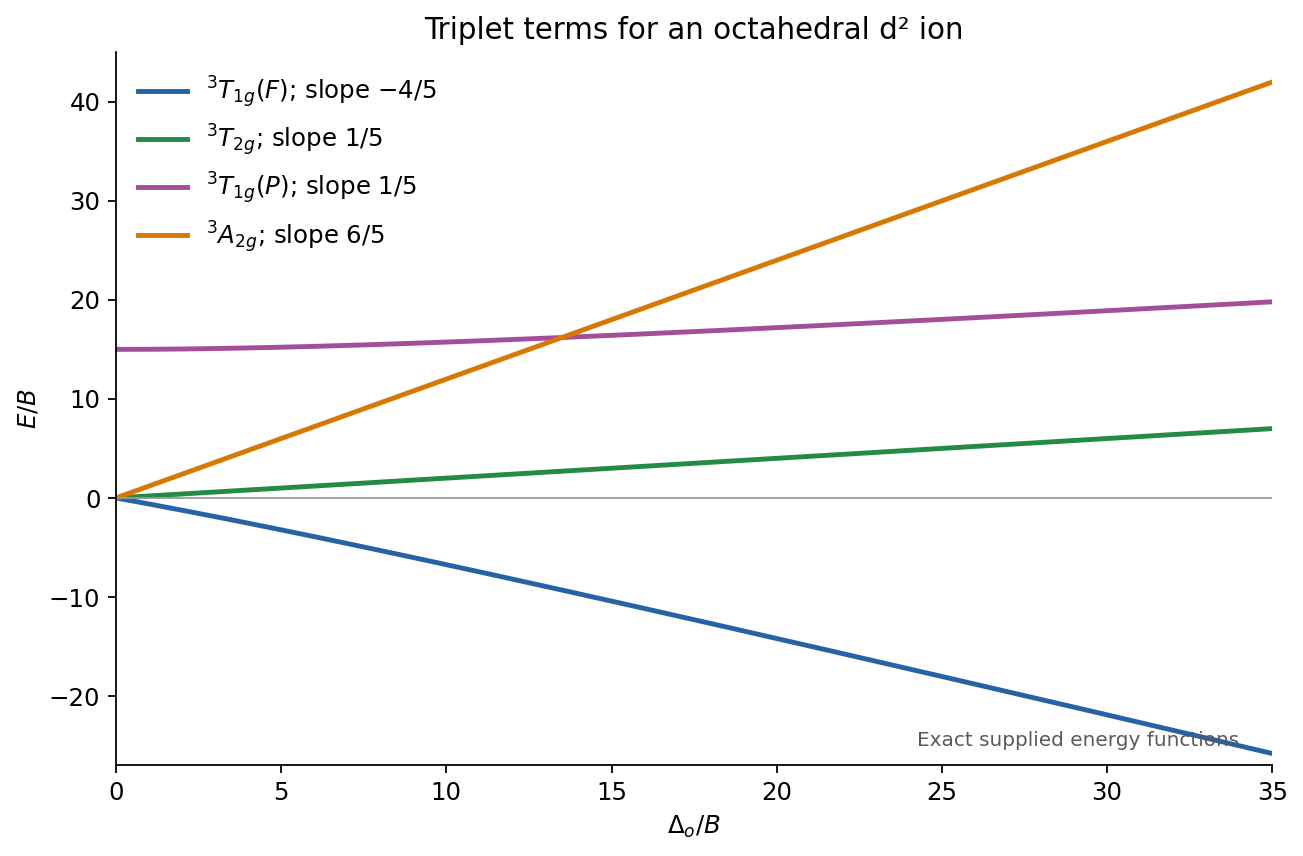
For positive , expand the common radical asSubstitution into the stated crystal field theory energies givesThe leading straight-line asymptotes retain the terms linear in and constant in . The terms show from which side the interacting levels approach them.
For , the corresponding asymptotic expansion isHenceAt zero field, converge to the atomic term and to at . The branch therefore has zero initial slope; its high-field slope is not zero.
The descending line is ; the low rising line is ; the steep line is ; and the branch starting at is . Their high-field slopes, in the same order, areThese are slopes of the supplied absolute term energies relative to their chosen reference, not slopes of transition energies measured upward from the ground state. The two states share a symmetry and mix, whereas the crossing of and the upper branch is allowed because they have different irreducible representations.
and . The Hückel method gives benzene's occupied frontier level as and its unoccupied frontier level as . ThereforeUsing the Koopmans' theorem approximation for the ionization energy, , gives and the stated parameters. This calibration neglects orbital relaxation, electron correlation and any distinction between a measured optical excitation and an independent-particle orbital gap.
The model predicts . For a uniform ten-site cyclic Hückel method model,Ten pi electrons fill with two electrons per orbital. The Homo is the degenerate pair, soThis is the prediction for the stipulated planar conjugated ring. It does not assert that an unconstrained all-cis ten-membered ring actually adopts a strain-free planar geometry.
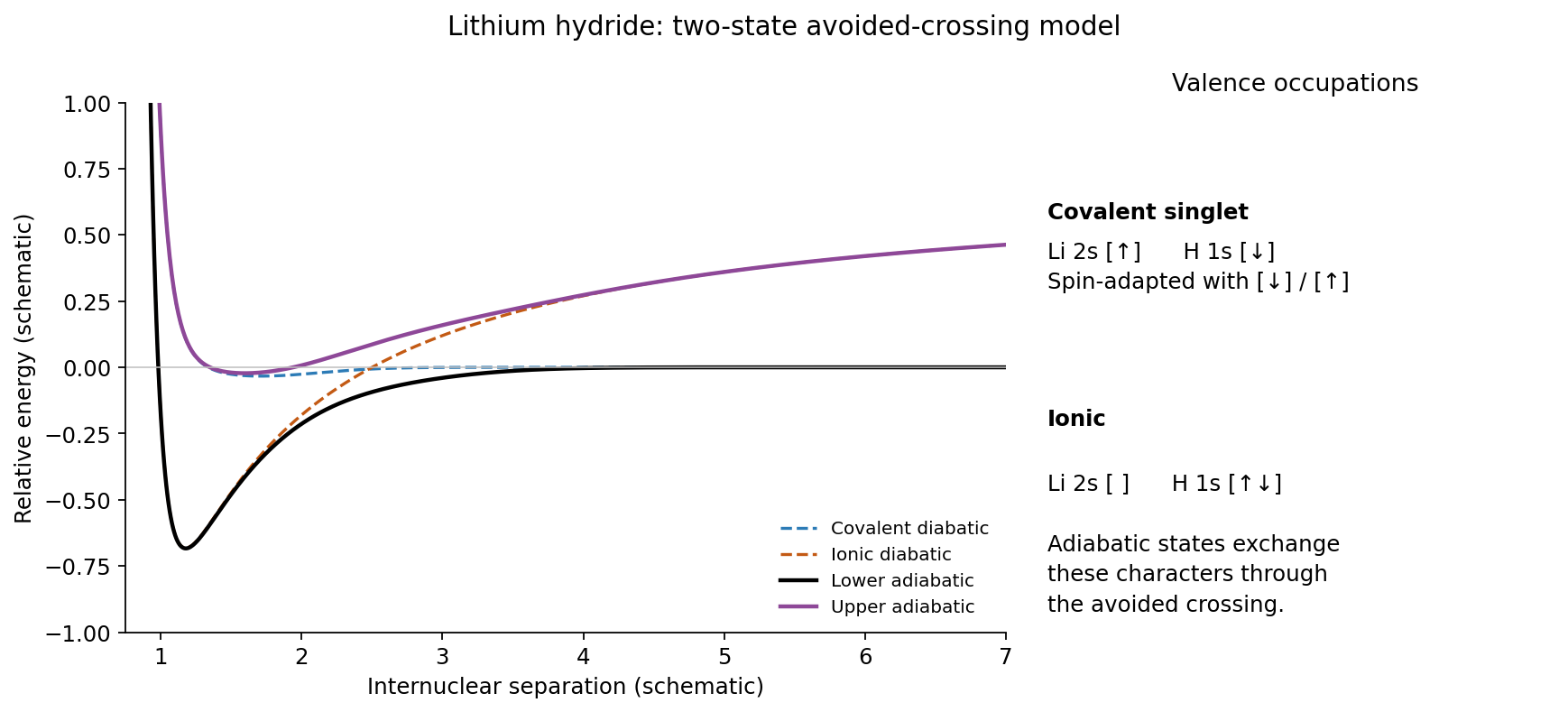
The ionic and covalent diabatic curves cross; coupling replaces the crossing by an avoided crossing of the adiabatic curves. Take the separated neutral atoms as the zero of valence energy. A covalent diabatic state has one electron in a lithium-centred orbital and one in a hydrogen-centred orbital, coupled to an overall singlet. An ionic diabatic state has an empty lithium valence orbital and a doubly occupied hydrogen orbital.
At large internuclear separation , the ionic limit lies above the neutral one by . At smaller , its attractive Coulomb term lowers it; short-range repulsion eventually raises both curves. A two-state Hamiltonian givesWhere the diabatic energies would coincide, nonzero coupling opens a gap . The lower adiabatic state changes continuously from predominantly ionic character near the bond minimum to predominantly neutral covalent character at dissociation. The upper state exchanges character in the opposite direction. Near the crossing both are mixtures, so a sketch assigning a fixed charge pattern to an entire adiabatic curve would miss the important physics.
Each site has a pi-electron population , and each adjacent pi bond order is . The two carbon sites supply one pi electron each and the nitrogen lone pair supplies two, giving four electrons in two occupied molecular orbitals. Orthogonality to the given Homo and LUMO fixes the remaining occupied normalized orbital, up to overall sign, asFor doubly occupied orbitals, the Hückel orbital charge density and Hückel pi bond order follow fromThe diagonal sums to four electrons. The negative is an off-diagonal density-matrix element between nonadjacent sites, not an additional directly connected chemical bond.
Relative to neutral pi contributions , the pi-system charges are : electron density has moved from nitrogen toward the two carbon sites. Thus the physical electric dipole moment vector points from the midpoint of the carbon pair toward nitrogen along the molecular symmetry bisector. The conventional chemical dipole arrow, with a crossed positive tail, points oppositely: from nitrogen toward the carbon pair. This is only the pi contribution, not a prediction of the full sigma-plus-pi molecular dipole.
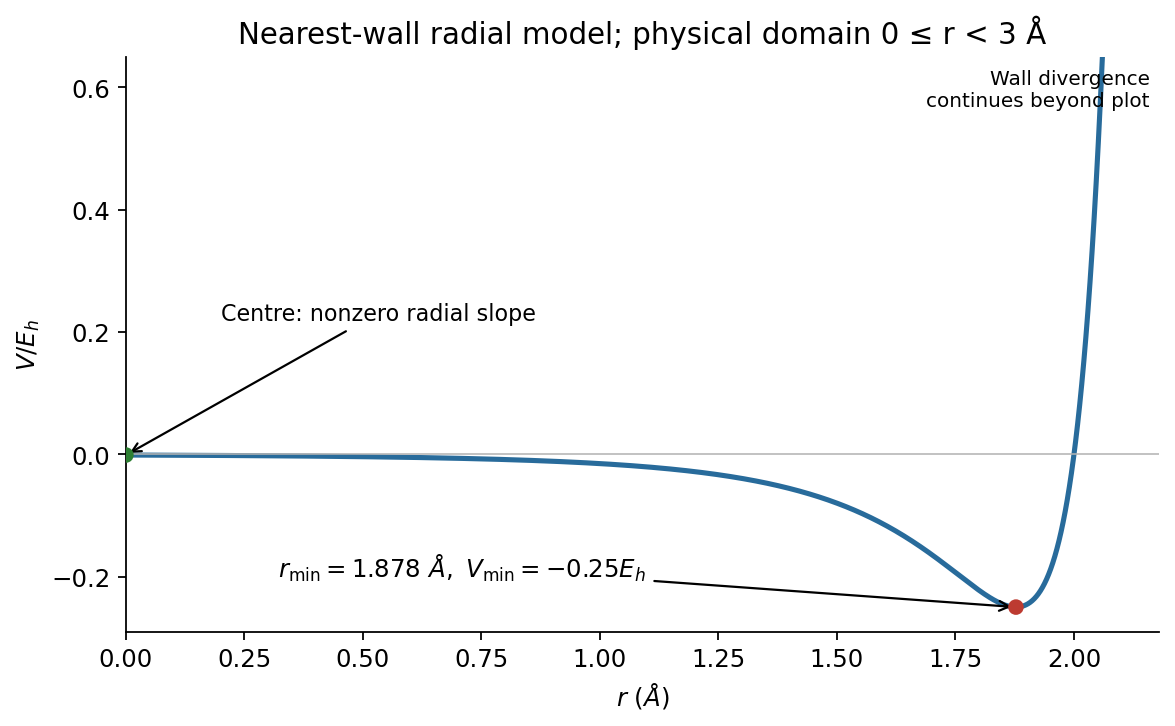
The minimum is at with depth ; the model is not a smooth physical potential at the cage centre. Put and . Thenso is the minimum. ThereforewhileThe positive inverse-twelfth-power term mimics short-range overlap repulsion, while the negative inverse-sixth-power term mimics London dispersion force. These powers are used in the Lennard-Jones potential; they are not a microscopic derivation for an atom inside a carbon cage.
The relevant domain is . As the atom approaches the wall the model diverges positively, which is qualitatively sensible. However, the energy depends only on the nearest radial wall distance and omits all the other cage atoms. More decisively, : a radial function of the Cartesian position must have zero first radial derivative at the centre to be differentiable there. The model produces a cusp and a nonvanishing directional force as the centre is approached. An off-centre minimum is not by itself forbidden, but this centre behaviour is inconsistent with a smooth symmetric cage potential.
The nine normal coordinates transform as . Place the molecule in the plane, with its four outer atoms on the and axes, as specified for the vertical reflection planes. In the class orderthe fifteen Cartesian displacements have characters of a representationFor each operation this character is the number of fixed atoms times the trace of its polar-vector matrix. Subtract translations and rotations , givingMolecular character reduction in the D4h molecular point group yields the stated decomposition. Its dimensions sum to , providing an independent degree-of-freedom check.
An infrared fundamental must transform like a component of the electric dipole moment; a Raman spectroscopy fundamental must transform like a component of the symmetric polarizability tensor. For this centrosymmetric D4h molecular point group, the resulting classification is:
Here parallel and perpendicular refer to the principal fourfold axis. The table obeys infrared and Raman mutual exclusion.
Three separated infrared fundamentals: one parallel band and two perpendicular bands. Each frequency belongs to a doubly degenerate mode, but degeneracy does not create two distinct band origins.
The square-planar rotor is an oblate symmetric top. A parallel band has and , producing P and R progressions with approximate spacing and a central Q contribution from ; the parallel Q branch is absent. At modest resolution many nearly coincident components merge.
A perpendicular band has and . Its Q subbranches produce a characteristic series of sharper features on the broader unresolved P/R envelope. Neglecting changes of rotational constants on vibration, successive perpendicular Q features are separated by approximately . These are rotational contours rather than extra normal-mode fundamentals.
All the listed modes are Raman active; only and are infrared active. For the C4v molecular point group, with vertical planes through the outer atoms:
| Symmetry | Number of modes of this symmetry | Infrared | Raman | 2 | Parallel, | Yes: | 2 | No | Yes: | 1 | No | Yes: | 2, each doubly degenerate | Perpendicular, | Yes: |
|---|
There is no inversion centre, so infrared and Raman mutual exclusion does not apply.
In the stipulated ideal, fully resolved limit, yes: square-planar geometry gives three infrared fundamentals, whereas square-pyramidal geometry gives four: two parallel bands and two perpendicular bands. The extra parallel fundamental is the distinguishing feature. In a real incomplete spectrum, a weak band, overlap or accidental degeneracy could hide that difference, so absence of a fourth observed band would not alone prove planarity.
. The parallel-band progression gives , so . The perpendicular Q-feature spacing givesFor an oblate symmetric top, , hence and . The rotational constant relation then givesThe estimated constants neglect centrifugal distortion and the change of rotational constants in the excited vibration.
; the central atom makes no contribution. Let be the radius of the square of outer atoms and the central atom's height above its plane. Then . Adjacent bond vectors have perpendicular in-plane components, soThe centre of mass lies on the fourfold axis, even when . Thus the central atom and the shift of origin along the axis contribute no perpendicular lever arm. The four outer atoms each contribute , givingThe result concerns the smallest adjacent bond angle; the angle between opposite outer atoms is a different angle in a pyramid.
With integer fluorine mass and ,This angle is below the planar limit , consistent with the proposed pyramid. The sulfur mass does not enter this axial moment of inertia.
The inferred dipole moment is approximately . With the static field parallel to the radiation electric field, the microwave selection rule is . A fully resolved three-component first-order rotational Stark effect pattern naturally identifies the , transition: the three initial values give the three components. would have no first-order shift.
Subtract the lower-state field shift from the upper-state field shift, rather than equating a transition shift to one level's shift:For and , neighbouring components are separated by . HenceThis assignment assumes the stated splitting resolves all allowed first-order components, rather than three accidentally unresolved groups of a higher- transition.
For the absorption spectrum, pass a scanned monochromatic beam through the solution and a matched solvent reference. Record the incident and transmitted intensities and calculate the absorbance , using an appropriate blank and concentration to avoid saturation.
For the fluorescence emission spectrum, excite at a fixed wavelength within an absorption band, collect emission away from the incident beam, commonly at , and scan an emission monochromator. Correct the detected signal for wavelength-dependent detector sensitivity, subtract solvent/background light and exclude scattered excitation light. The two plotted vertical scales have been independently normalized; their equal peak heights do not imply equal absorption and emission rates or unit fluorescence quantum yield.
Vibrational and solvent relaxation remove energy before emission, producing a Stokes shift. Absorption initially excites a vertical transition from the populated ground-state vibrational levels to excited-state vibrational levels. Vibrational relaxation and solvent rearrangement then bring the molecule near the relaxed lowest excited singlet level before fluorescence. Emission ends in vibrationally excited levels of the electronic ground state, so the emitted photon generally has less energy and a longer wavelength. This explanation does not require a change of electronic multiplicity.
The approximate mirror relationship follows from the Franck-Condon principle when the ground and excited electronic states have similar vibrational frequencies and comparable potential shapes displaced along the active coordinates. Absorption samples overlaps, while relaxed emission samples overlaps. For displaced harmonic potentials, the corresponding overlap intensities form similar progressions on opposite sides of the transition between the lowest vibrational levels of the two electronic states.
The symmetry is approximate and is most naturally compared on an energy or wavenumber axis. A wavelength axis is nonlinear in photon energy, and solvent response, frequency changes, differing transition strengths and instrumental corrections can spoil an exact mirror image.
For a fluorescence excitation spectrum, hold the emission detector at a fixed wavelength within the fluorescence band and scan the excitation wavelength. Correct for the incident photon flux and instrumental response at each excitation wavelength.
For one emitting molecular species with an approximately excitation-independent fluorescence yield, it should follow the absorption spectrum. In a dilute sample the detected emission is proportional to the photons absorbed, . Without the dilute approximation it follows absorptance rather than absorbance exactly. Impurities, photochemistry or multiple emitting states could invalidate that correspondence.
The phosphorescence quantum yield is the number of phosphorescence photons emitted per photon absorbed. In rate form,It is dimensionless. The denominator counts absorbed photons, not incident photons or the instantaneous triplet population.
Almost every absorbed photon generates a triplet, within the stated kinetic scheme. The branching fraction from the excited singlet isso under steady illumination. This statement concerns the triplet formation yield; it does not mean that the triplet population or the phosphorescence yield is also one. The triplet can subsequently deactivate or be quenched.
The steady-state approximation for the excited singlet givesand that for the triplet givesCombining these with the quantum yield definition gives the more general expressionUnder the supplied limit , this becomesThe approximation is the near-unit triplet formation yield, not an assumption that phosphorescence is the only triplet loss process.
Without quencher, . Taking the ratio gives the Stern-Volmer equationThus the plot has unit intercept and slope . A triplet formation yield less than one would cancel from this ratio if it remained independent of quencher concentration. The result assumes dynamic triplet quenching and no additional quencher-induced absorption or singlet loss.[ref]
Stern-Volmer kinetic relationships in the IUPAC Gold Book. Definition and dynamic-quenching relation between quantum-yield ratios, quencher concentration and unquenched lifetime
. The unquenched triplet lifetime isSince the slope is , the bimolecular rate constant isFor comparison, the unquenched phosphorescence yield in the unit-triplet-yield approximation is .
The measured decay is approximately consistent with the predicted loss rate. Following rapid singlet-to-triplet population transfer, the unquenched phosphorescence intensity obeysA straight-line fit of to the four times, expressed in seconds, givesThis differs from by about . For example, using the first point and the predicted rate gives subsequent intensities about , close to the supplied . The data support the expected millisecond exponential decay to this precision. With no measurement uncertainties supplied, a formal statistical acceptance or rejection is not justified.
Let denote a small longitudinal displacement from equilibrium, and let every atomic mass be . The constant equilibrium lengths disappear from the second derivatives. The force constant matrix isThe mass-weighted dynamical matrix is , with equations . If the phrase dynamical matrix denotes the unweighted Hessian, that object is instead; the normal-mode equation is in either notation. Every row sums to zero, as required for a freely translating chain.
At , each independent diatomic spring has one translation and one stretch. Consequently the angular frequencies areThe two zero modes are independent centre-of-mass translations of the two molecules. There are no transverse coordinates in this model; adding transverse degrees of freedom would be a different problem.
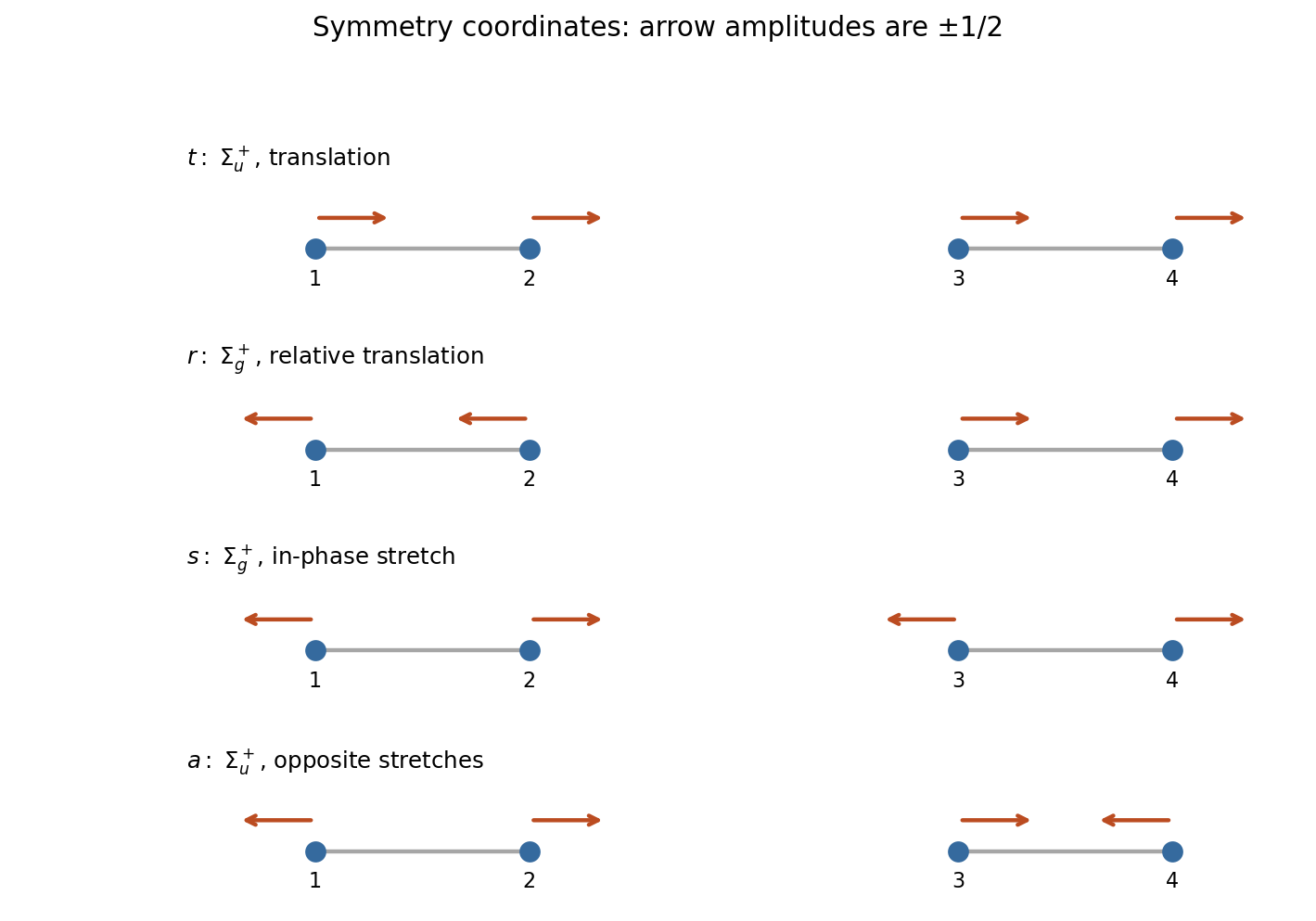
For the collinear centrosymmetric arrangement, the longitudinal coordinates transform in the D infinity h molecular point group. Inversion sends , because displacement is a polar vector. ThereforeAn orthonormal set of symmetry coordinates is:
| Coordinate | Displacement vector | Symmetry | at |
|---|
Here translates the complete system, separates the molecular centres, stretches both molecules together, and lengthens one while shortening the other. Reversing every arrow changes the coordinate sign, not its physical mode.


The nontotally symmetric longitudinal modes are the two coordinates and . Both have , so the middle spring is not extended. Hence its spring constant cannot alter their energies:These results are exact for every positive , not just perturbative. The zero mode expresses overall translation invariance.
In the totally symmetric basis, the force constant matrix reduces toThe unperturbed eigenvalues are distinct within this symmetry block, so nondegenerate perturbation theory applies even though the full unperturbed matrix has degeneracies in different symmetry sectors. The first-order shifts are both . At second order the off-diagonal matrix element gives for the lower mode and for the upper one. ThereforeIn frequency form,The corresponding eigenvectors are and . As a check, the exact squared-frequency eigenvalues arewhose expansions reproduce the perturbation theory result. The newly lifted zero frequency scales as , so expanding as an ordinary Taylor series in would be inappropriate.
and . With and , the dilute-gas stretch givesUse in here. The shifted line is the higher totally symmetric mode; the other molecular stretch remains at . To first order,The ratio validates the weak-coupling expansion. Inverting the exact eigenvalue instead, with , givesa negligible change at the precision of the model.
For clamped nuclei and SI units, the many-electron electronic Hamiltonian isThe terms are electron kinetic energy, electron–nucleus attraction, and electron–electron repulsion. The nuclear kinetic operator is omitted in the Born-Oppenheimer approximation. The nuclear repulsionis a constant at fixed separation and is added to electronic energies to form the total potential curve. Some conventions include it in as a constant; the electronic-energy convention used below excludes it so that the two one-electron energies can be compared without double-counting nuclear repulsion.
An effective one-electron Hückel method operator may be writtenThe first term is one-electron kinetic energy. The effective site potentials represent attraction to the nuclei and any averaged screening implicit in the chosen parametrization. They replace the explicit many-electron interaction; they do not contain a coordinate-dependent two-electron operator .
For normalized hydrogen-centred orbitals, symmetry givesThe Hückel Coulomb parameter is an on-site one-electron energy, not the electron–electron Coulomb repulsion integral. The Hückel resonance integral couples the sites; with the usual same-phase atomic-orbital convention it is negative and stabilizes the bonding combination. For zero overlap, the two energies are .
Articles were limited to the first 100 out of 114 total.
Articles by others on the same topic
There are currently no matching articles.