Let denote a small longitudinal displacement from equilibrium, and let every atomic mass be . The constant equilibrium lengths disappear from the second derivatives. The force constant matrix isThe mass-weighted dynamical matrix is , with equations . If the phrase dynamical matrix denotes the unweighted Hessian, that object is instead; the normal-mode equation is in either notation. Every row sums to zero, as required for a freely translating chain.
At , each independent diatomic spring has one translation and one stretch. Consequently the angular frequencies areThe two zero modes are independent centre-of-mass translations of the two molecules. There are no transverse coordinates in this model; adding transverse degrees of freedom would be a different problem.
For the collinear centrosymmetric arrangement, the longitudinal coordinates transform in the D infinity h molecular point group. Inversion sends , because displacement is a polar vector. ThereforeAn orthonormal set of symmetry coordinates is:
| Coordinate | Displacement vector | Symmetry | at |
|---|
Here translates the complete system, separates the molecular centres, stretches both molecules together, and lengthens one while shortening the other. Reversing every arrow changes the coordinate sign, not its physical mode.
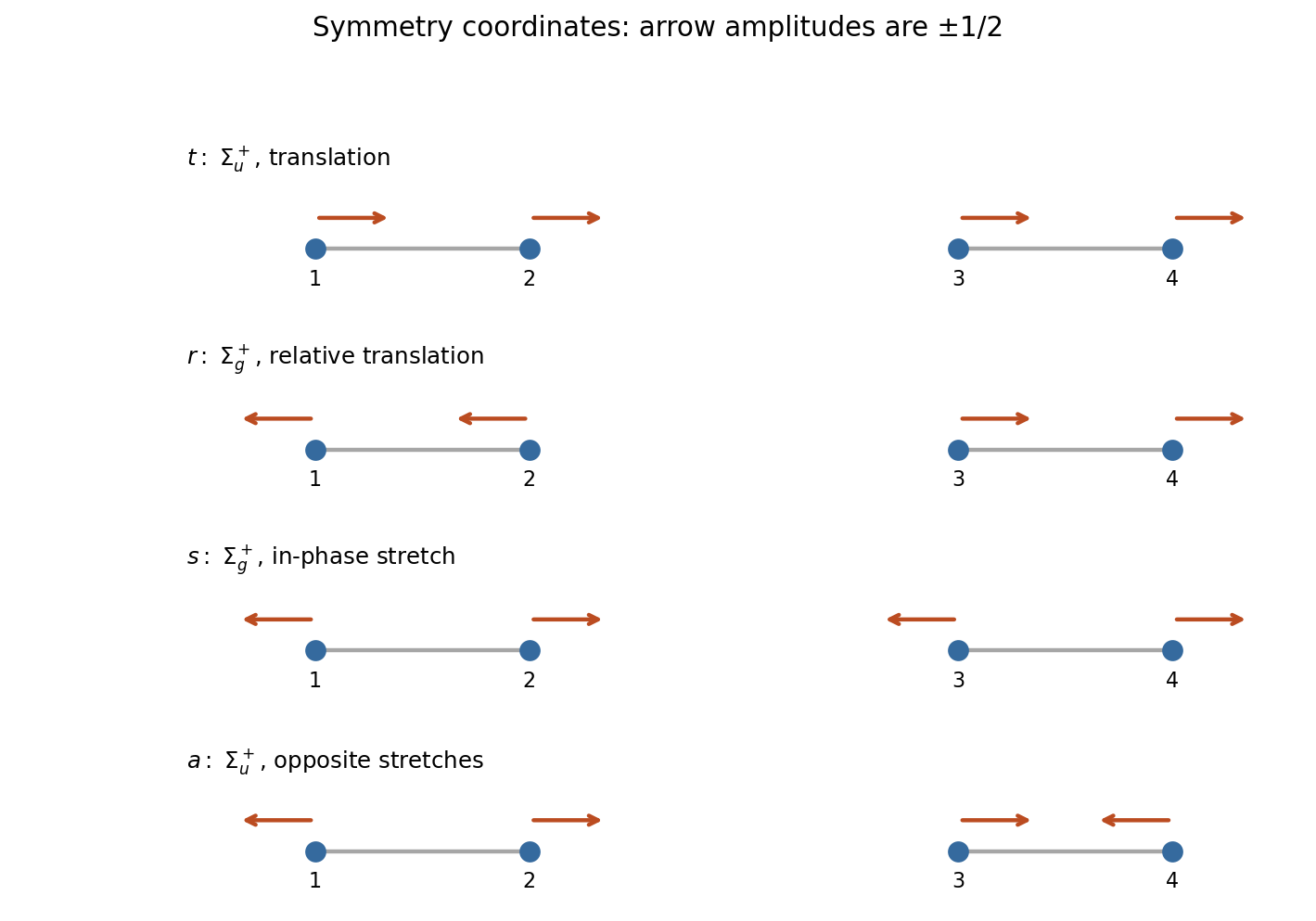

The nontotally symmetric longitudinal modes are the two coordinates and . Both have , so the middle spring is not extended. Hence its spring constant cannot alter their energies:These results are exact for every positive , not just perturbative. The zero mode expresses overall translation invariance.
In the totally symmetric basis, the force constant matrix reduces toThe unperturbed eigenvalues are distinct within this symmetry block, so nondegenerate perturbation theory applies even though the full unperturbed matrix has degeneracies in different symmetry sectors. The first-order shifts are both . At second order the off-diagonal matrix element gives for the lower mode and for the upper one. ThereforeIn frequency form,The corresponding eigenvectors are and . As a check, the exact squared-frequency eigenvalues arewhose expansions reproduce the perturbation theory result. The newly lifted zero frequency scales as , so expanding as an ordinary Taylor series in would be inappropriate.
and . With and , the dilute-gas stretch givesUse in here. The shifted line is the higher totally symmetric mode; the other molecular stretch remains at . To first order,The ratio validates the weak-coupling expansion. Inverting the exact eigenvalue instead, with , givesa negligible change at the precision of the model.
Articles by others on the same topic
There are currently no matching articles.