There are three largely independent constructions: a substituted Robinson-annulation core, a protected vicinal diol, and the ester acyl fragment. Disconnect the ester first to an allylic alcohol on the bicyclic ring and the acid . Disconnect the benzylidene acetal to a side chain and benzaldehyde. Reversing 1,2-reduction of the allylic alcohol gives the corresponding bicyclic enone; its six-membered enone ring is a Robinson disconnection back to a suitably alpha-substituted cyclohexanone and methyl vinyl ketone.
An efficient way to protect the side chain before annulation is to prepare 4-(bromomethyl)-2-phenyl-1,3-dioxolane from and benzaldehyde with mild acid and water removal. The desired five-membered acetal protects the adjacent hydroxyl groups, while its external primary bromide remains an alkylating site. Alpha alkylation of the indicated cyclohexanone with this bromide gives a ring bearing in the benzylidene-protected form. There is no need to expose the eventual ring enone to a nonselective late dihydroxylation.
Generate the enolate at the other, less substituted alpha position of the cyclohexanone and add methyl vinyl ketone. Hydrolysis of an enamine-mediated Michael variant or direct enolate trapping gives the appropriate 1,5-dicarbonyl. Intramolecular aldol condensation closes a six-membered ring onto the original cyclohexanone carbonyl. Dehydration gives the fused bicyclic enone, with the protected three-carbon side chain on the adjacent carbon of the original ring. Regioselecting the initial Michael addition is essential: reaction at the side-chain-bearing alpha site would place that substituent at the wrong fusion position.
Reduce the new enone carbonyl by 1,2-addition, for example sodium borohydride with cerium(III) chloride under Luche-type conditions, to retain the displayed ring C=C bond and produce the allylic alcohol. The benzylidene acetal should be maintained through these neutral/basic operations. The target has no wedge/dash assignments, so a constitutional solution does not require a claim of a unique fused-ring/alcohol diastereomer; isolate the required constitutional annulation product.
For the acyl branch, form the enolate of the indicated methyl butanoate, add acetone, then dehydrate the beta-hydroxy ester:Hydrogenate this isolated alkene before coupling it to the bicyclic substrate, giving . saponification gives ; activate it as its acid chloride or use a mild ester-coupling reagent, then acylate the bicyclic allylic alcohol. Performing the hydrogenation on the separate acyl branch avoids reducing the target ring alkene. Strong acid should be avoided during the final esterification because the benzylidene group is acid-labile.
The carbon audit is particularly useful: the fused rings contain six carbons from cyclohexanone plus four from methyl vinyl ketone; the side chain has three carbons from the protected bromodiol; the benzylidene unit supplies its acetal carbon and phenyl group. In the acyl fragment, the four butanoate acyl carbons plus three acetone carbons give seven; the starting ester methoxy carbon is lost during hydrolysis.
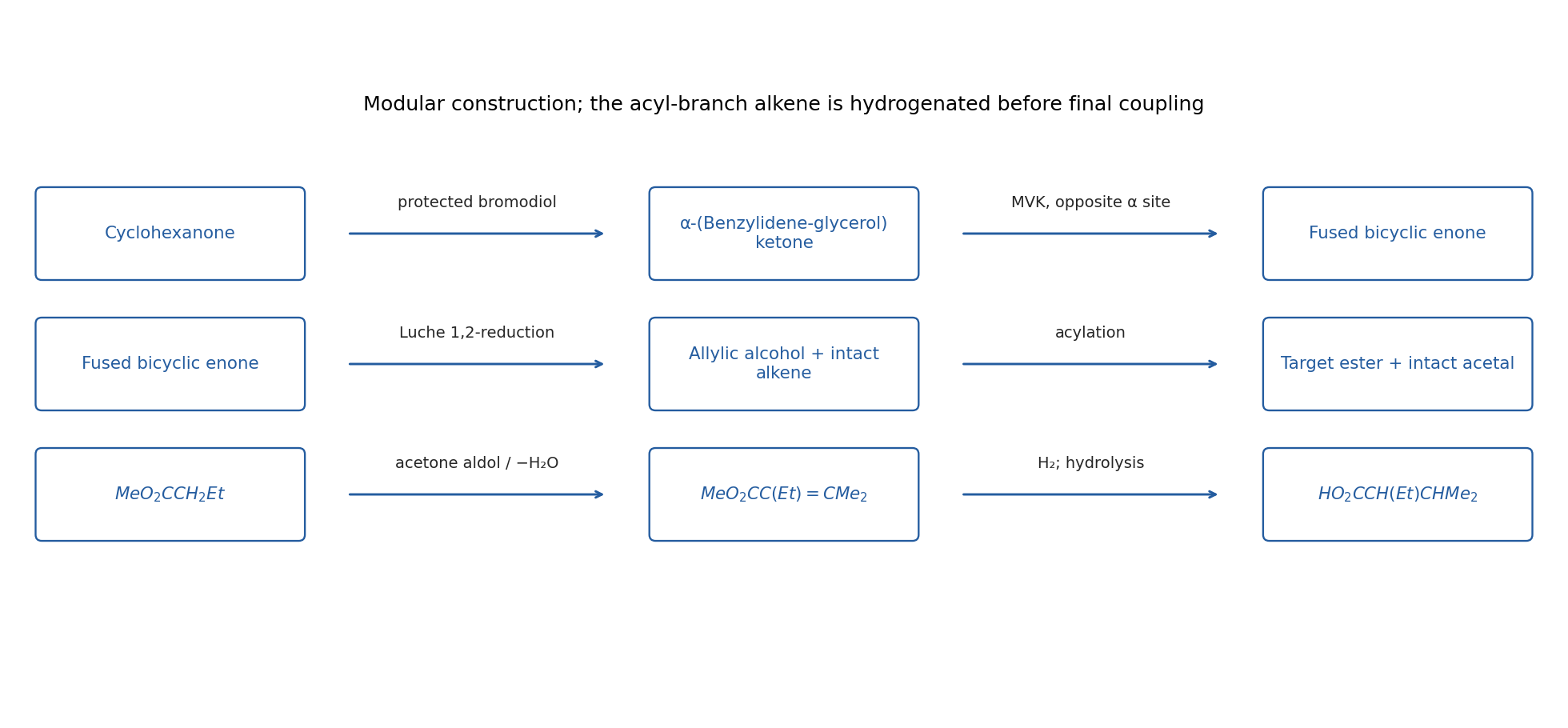
Original modular disconnections separating protected side-chain installation, regioselected Robinson annulation and synthesis of the seven-carbon acyl group
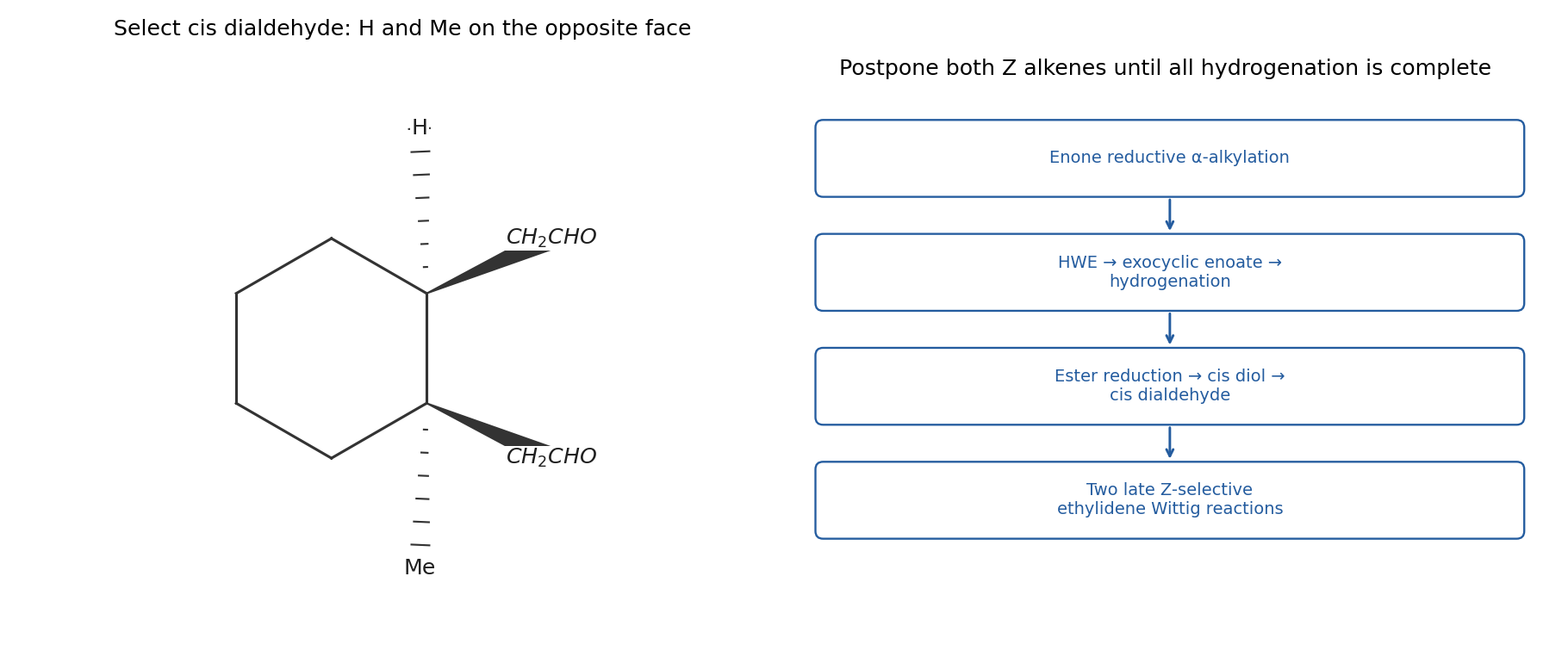
. Details. Both side chains have the order ring–, and both printed double bonds have the Z geometry. The two carbon side chains are cis to one another; equivalently the labelled ring H and ring Me are cis on the opposite face. A useful common late precursor therefore has two cis ring– substituents, which can undergo two Z-selective ethylidene Wittig reactions.
Use the starting 2-methylcyclohex-2-en-1-one in a reductive alpha-alkylation. Conjugate reduction under dissolving-metal/enolate-trapping conditions, followed by a primary electrophile , installs a protected two-carbon alcohol side chain at the original methyl-bearing alpha carbon. This gives 2-methyl-2-(2-siloxyethyl)cyclohexanone. The carbon at that position is now quaternary, with its original methyl retained. Alternatively, reduce the enone to 2-methylcyclohexanone and deliberately form/select its more substituted enolate before alkylation; its opposite kinetic enolate would give the wrong regioisomer.
Convert the remaining ring ketone to an exocyclic enoate by Horner–Wadsworth–Emmons olefination with a phosphonoacetate:Hydrogenate this sole alkene to give ring– at that carbon. Select the diastereomer with this substituent cis to the pre-existing protected hydroxyethyl side chain, so the newly installed ring H is cis to ring Me. Less hindered-face hydrogenation can assist this relationship, but the route should include separation/verification of the desired cis product rather than assert complete stereoselectivity without data.
Reduce the ester with lithium aluminium hydride to ring– and remove the TBS group from the other side chain. Both appendages are now two-carbon primary alcohols. Oxidize them to aldehydes under non-overoxidizing conditions, for example Dess–Martin oxidation, obtaining the cis dialdehyde with two ring– groups. Treat with excess salt-controlled, nonstabilized ethylidenetriphenylphosphorane under conditions favouring kinetic Z olefination; isolate the Z,Z product. Each aldehyde carbon becomes the inner vinylic carbon of its crotyl group, while the ylide supplies .
This order postpones both stereodefined alkenes until after hydrogenation, so they are not accidentally saturated. It also avoids assuming that a crotyl grignard reagent adds without allylic transposition or that direct alcohol deoxygenation fixes the required ring stereochemistry. An achiral synthesis gives a racemic mixture pair with the specified relative configuration.


Articles by others on the same topic
There are currently no matching articles.