Write for the imidazolylidene N-heterocyclic carbene bearing the two mesityl groups shown. The proposed active unit is , with H and SiPh both bonded to nickel, rather than a nickel-free hydrosilane or a bare NHC-Ni fragment.
Displacement of coordinated styrene and formal oxidative addition of Si-H to Ni(0) give a low-coordinate nickel(II) hydride-silyl unit; substrate binding fills a vacant site. The productive cycle is alkene coordination, migratory insertion into Ni-H, then beta-hydride elimination from the other beta carbon, releasing the shifted alkene and regenerating Ni-H.
The strongly donating NHC stabilizes a reactive low-coordinate metal and assists Si-H activation. Its steric bulk discourages unproductive saturated bis-alkene species and promotes product departure, but excessive crowding can hinder substrate binding/insertion. The silyl ligand also tunes the metal electronically: changing its aryl substituents changes donation and the barriers for hydride transfer/elimination. Product release and reversible insertion determine whether further double-bond migration occurs. Bulky ligands can suppress competing alkyl-silyl reductive elimination, which would instead consume substrate by hydrosilylation.
The hydride-silyl formulation and insertion/elimination interpretation are the experimentally proposed mechanism; the individual catalyst resting states need not all be uniquely fixed by the activation recipe.[ref]
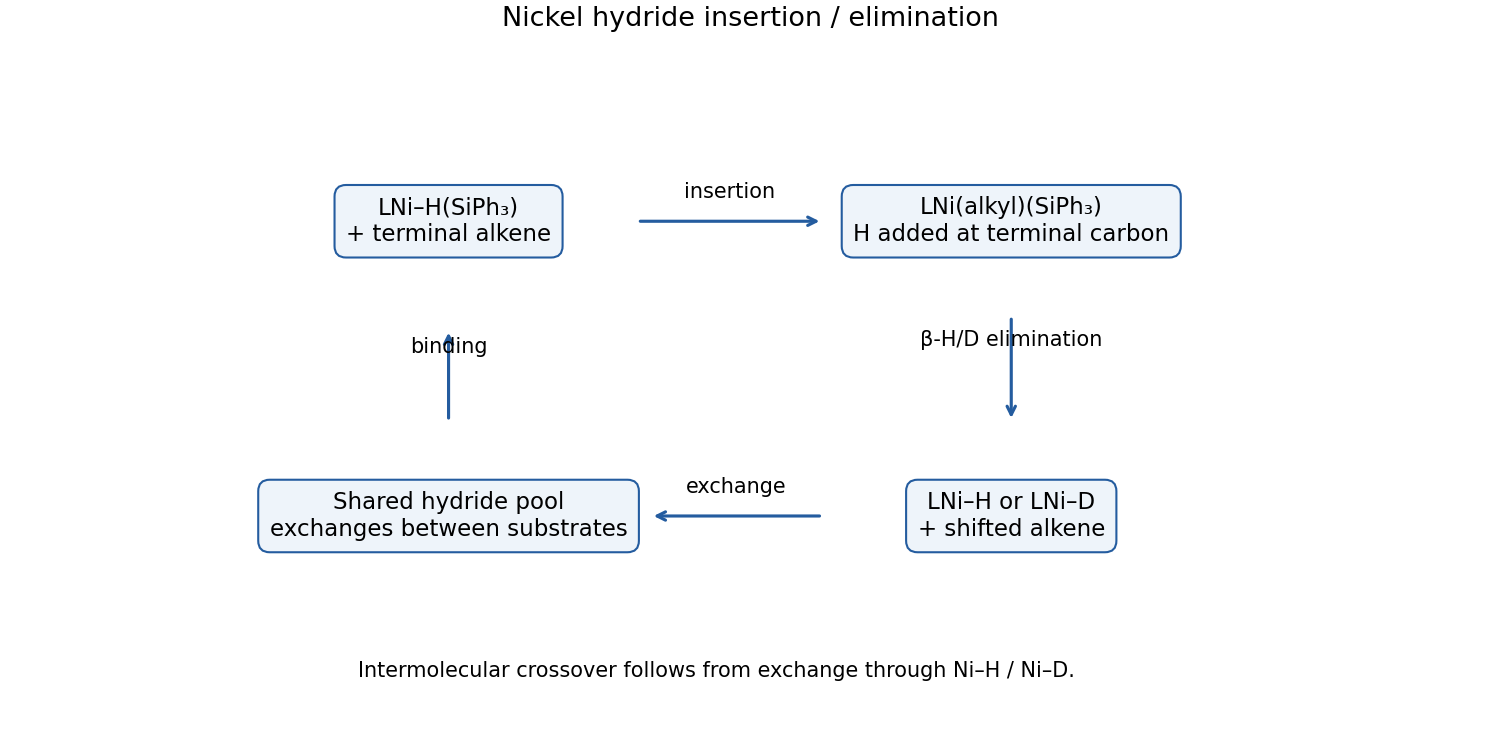

Label the starting exomethylene carbon , the aryl-bearing carbon , the ethyl CH/CD carbon , and the terminal methyl :Insertion into Ni-H places H on and Ni on . Elimination of a beta H or D from gives and Ni-H or Ni-D. Thus the labeled substrate can retain one D on the new vinylic carbon while exporting the other into the catalyst hydride pool.
Ni-D can then add to the exomethylene of either aryl substrate, introducing D into the methyl group derived from . Reversible insertion/elimination and substrate exchange also introduce D into the vinylic position of the originally unlabeled compound. This explains both the approximately comparable methyl labeling of the two products and the larger residual vinylic labeling of the initially CD-bearing substrate.
The decisive observation is intermolecular crossover of deuterium into the unsubstituted-phenyl product. It rules out a purely intramolecular, identity-preserving 1,3-H/D shift. The unequal percentages retain kinetic and substrate-history information; they are not a requirement for completely statistical H/D equilibration and cannot determine all elementary rate constants by themselves.
Articles by others on the same topic
There are currently no matching articles.