Write for the imidazolylidene N-heterocyclic carbene bearing the two mesityl groups shown. The proposed active unit is , with H and SiPh both bonded to nickel, rather than a nickel-free hydrosilane or a bare NHC-Ni fragment.
Displacement of coordinated styrene and formal oxidative addition of Si-H to Ni(0) give a low-coordinate nickel(II) hydride-silyl unit; substrate binding fills a vacant site. The productive cycle is alkene coordination, migratory insertion into Ni-H, then beta-hydride elimination from the other beta carbon, releasing the shifted alkene and regenerating Ni-H.
The strongly donating NHC stabilizes a reactive low-coordinate metal and assists Si-H activation. Its steric bulk discourages unproductive saturated bis-alkene species and promotes product departure, but excessive crowding can hinder substrate binding/insertion. The silyl ligand also tunes the metal electronically: changing its aryl substituents changes donation and the barriers for hydride transfer/elimination. Product release and reversible insertion determine whether further double-bond migration occurs. Bulky ligands can suppress competing alkyl-silyl reductive elimination, which would instead consume substrate by hydrosilylation.
The hydride-silyl formulation and insertion/elimination interpretation are the experimentally proposed mechanism; the individual catalyst resting states need not all be uniquely fixed by the activation recipe.[ref]
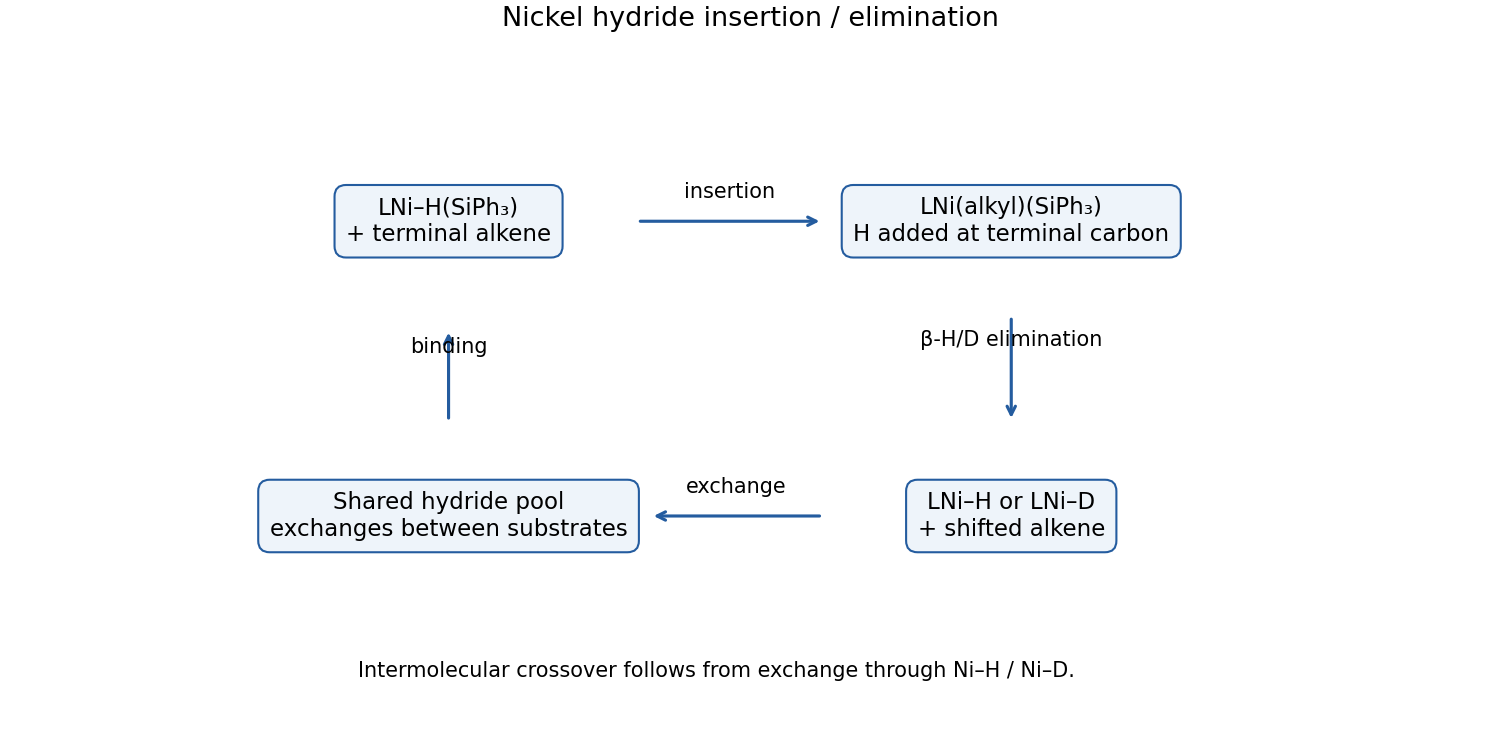
Label the starting exomethylene carbon , the aryl-bearing carbon , the ethyl CH/CD carbon , and the terminal methyl :Insertion into Ni-H places H on and Ni on . Elimination of a beta H or D from gives and Ni-H or Ni-D. Thus the labeled substrate can retain one D on the new vinylic carbon while exporting the other into the catalyst hydride pool.
Ni-D can then add to the exomethylene of either aryl substrate, introducing D into the methyl group derived from . Reversible insertion/elimination and substrate exchange also introduce D into the vinylic position of the originally unlabeled compound. This explains both the approximately comparable methyl labeling of the two products and the larger residual vinylic labeling of the initially CD-bearing substrate.
The decisive observation is intermolecular crossover of deuterium into the unsubstituted-phenyl product. It rules out a purely intramolecular, identity-preserving 1,3-H/D shift. The unequal percentages retain kinetic and substrate-history information; they are not a requirement for completely statistical H/D equilibration and cannot determine all elementary rate constants by themselves.
A Fischer carbene complex typically has a low-oxidation-state, relatively electron-rich middle/late transition metal with strong pi-acceptor ligands such as CO. The carbene is treated as a neutral two-electron donor; metal-to-carbene back-donation contributes to its bond, but its carbon remains electrophilic. An OR or NR substituent stabilizes that carbon by heteroatom donation. Here the metal is Cr(0), , in an 18-electron pentacarbonyl complex.
A Schrock carbene complex usually contains an early metal in a high oxidation state, often , with electron-donating ligands rather than a shell of pi-accepting carbonyls. Its alkylidene has substantial dianionic character in ionic counting, and its carbon is correspondingly nucleophilic. Alkyl substituents are common; heteroatom stabilization of an electrophilic carbon is not the defining feature. These are bonding/electronic limiting descriptions rather than a rule based only on the drawn metal-carbon double bond.
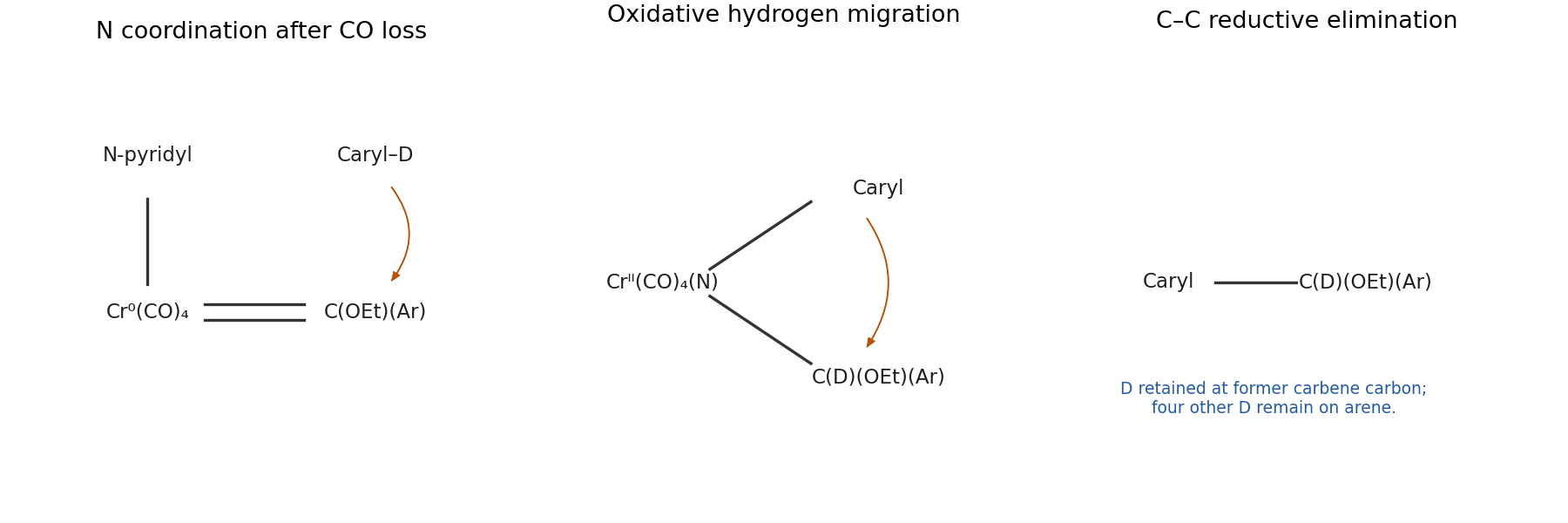
CO first dissociates from the 18-electron Fischer carbene. Pyridyl nitrogen of C then coordinates at the vacant chromium site, positioning an ortho C-D bond of its phenyl group beside the carbene unit.
The appropriate pathway is oxidative hydrogen migration: chromium assists C-D cleavage while D transfers to the electrophilic carbene carbon. The resulting cyclometalated intermediate has both an aryl-Cr bond and an alkyl-Cr bond, the latter to . Formally Cr(0) becomes Cr(II). Reductive elimination between those two carbon ligands forms the new aryl– bond and returns chromium to low oxidation state.
This accounts for all three controls. Extra CO suppresses the coordinative vacancy. Biphenyl E lacks the pyridyl-N directing group and cannot organize the necessary C-H activation geometry. The ortho deuterium moves onto the former carbene carbon rather than being lost to solvent: four D remain on the original phenyl ring and the fifth becomes the benzylic C-D bond.
This is not adequately represented as electrophilic aromatic substitution followed by proton loss, which would discard the diagnostic D. The primary mechanistic study distinguishes oxidative hydrogen migration/reductive elimination from that classical alternative.[ref]
Phosphine binding breaks the hydroxo-bridged dimer into mononuclear Rh-OH units. Hydroxide/boronic-acid association forms a Rh-O-B linkage; transfer of the aryl group from boron to rhodium, with Rh-O bond cleavage, gives the Rh-aryl initiator. This is transmetalation, with rhodium remaining formally Rh(I).
Writing and , the balanced net activation isThe stoichiometric byproduct is boric acid, . Each monomeric Rh(I) product is a 16-electron complex: Rh(I), four electrons from COD, two from phosphine and two from the aryl X ligand. Temporary phosphine dissociation makes room for alkyne binding during propagation.
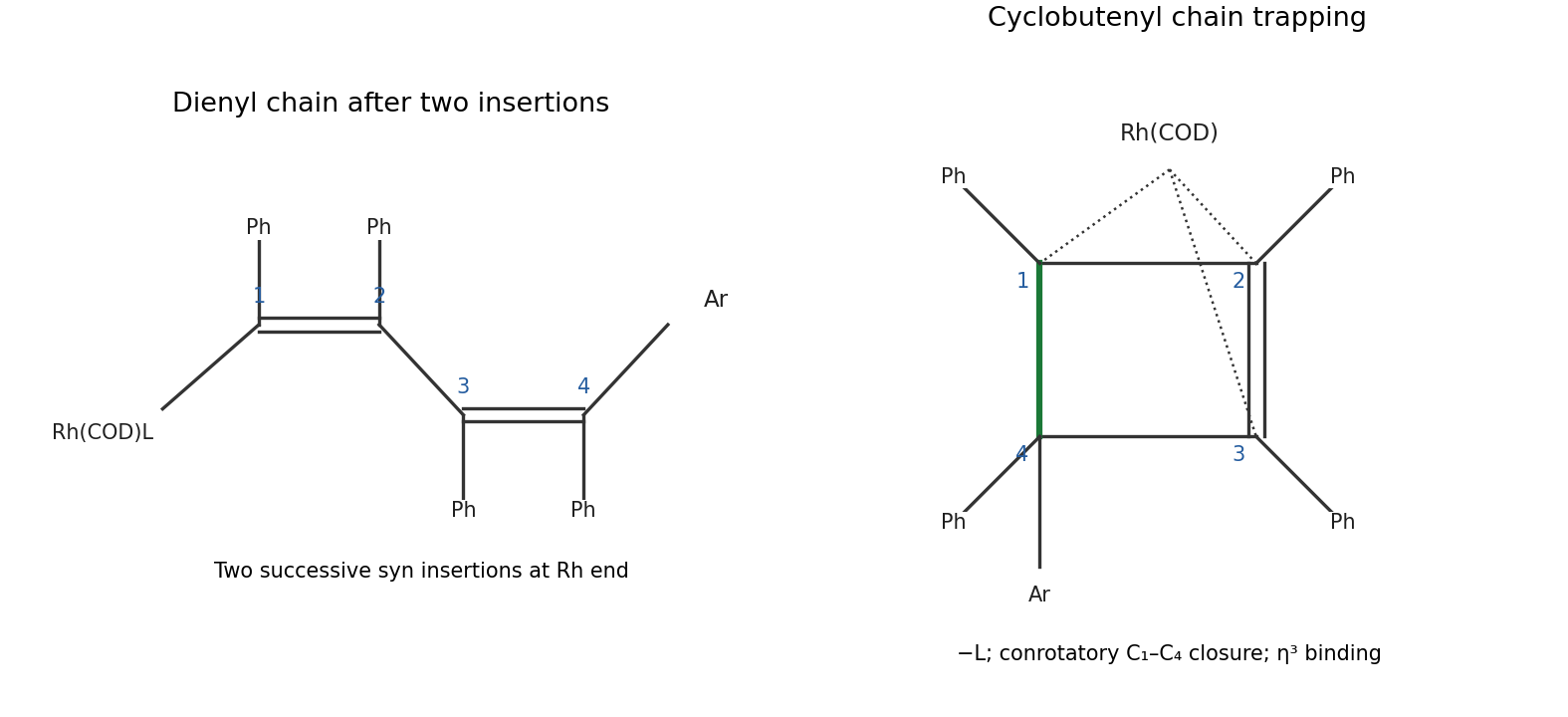
Coordinate one diphenylacetylene and insert it into Rh-Ar. Syn migration puts the new Rh-C and Ar-C bonds on the same face of the former alkyne. Repeat alkyne coordination/insertion into the resulting Rh-vinyl bond. The chain after two insertions isNumbering runs from the metal toward the initiating aryl group. Each insertion is syn: Rh and the continuing chain lie on the same side of the newly made double bond, giving the displayed cis relationship of the two Ph substituents at each inserted unit. The second alkyne inserts at the Rh end; it is not appended by coupling two free vinyl radicals.
To obtain F, promote PPh dissociation, allowing G's dienyl group to fold and form the new C-C bond. A four-pi-electron electrocyclic ring closure gives a cyclobutenyl ligand, stabilized by eta-three coordination of its allylic C-C-C fragment to Rh. The substituted C is the saturated ring carbon bearing Ar and Ph.
The thermal four-pi closure is conrotatory. Ring closure plus eta-three binding restores a 16-electron Rh(I) centre after phosphine loss; no net oxidation-state change is needed. F is an eta-three cyclobutenyl complex, not an eta-four cyclobutadiene with five substituents squeezed onto four unsaturated carbons.


Articles by others on the same topic
There are currently no matching articles.