Activate the oxime hydroxyl oxygen with thionyl chloride to give a good N–O leaving group. In the Beckmann rearrangement branch, the C–C bond anti to that leaving group migrates onto nitrogen as the N–O bond breaks. Here the migrating carbon is the spiro centre. Inserting N between that centre and the former oxime carbon expands the five-membered oxime ring to a six-membered nitrilium ion ring. Water attacks the electrophilic nitrilium carbon, followed by proton transfers and tautomerization to the observed spiro lactam. The lactam carbonyl oxygen is introduced in the aqueous work-up.
The competing Beckmann fragmentation cleaves the same anti C–C bond instead of completing migration onto N. Formation of the C≡N bond gives an open-chain nitrile and a tertiary carbocation at the former spiro centre. Loss of a proton from the adjacent chain carbon then gives the exocyclic alkene attached to the retained cyclopentane. The key distinction is N insertion and ring expansion for the lactam, versus C–C cleavage followed by elimination for the unsaturated nitrile. Stabilization of the resulting tertiary carbocation makes fragmentation plausible.
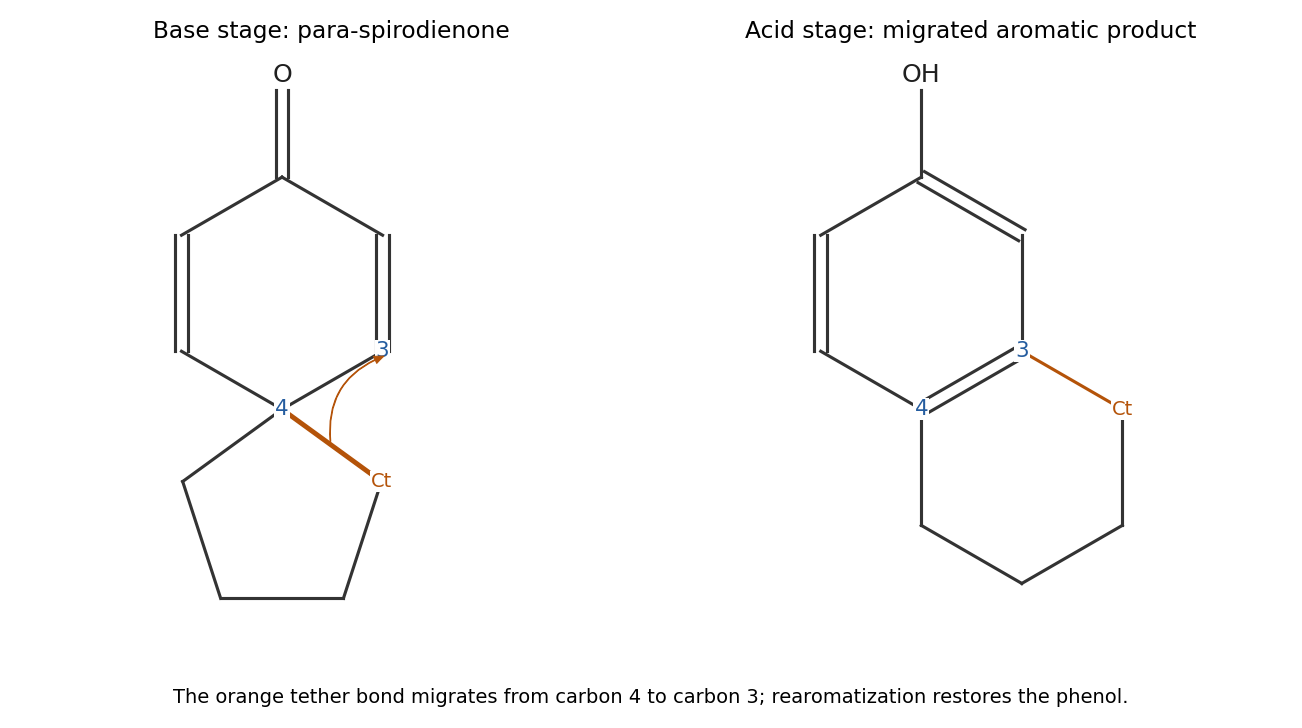
Base first gives phenoxide. Use its para-carbanion/quinoid resonance contributor: the para carbon bearing the tether attacks the terminal chloromethylene carbon in an intramolecular substitution, ejecting chloride. This forms a five-membered ring at that carbon and produces a para-spirocyclohexadienone, with the phenoxide oxygen becoming a carbonyl oxygen. The first stage is a dearomatizing spirocyclization of a phenoxide.
On acidification, carbonyl protonation makes the dienone electrophilic. A tether C–C bond attached to the spiro centre migrates to the adjacent dienone carbon, with the accompanying pi-bond shifts; loss of a proton restores aromaticity. This dienone-phenol rearrangement converts the spiro five-membered ring into the fused six-membered ring while regenerating the phenolic OH. The apparent bond formation meta to OH is thus explained by para spirocyclization followed by skeletal migration, rather than requiring the final fused connectivity to form directly in the base step.

Amide base removes a proton alpha to the nitrile, giving a resonance-stabilized carbon nucleophile. Removal of the available aryl proton ortho to chlorine, together with chloride elimination, generates a benzyne between the chlorine-bearing carbon and its unsubstituted ortho neighbour. The side-chain nitrile carbanion attacks the former chlorine-bearing aryne carbon intramolecularly; one aryne pi bond shifts to the neighbouring aryl carbon. Protonation of that aryl anion by ammonia restores the aromatic ring. The newly formed C–C bond closes the four-membered ring of the cyanobenzocyclobutane product. Two deprotonation processes are required to generate both the nitrile nucleophile and the aryne. The nitrile group is retained, and the product is not formed by simple replacement of aryl chlorine with an external amide nucleophile.
Copper-assisted loss of nitrogen from the diazo group forms a metal carbenoid at the carbon bearing the ester substituent. That tethered electrophilic carbon adds across the nearby exocyclic alkene in an intramolecular cyclopropanation. Two C–C bonds form: one to the alkene ring carbon and one to its terminal methylene. The existing tether thereby also becomes the five-membered ketone ring in the product; the methyl ester stays attached to the former diazo carbon.
Cyclopropanation is suprafacial on the reacting alkene face. A folded tether geometry that permits the short intramolecular closure selects the approach face and accounts for the shown relationship of the angular methyl group and the new cyclopropane methylene bridge. This is a stereoselective conformational ring-closure model, not a freely rotating intermediate carbocation: the two new bonds are formed in the same cyclopropanation event. A detailed quantitative preference between folded conformers would require an energetic model beyond the structure alone.
Articles by others on the same topic
There are currently no matching articles.