Reality of the electron density implies . Writing and pairing positive and negative indices givesThe sign in the cosine follows from the supplied negative-sign Fourier-synthesis convention. is the mean electron density in the fractional-coordinate normalization.
With an origin at an inversion center, the structure factors are real, so their phases are either or . Defining givesCentrosymmetry converts the phase problem into a sign problem; it does not imply that every structure factor is positive.
For a strong term, maxima lie where . At either possible set of such maxima, : doubling a phase of either or gives zero modulo . A strong term reinforces those positive maxima when . The direct-methods pair relationship is thereforeA negative strong second harmonic would oppose the maxima favored by the first and tend to create implausible negative or flattened density elsewhere. The relationship is a strong-reflection inference, not a sign identity for arbitrary weak coefficients.
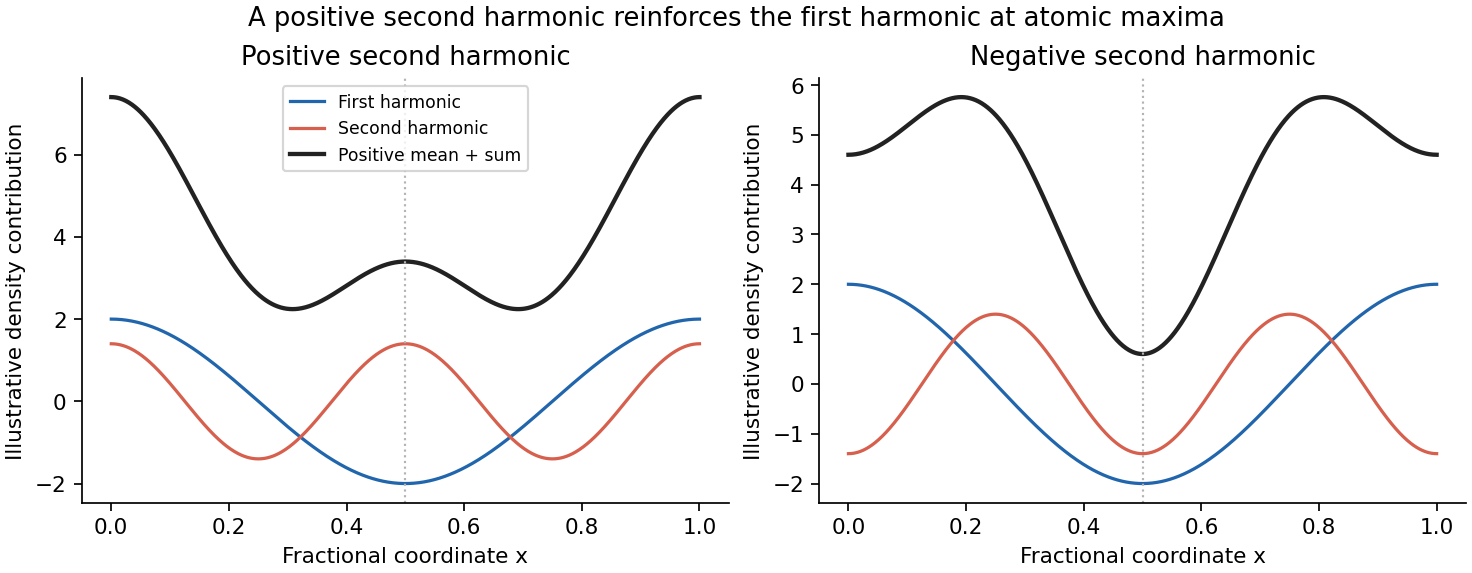

The inference is most useful when the contributing normalized amplitudes are large. Positivity gives a precise illustration: let and regard as a probability density over a period. From ,Thus forces . If is weak, this bound allows either sign; a small also contributes too little to the density sketch to impose a persuasive sign constraint. Large unnormalized intensity alone should not be confused with a large amplitude relative to .
The dominant contributions are . Their extrema occur at or and independently or , modulo unit translations. The four candidate positions areWhich is a maximum rather than a minimum or saddle depends on the two signs. Higher Fourier terms sharpen these broad maxima into atomic peaks.
- : and .
- : and .
- : and .
- : and .
The third term is . To reinforce a maximum at from the preceding table, its sign should beHence the direct-methods triplet relationship is for the strong reflections under consideration. This maximizes constructive density at shared atomic positions. For weak or competing reflections the relation is probabilistic rather than an unconditional algebraic theorem.
Moving the origin by changes a structure-factor phase by in the corresponding coordinate convention. The triplet phaseis unchanged because the three origin shifts cancel. In a centrosymmetric origin convention, the associated sign product is therefore invariant.
For example shifting by half a period flips both and , leaving unchanged; shifting flips the other corresponding pair. A general origin may make the factors complex, but the phase-invariant statement remains valid.
Set in the direct-methods triplet relationship. It becomes , and since the square of a nonzero sign is one, . This recovers the direct-methods pair relationship, with the same strong-amplitude qualifications.
Articles by others on the same topic
There are currently no matching articles.