Reality of the electron density implies . Writing and pairing positive and negative indices givesThe sign in the cosine follows from the supplied negative-sign Fourier-synthesis convention. is the mean electron density in the fractional-coordinate normalization.
With an origin at an inversion center, the structure factors are real, so their phases are either or . Defining givesCentrosymmetry converts the phase problem into a sign problem; it does not imply that every structure factor is positive.
For a strong term, maxima lie where . At either possible set of such maxima, : doubling a phase of either or gives zero modulo . A strong term reinforces those positive maxima when . The direct-methods pair relationship is thereforeA negative strong second harmonic would oppose the maxima favored by the first and tend to create implausible negative or flattened density elsewhere. The relationship is a strong-reflection inference, not a sign identity for arbitrary weak coefficients.
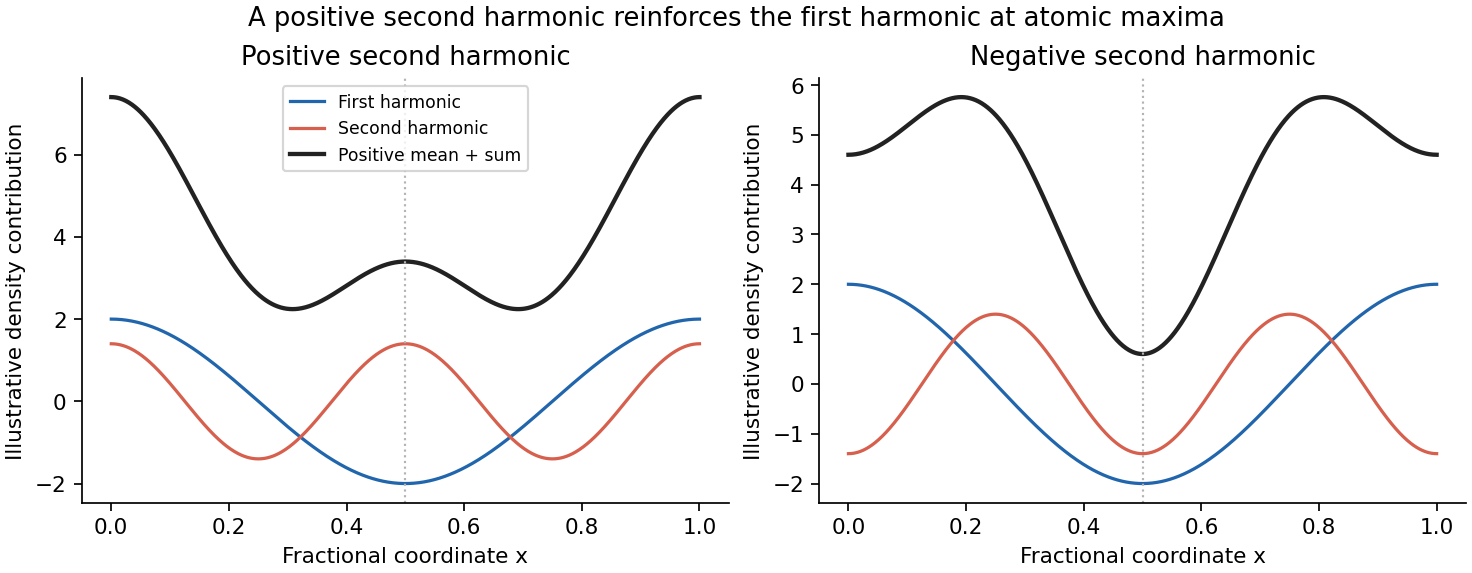

The inference is most useful when the contributing normalized amplitudes are large. Positivity gives a precise illustration: let and regard as a probability density over a period. From ,Thus forces . If is weak, this bound allows either sign; a small also contributes too little to the density sketch to impose a persuasive sign constraint. Large unnormalized intensity alone should not be confused with a large amplitude relative to .
Articles by others on the same topic
There are currently no matching articles.