The three regions represent competing pathways whose leaving-group sensitivities differ.
- Region 1, : good leaving groups permit E1cB mechanism. OH first deprotonates the para phenol. The phenoxide lone pair then pushes through the ring, with loss of ArO from the acyl group, giving a quinoid ketene, schematically . Water/hydroxide traps the ketene and proton transfers restore the aromatic hydroxybenzoate. Rate-limiting fragmentation has extensive C–OAr cleavage, hence strong dependence on leaving-group basicity.
- Region 2, : as ArO becomes a worse leaving group, elimination slows steeply and ordinary hydroxide addition to neutral C becomes competitive/dominant. The tetrahedral acyl-substitution pathway is much less sensitive to leaving-group p.
- Region 3, : hydroxide attacks the deprotonated phenoxide ester C. Its low electrophilicity and anion-anion interaction make addition slow. The leaving group is little involved in that addition transition state. Combined with prior deprotonation, this is the third-order term.
The bend in the upper plot is a crossover of mechanisms, not a discontinuous change in the identity of the leaving group. The lower plot is the separate hydroxide-on-phenoxide pathway.
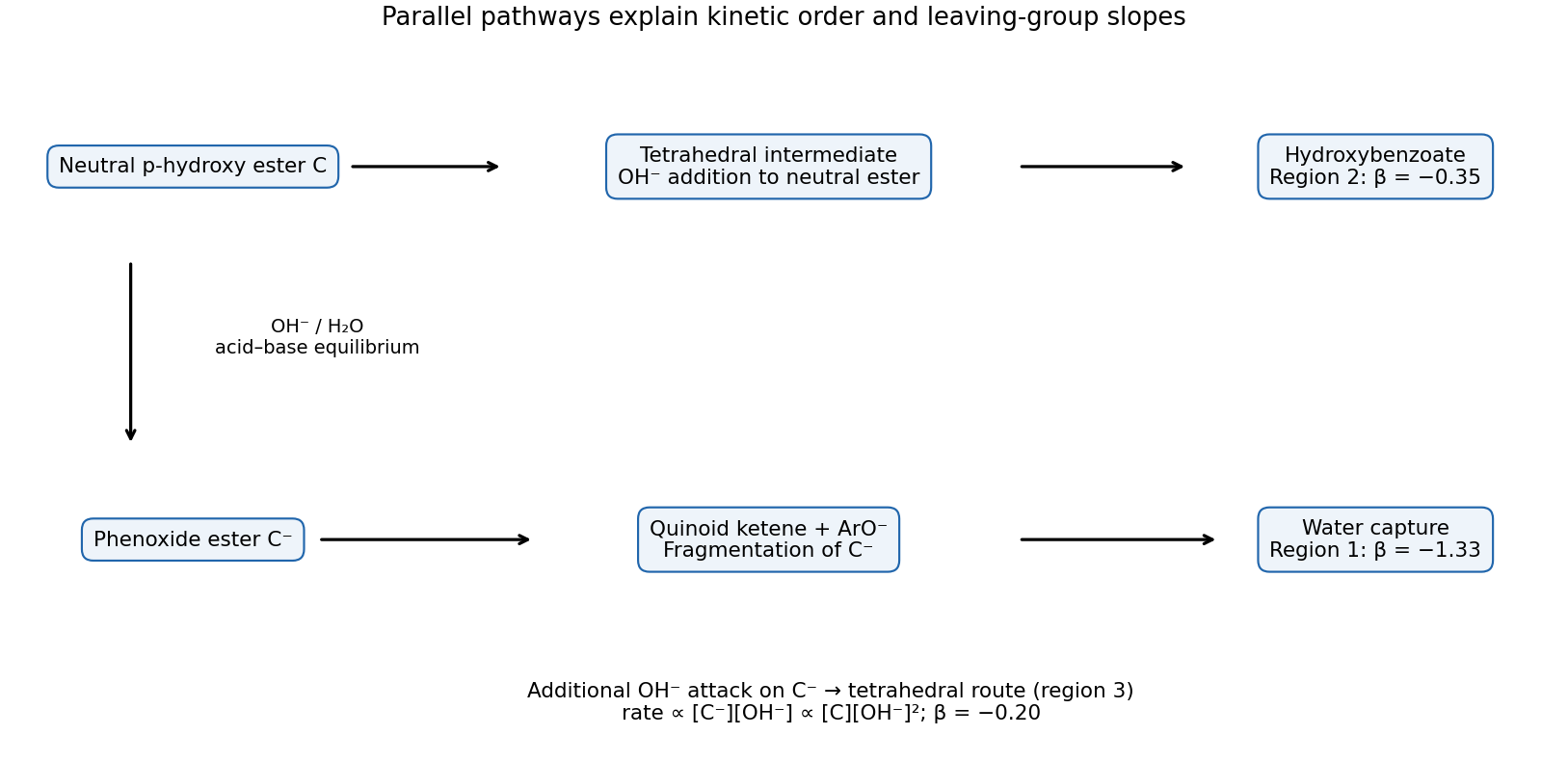
Parallel acyl-substitution and conjugate-base elimination pathways
. Details. 
Articles by others on the same topic
There are currently no matching articles.