For the ordinary esters, hydroxide adds to the acyl carbon, producing a tetrahedral oxyanion; collapse expels 2,4-dinitrophenoxide, followed by acid-base equilibration to the benzoate. This is base-promoted acyl-oxygen cleavage, a BAC2 mechanism. Rate-limiting addition naturally gives the observed bimolecular dependence on ester and OH.
The Hammett equation is . The positive slope, , means electron-withdrawing para substituents accelerate hydrolysis. They increase carbonyl electrophilicity and stabilize the additional negative charge associated with the addition transition state/tetrahedral intermediate. Strong electron donation has the opposite effect. Hydroxide addition to the acyl carbon, followed by tetrahedral-intermediate collapse and aryloxide loss, is consistent with both this trend and the bimolecular rate law.
The neutral para-OH ester B lies above the ordinary Hammett line, so an additional accelerating pathway is needed; ordinary resonance donation by OH alone predicts the wrong direction.
The phenoxide B lies far below the line: its strong resonance donation reduces acyl electrophilicity, and an anionic ester is less favorable for approach by OH. A single neutral-substituent parameter is also a poor description of this charged, strongly conjugated substrate. These deviations should not be forced onto the same straight line.
The kink indicates that two pathways with different leaving-group sensitivities compete: one dominates for good leaving groups and another for poorer ones. A single straight-line free-energy relationship is insufficient. The additional hydroxide-order information can be accommodated by rapid phenol deprotonation,Two rates are then possible. A route with one hydroxide equivalent in its overall kinetic dependence contributes . Attack of a further hydroxide on phenoxide ester contributesThus . The third-order term need not involve a simultaneous collision of three molecules: sequential acid-base equilibration followed by bimolecular attack produces it.
Hydroxide attack at the aromatic carbon bearing the leaving-group oxygen, followed by SNAr reaction, would put solvent-derived O into the liberated dinitrophenol. Its absence rules out that aryl C-O cleavage route, conventionally called BAr2, as the significant pathway.
Acyl C-O cleavage instead releases the original aryloxy oxygen with the leaving group, so unlabeled dinitrophenol is expected for both tetrahedral acyl substitution and the elimination route below.
The three regions represent competing pathways whose leaving-group sensitivities differ.
- Region 1, : good leaving groups permit E1cB mechanism. OH first deprotonates the para phenol. The phenoxide lone pair then pushes through the ring, with loss of ArO from the acyl group, giving a quinoid ketene, schematically . Water/hydroxide traps the ketene and proton transfers restore the aromatic hydroxybenzoate. Rate-limiting fragmentation has extensive C–OAr cleavage, hence strong dependence on leaving-group basicity.
- Region 2, : as ArO becomes a worse leaving group, elimination slows steeply and ordinary hydroxide addition to neutral C becomes competitive/dominant. The tetrahedral acyl-substitution pathway is much less sensitive to leaving-group p.
- Region 3, : hydroxide attacks the deprotonated phenoxide ester C. Its low electrophilicity and anion-anion interaction make addition slow. The leaving group is little involved in that addition transition state. Combined with prior deprotonation, this is the third-order term.
The bend in the upper plot is a crossover of mechanisms, not a discontinuous change in the identity of the leaving group. The lower plot is the separate hydroxide-on-phenoxide pathway.
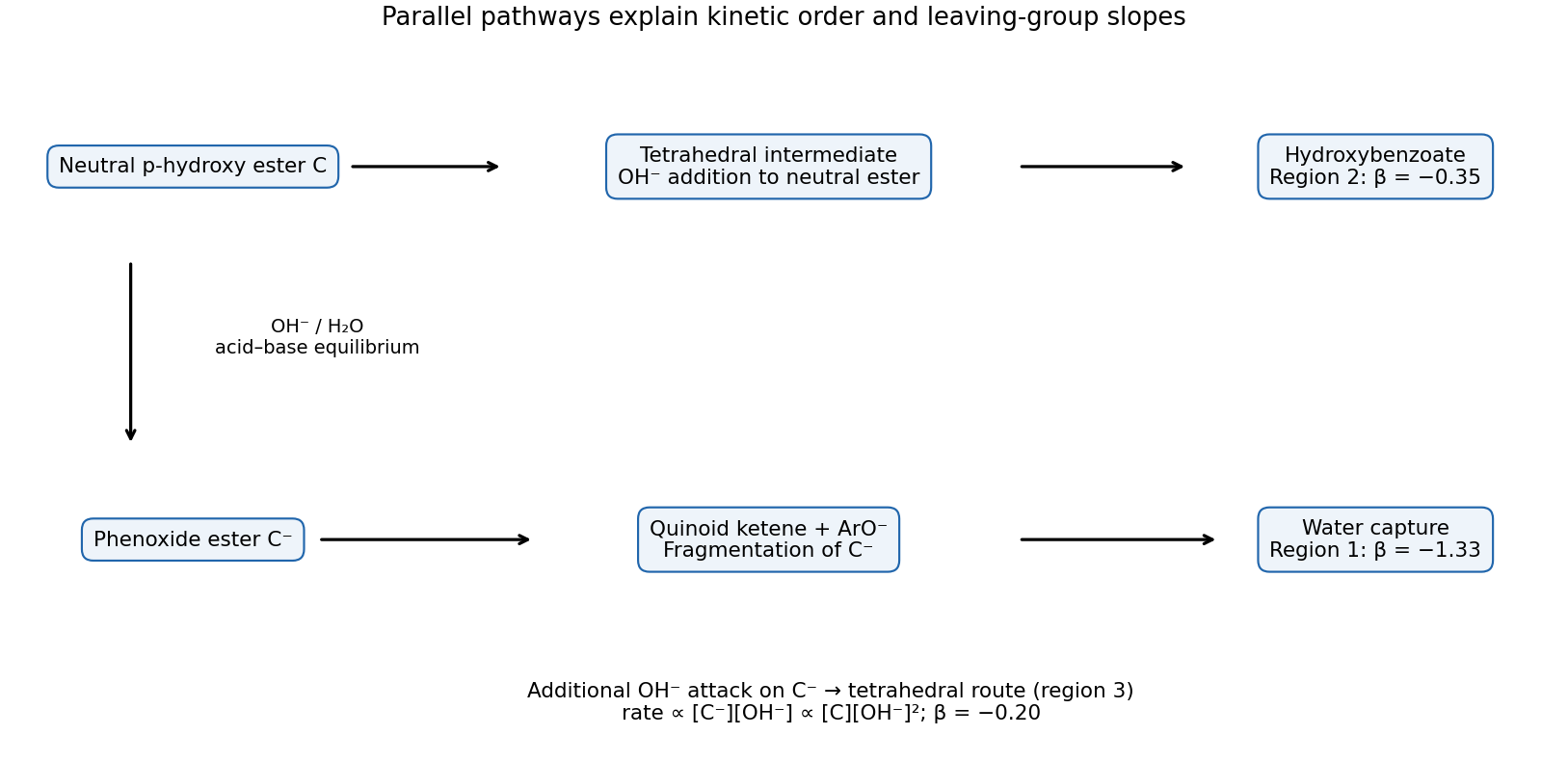
Parallel acyl-substitution and conjugate-base elimination pathways
. Details. 
The positive is compatible with fragmentation/desolvation in the elimination route. A simple rate-limiting association of hydroxide with a neutral ester would usually have a less favorable activation entropy.
The measured activation parameters belong to the overall second-order rate constant: the acid-base pre-equilibrium and solvent reorganization contribute as well. Consequently positive activation entropy supports the fragmentation interpretation together with the leaving-group slope, but does not by itself prove a particular elementary transition structure.
Articles by others on the same topic
There are currently no matching articles.