The natural mechanism is ionizing solvolysis: C-OTs cleavage gives a cyclopentyl cation/ion pair, capture by acetic acid gives the protonated acetate ester, and deprotonation gives product.
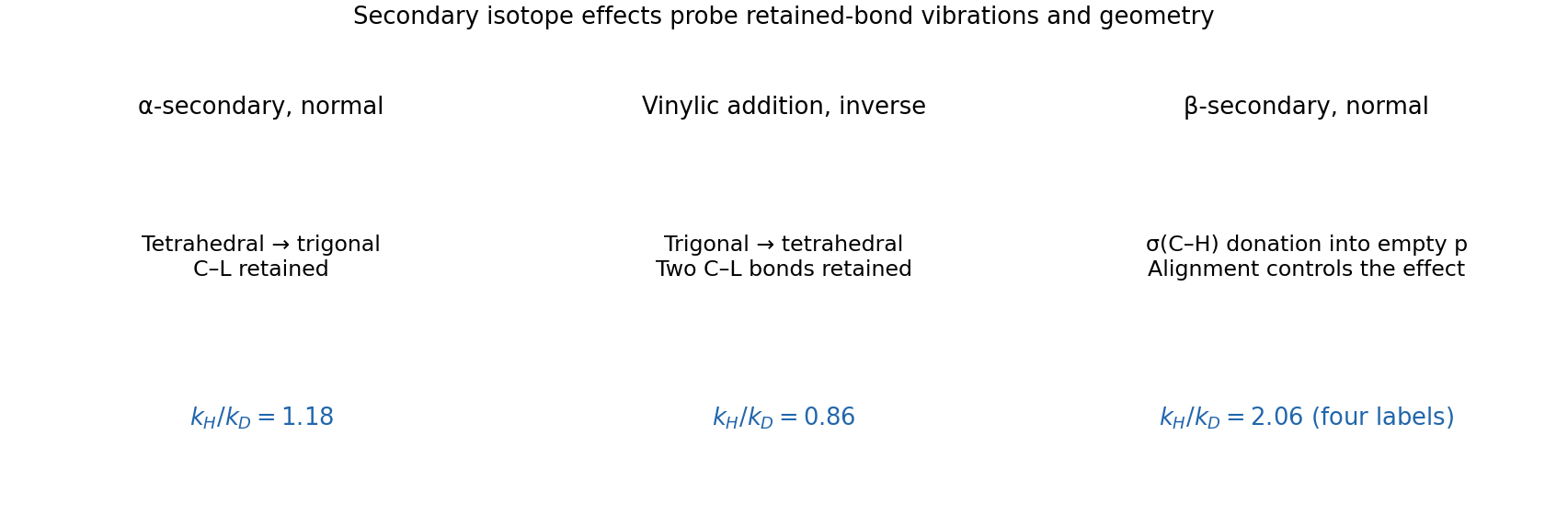
The effect from H/D at the leaving-group carbon is normal alpha-secondary: that carbon develops trigonal carbocation character. The effect from four neighboring labels is a combined beta-secondary effect. Adjacent C-H sigma bonds stabilize the developing empty p orbital by hyperconjugation; replacing H by D changes the vibrational stabilization and slows ionization. If the four contributions were equal and independent, each would be .
None of those labeled C-H bonds is broken. The isotope effects support substantial carbocation character, although distinguishing a free cation from an intimate ion pair needs additional evidence.

Articles by others on the same topic
There are currently no matching articles.