Protonation converts OH into a water leaving group; ionization then gives the diarylmethyl cation. The labeled C-H/D bond is retained, so is a normal alpha-secondary kinetic isotope effect, not a primary C-H cleavage effect.
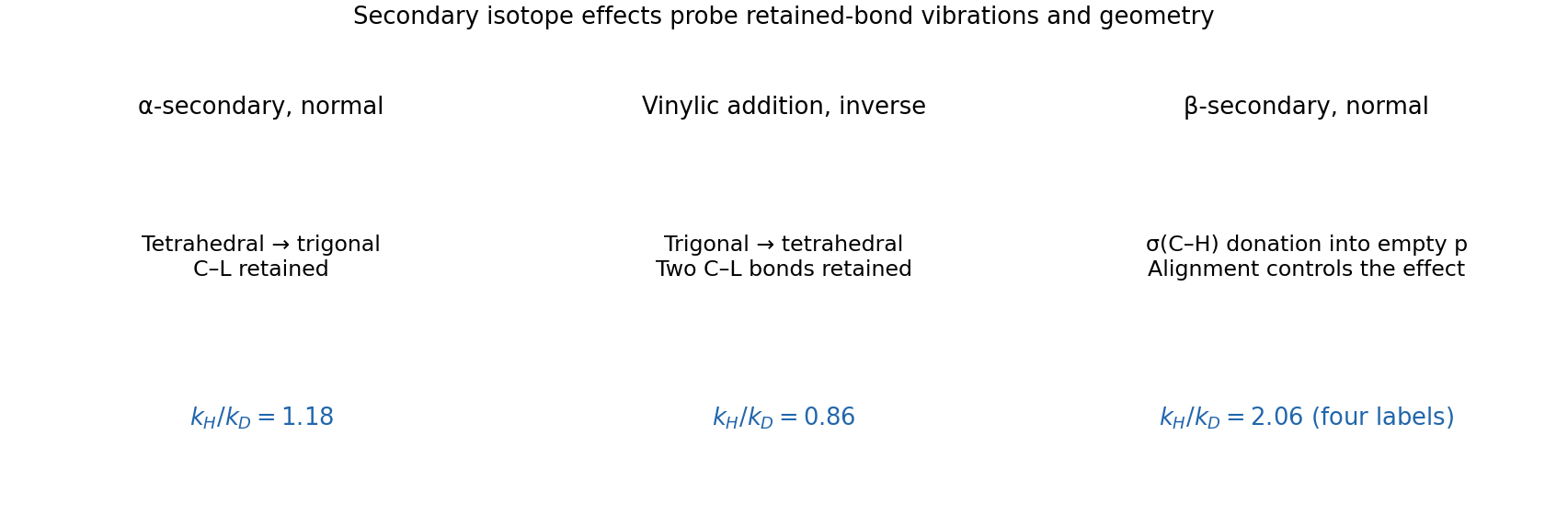
At the labeled carbon, tetrahedral geometry becomes approximately trigonal planar. The associated change in bending vibrations and zero-point energies favors the H isotopologue in a substantially carbocation-like transition state. The two anisyl rings stabilize that cation and make this ionization pathway plausible.
A plausible ionic catalytic cycle is reversible thiocyanate addition to the activated maleic-acid double bond, with proton transfers, followed by rotation about the resulting C-C single bond and elimination that regenerates thiocyanate and forms the less crowded trans alkene.
The retained vinylic labels pass from approximately sp toward sp at the addition stage. Stiffer bending modes in that direction give an inverse secondary kinetic isotope effect, consistent with . The cycle changes alkene geometry without requiring cleavage of either original labeled C-H bond. Since two positions are labeled, is a combined effect; equal independent contributions would each be .
The isotope effect supports an addition/elimination route rather than simple rotation of an intact double bond; it does not, alone, identify every proton-transfer order.
The natural mechanism is ionizing solvolysis: C-OTs cleavage gives a cyclopentyl cation/ion pair, capture by acetic acid gives the protonated acetate ester, and deprotonation gives product.
The effect from H/D at the leaving-group carbon is normal alpha-secondary: that carbon develops trigonal carbocation character. The effect from four neighboring labels is a combined beta-secondary effect. Adjacent C-H sigma bonds stabilize the developing empty p orbital by hyperconjugation; replacing H by D changes the vibrational stabilization and slows ionization. If the four contributions were equal and independent, each would be .
None of those labeled C-H bonds is broken. The isotope effects support substantial carbocation character, although distinguishing a free cation from an intimate ion pair needs additional evidence.

Bridgehead substitution proceeds by ionization and solvent capture; backside displacement at the adamantyl bridgehead is geometrically inaccessible. The rigid cage prevents the labeled bonds from sampling all the favorable alignments available in cyclopentyl solvolysis.
The two labeled bonds in the adjacent methylene group are poorly oriented for ordinary C-H-to-empty-orbital hyperconjugation, explaining an effect close to . Cage C-C sigma donation and geometrical relaxation can still stabilize the developing adamantyl cation. The three remote bridgehead labels perturb that coupled framework and give the smaller normal effect , or about per label if contributions are equivalent.
This is a geometrical and remote secondary isotope effect. It does not imply cleavage of the remote C-H bonds, and absence of a beta effect at one selected site does not establish absence of a cation.
Triethylamine attacks the benzyl carbon and bromide leaves, giving the quaternary benzyltriethylammonium salt. A useful substitution transition structure iswith developing N-C bonding and breaking C-Br bonding. The C-H/D bonds remain intact, so the small effects are secondary.
For X=NO, a relatively associative SN2 reaction transition state can give a small inverse effect, , through altered bending constraints. The unsubstituted case, , is close to cancellation of opposing contributions. Electron-donating OMe stabilizes benzylic positive charge, favoring a looser, more dissociative transition state and a slightly normal effect, ; it also explains the increased relative rate, versus for H and for NO.
Thus the data indicate increasing dissociative character with electron donation. A contribution from a separate ionization pathway is possible for the strongest donor, but these small isotope effects and three relative rates do not uniquely require a sharp SN2-to-SN1 mechanism switch.
Articles by others on the same topic
There are currently no matching articles.