The first step is an endo-selective Diels-Alder reaction of the pyrone diene with the electron-poor acrylamide. Number the pyrone , and the acrylamide carbons and , with next to its carbonyl. The favored polar connection is C3–C and C6–C, leaving C4=C5 and the original C2–O1 lactone bridge intact.
Lithium allyloxide, generated from n-Butyllithium and allyl alcohol, attacks the bridging lactone carbonyl. Collapse of the tetrahedral intermediate cleaves its acyl–oxygen bond. proton transfer converts the former O1 bridge into an OH substituent at C6 and leaves the former pyrone carbonyl as an allyl ester attached to C3. The morpholine amide is retained.
Thus C is allyl 1,4-dihydroxy-2-(morpholine-4-carbonyl)cyclohex-5-ene-1-carboxylate, with the stereochemistry described below. In this product numbering C1 is the former pyrone C3, C2 is the acrylamide , C3 is , and C4 is the former pyrone C6.
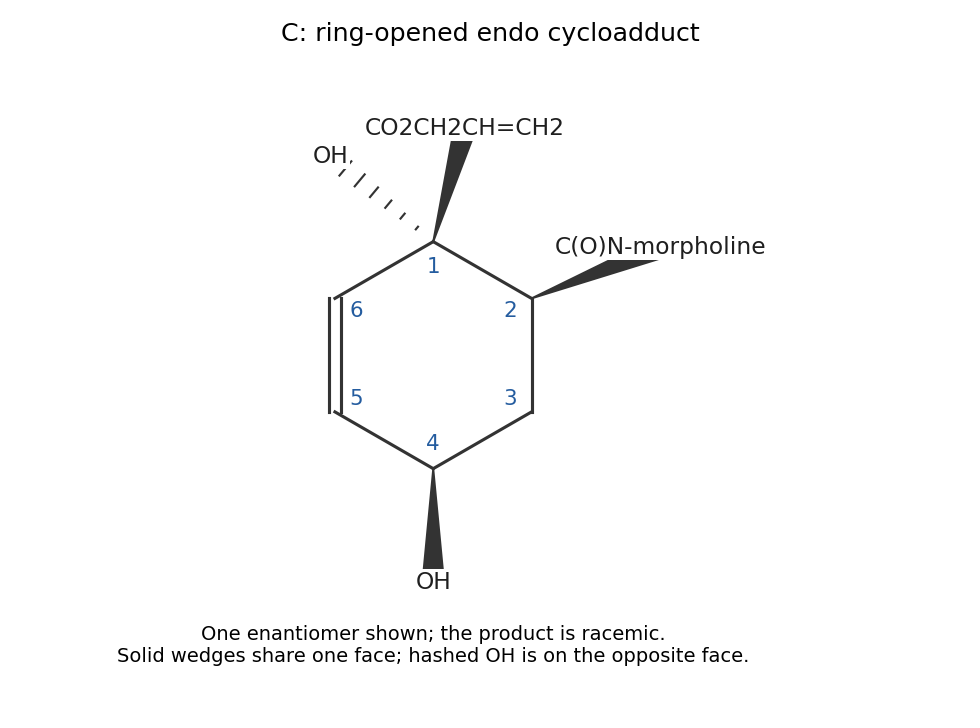

The bridge fixes the former C3 carboxyl group and C6 oxygen on the same face. An endo acrylamide places its amide substituent on that face too. Accordingly COallyl at C1, the C2 amide and the C4 OH are cis; the C1 OH is on the opposite face. The alternative face of attack gives the enantiomer, so achiral reagents give a racemate. The band is consistent with the newly formed ester, while the strong lower-frequency band is consistent with the retained, strongly polarized amide carbonyl. These bands support carbonyl-class retention; they do not independently prove the predicted regioisomer or stereochemistry.
The terminal alkene of D first undergoes Wacker oxidation, giving the side chain . Alkene coordination to Pd(II), water attack, proton transfers and beta-hydride elimination give the ketone. Copper and oxygen regenerate the active palladium oxidation state.
Base removes a proton from the terminal methyl of that ketone. Its enolate attacks the neighboring aromatic aldehyde intramolecularly, closing a six-membered ring. Dehydration gives a conjugated cyclohexadienone-type intermediate, and keto-enol tautomerism furnishes aromatic naphthol E. The retained methoxy and MOM-protected oxygen groups follow the original aromatic-carbon positions.
F is the O-allyl ether of E. Carbonate forms the naphthoxide and allyl bromide undergoes an SN2 reaction at its terminal carbon. Heating F then causes a [3,3]-Claisen rearrangement: the O–allyl bond breaks, the terminal allyl carbon bonds to the adjacent naphthalene C1, and the phenolic carbon temporarily becomes a ketone. Rearomatization gives G, with a free phenolic OH and a C1 allyl group. The C1 position gives the favored alpha-substituted naphthol and avoids the alternative less favorable annulation pattern.
The final step is a dearomative Michael addition, not a Nef conversion of the nitro group. Hydrogen bonding from the thiourea activates nitroethylene. The nucleophilic C1 resonance form of G attacks the terminal carbon of , and proton transfer converts the nitronate to a 2-nitroethyl substituent. The phenolic carbon becomes a ketone.
H is the corresponding 1-allyl-1-(2-nitroethyl)naphthalen-2-one, retaining the methoxy and MOM substituents of G. The second ring now has a C2=O group and a C3=C4 bond, while the other ring remains aromatic. The reported C signal near ppm is consistent with that newly formed ketone. Related dearomative additions establish this reaction class.[ref]
C1 is now an all-carbon quaternary stereocenter bearing both allyl and 2-nitroethyl groups. Both the drawn thiourea and the starting materials are achiral, so H is racemic. A chiral catalyst would be needed to select one absolute configuration.
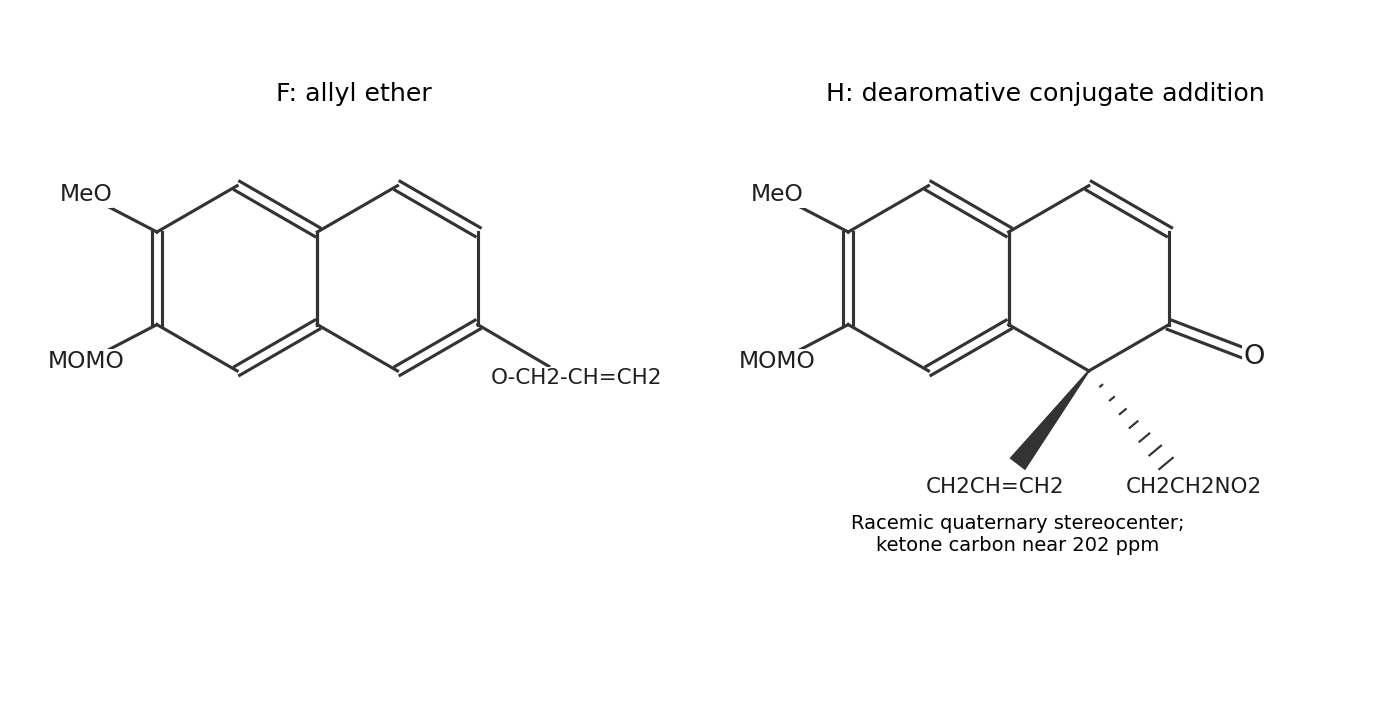
O-allyl intermediate and dearomative Michael-addition product
. Details. 
Articles by others on the same topic
There are currently no matching articles.