The hard-core chain does not undergo an energetic low-temperature collapse. For allowed configurations the only finite energy is bond stretching. If , bond lengths remain near and temperature mostly changes the small bond-length fluctuations, not the distribution of angular conformations. The end-to-end distance therefore fluctuates over an expanded self-avoiding-coil distribution even at low temperature, with an approximate scale and for sufficiently long three-dimensional chains.
For , the scaling is qualitative and finite-chain effects matter. An equilibrated distance-versus-sweep trace is stationary, with correlated excursions; a histogram of that trace is a distinct plot, not a curve of probability density against simulation step. Neither the temperature in kelvin nor the spring constant is specified, so an exact histogram cannot be calculated. The illustrative figure compares like-for-like coil traces rather than asserting a unique numerical simulation result.
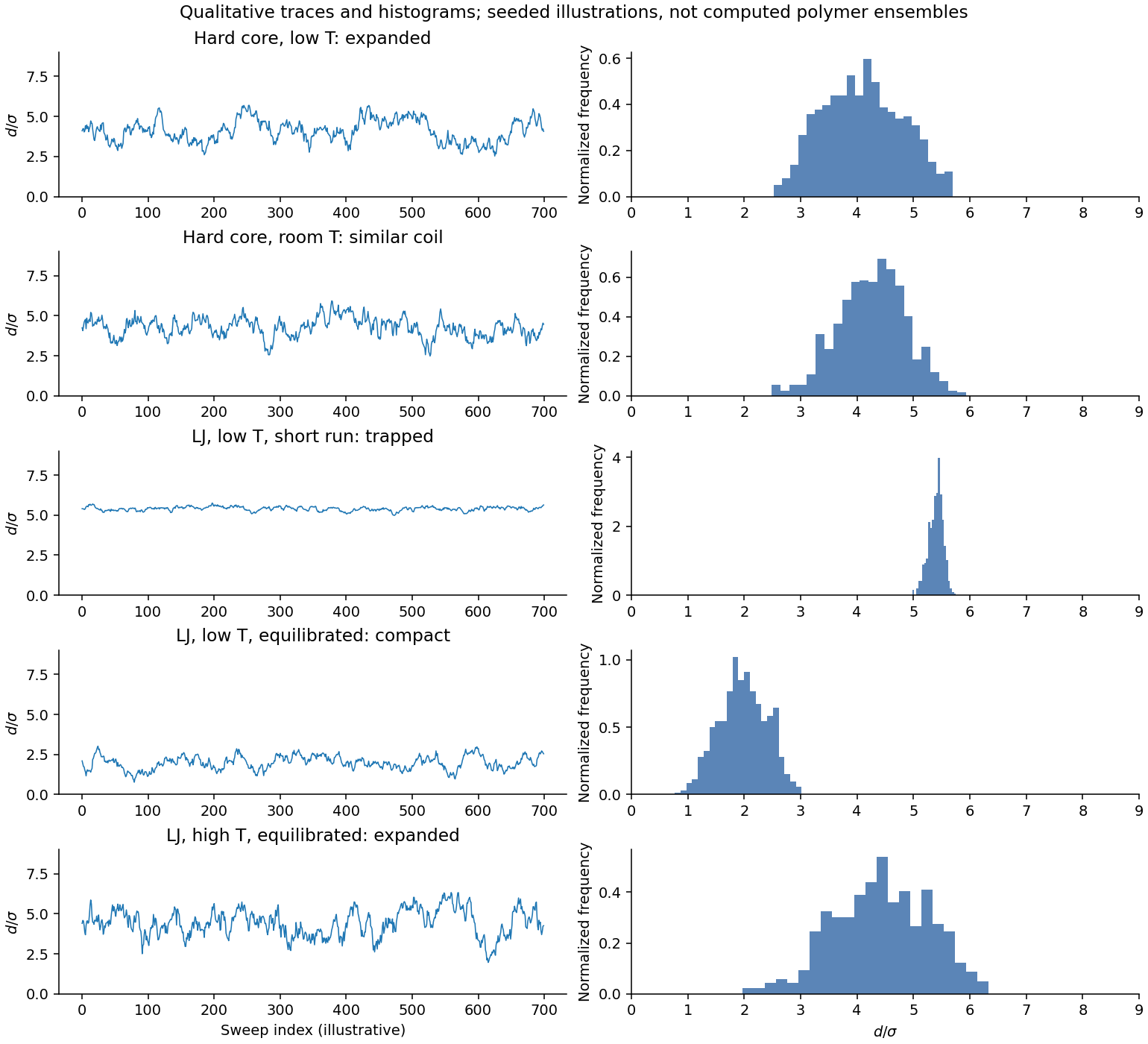
Original qualitative Monte Carlo traces and end-to-end-distance distributions for repulsive and attractive chains
. Details. 
At room temperature, the same hard-core exclusion remains temperature independent. If the spring remains stiff, the conformational distribution remains broadly similar to the low-temperature expanded-coil distribution. Finite bond-length fluctuations increase with and can slightly enlarge the length scale and distribution width. The radial bond measure also favours lengths slightly above the harmonic minimum.
The comparison depends on the dimensionless stiffness , not on the word “room” alone. There is no attractive energy in this model to produce a low-temperature globule and high-temperature coil transition. Monte Carlo decorrelation speed can change with temperature and proposal scale, but the premise already stipulates adequate equilibrium sampling in both cases.
Articles by others on the same topic
There are currently no matching articles.