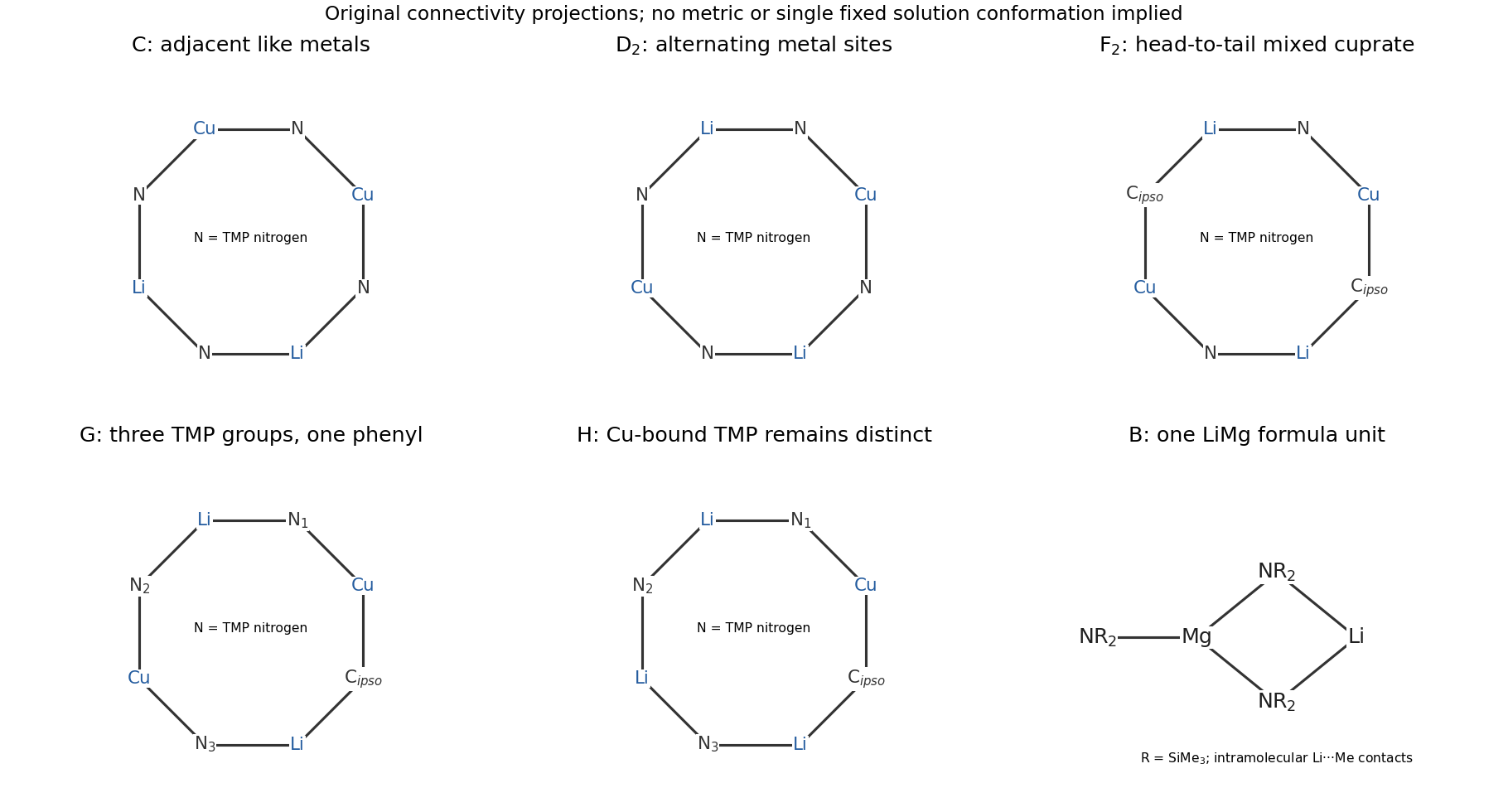
C and the dimer of D have the same composition, , but different metal ordering around an eight-membered metal–nitrogen ring. C has adjacent Cu sites and adjacent Li sites; in the conventional Gilman dimer D, Cu and Li alternate around the four metal positions. D is represented by per formula unit. The salt by-product is LiCl.
A TMP anion has formula and mass about 140.25. Therefore the mass per empirical unit is , giving for the dimer, consistent with . A monomer would be near 351 and is excluded. In C, inequivalent Cu/Cu, Cu/Li and Li/Li amide surroundings, combined with the constrained TMP orientations, permit the three methyl environments in the observed 1:2:1 integral ratio. D has the higher exchange-averaged methyl equivalence needed for one methyl signal. One signal need not imply that all instantaneous solid-state methyl environments are identical.
The remaining formulae follow from atom and charge balance:E can itself aggregate; its formula here specifies the copper-amide unit. F is a mixed organyl/amido Gilman cuprate, and G combines one F unit with one D unit. The distinct metal-ordering isomers and these mixed aggregates have experimental precedent.[ref]
A new route for the efficient metalation of unfunctionalized aromatics by Andrew J. Peel and others. 2019, metal-exchange isomers and mixed organyl/amido aggregates
F is an eight-membered ring with sequence , closed back to the first Cu. Each N belongs to TMP; each ipso carbon belongs to a phenyl group. Each Cu is approximately linear between one TMP nitrogen and one phenyl ipso carbon. Each Li contacts a TMP nitrogen and the phenyl group bound to the other Cu, so the dimer is assembled head-to-tail rather than from two independent separated ion pairs.
G has the eight-membered sequence , closed to Cu. The three N atoms belong to three TMP groups and the carbon belongs to the single phenyl group. Both copper sites remain approximately two-coordinate. The Li next to phenyl can also interact with its aromatic surface; this secondary contact need not have the same hapticity as in F. The figure gives a connectivity projection, not idealized square bond angles or an X-ray metric reconstruction.

Articles by others on the same topic
There are currently no matching articles.