and . Both metals are bridged by the two diisopropylamide nitrogen atoms in a four-membered Li–N–K–N ring. The smaller lithium ion accommodates the two amides plus one THF oxygen, while the larger potassium ion has space for two THF donors and more readily adopts the higher coordination number. The principal Li–N and Li–O contacts should be shorter than their potassium counterparts because of the much smaller lithium ionic radius. A larger number of donors does not imply shorter individual K–donor bonds.
Protonolysis of both magnesium–butyl bonds givesThus A is magnesium bis(hexamethyldisilazide), and the gas is butane. Addition of the corresponding lithium amide gives B = , a lithium tris(amido)magnesiate.
A useful connectivity sketch is with : magnesium binds three approximately coplanar nitrogen atoms, two of which also bridge to lithium. The remaining nitrogen is terminal at magnesium. Lithium can gain additional intramolecular contacts to methyl groups on the silylamide substituents. These contacts and the steric envelope of the bulky ligands help satisfy coordination without intermolecular aggregation. “Monomeric” here means one LiMg formula unit, not a single metal atom or an isolated bare counterion.
C and the dimer of D have the same composition, , but different metal ordering around an eight-membered metal–nitrogen ring. C has adjacent Cu sites and adjacent Li sites; in the conventional Gilman dimer D, Cu and Li alternate around the four metal positions. D is represented by per formula unit. The salt by-product is LiCl.
A TMP anion has formula and mass about 140.25. Therefore the mass per empirical unit is , giving for the dimer, consistent with . A monomer would be near 351 and is excluded. In C, inequivalent Cu/Cu, Cu/Li and Li/Li amide surroundings, combined with the constrained TMP orientations, permit the three methyl environments in the observed 1:2:1 integral ratio. D has the higher exchange-averaged methyl equivalence needed for one methyl signal. One signal need not imply that all instantaneous solid-state methyl environments are identical.
The remaining formulae follow from atom and charge balance:E can itself aggregate; its formula here specifies the copper-amide unit. F is a mixed organyl/amido Gilman cuprate, and G combines one F unit with one D unit. The distinct metal-ordering isomers and these mixed aggregates have experimental precedent.[ref]
A new route for the efficient metalation of unfunctionalized aromatics by Andrew J. Peel and others. 2019, metal-exchange isomers and mixed organyl/amido aggregates
F is an eight-membered ring with sequence , closed back to the first Cu. Each N belongs to TMP; each ipso carbon belongs to a phenyl group. Each Cu is approximately linear between one TMP nitrogen and one phenyl ipso carbon. Each Li contacts a TMP nitrogen and the phenyl group bound to the other Cu, so the dimer is assembled head-to-tail rather than from two independent separated ion pairs.
G has the eight-membered sequence , closed to Cu. The three N atoms belong to three TMP groups and the carbon belongs to the single phenyl group. Both copper sites remain approximately two-coordinate. The Li next to phenyl can also interact with its aromatic surface; this secondary contact need not have the same hapticity as in F. The figure gives a connectivity projection, not idealized square bond angles or an X-ray metric reconstruction.
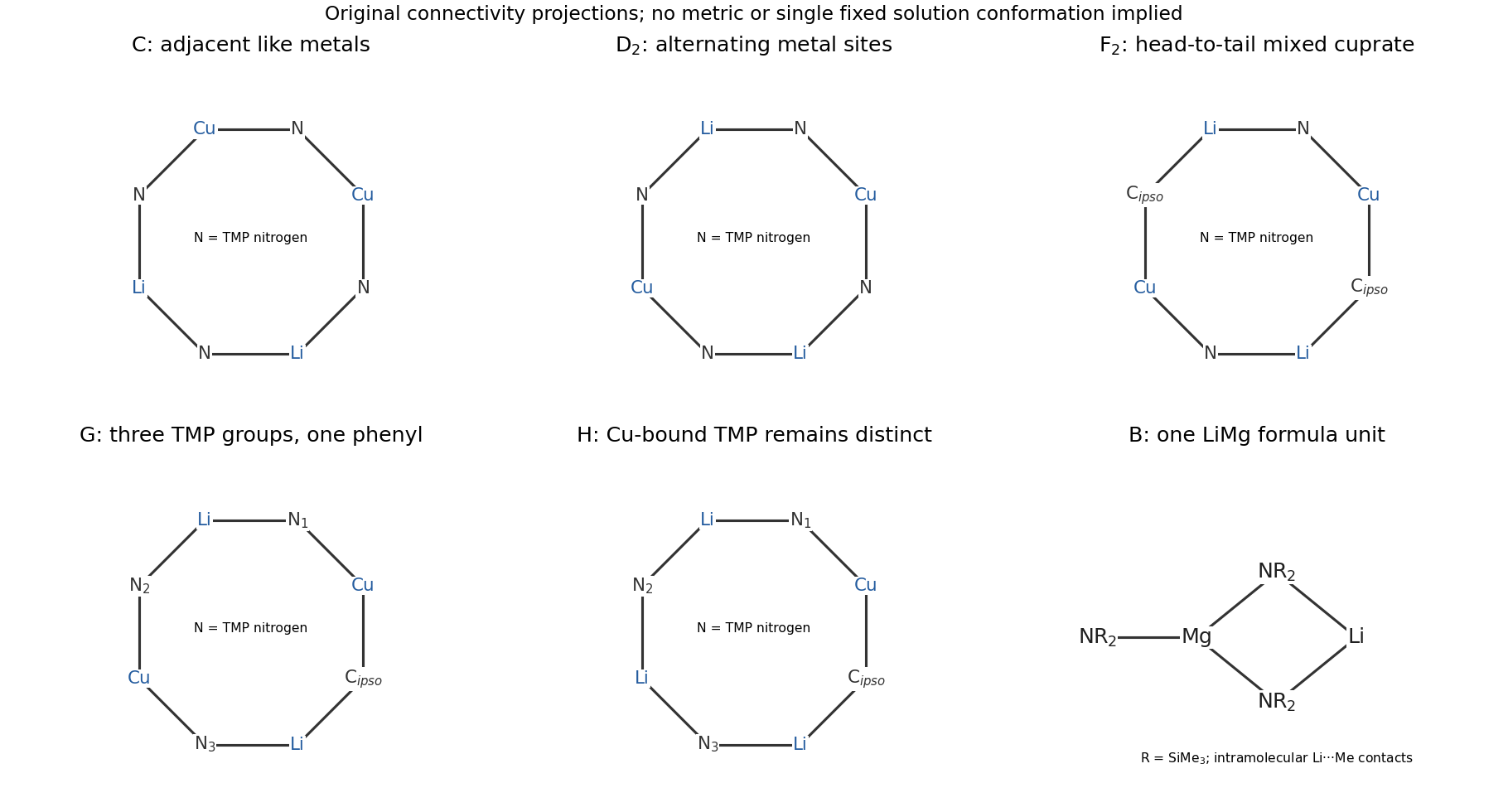
Original connectivity diagrams for amido-metal aggregates and the exchangeable lithium-amide segment
. Details. 
Stoichiometry gives H = , formally F plus two LiTMP units. A compatible ring connectivity is , closed through a lithium–phenyl interaction. The TMP attached to copper, N, remains chemically distinct; N and N belong to the more labile lithium-amide part.
Reversible detachment and reattachment of a symmetric segment can exchange its two amides and reassign which Li occupies the phenyl-contacting or nitrogen-bridging positions. It can therefore exchange all three Li sites and the two Li-associated TMP groups while retaining the Cu-bound TMP group. Fast TMP-ring conformational inversion can further average methyl environments without exchanging entire ligands. These are different kinds of motion; simple ring inversion alone cannot explain exchange of the lithium sites. Such a dissociative interpretation is consistent with the experimentally studied lithium-rich aggregate, but the exchange pattern does not determine a unique transition state or prove that every bond breaks in one concerted event.
Articles by others on the same topic
There are currently no matching articles.