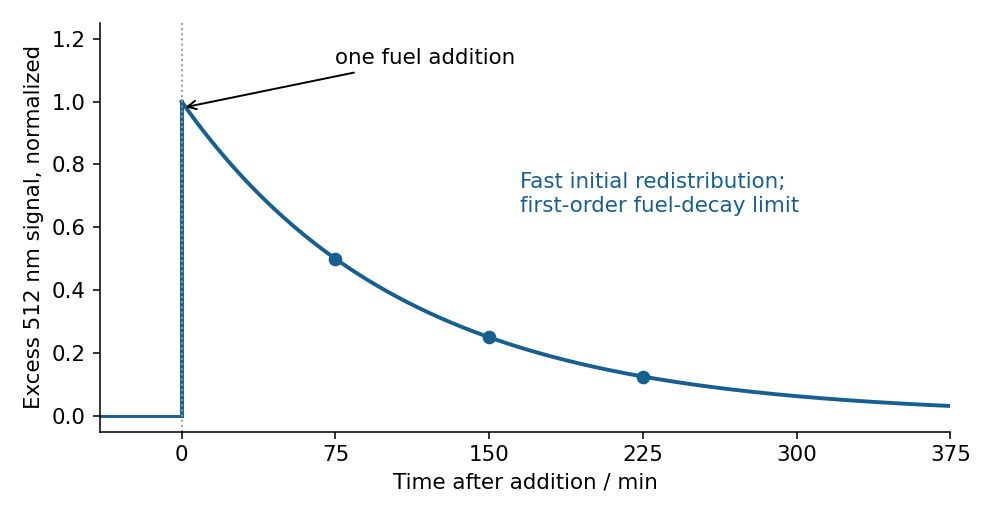
The acid initially protonates 1 and switches the system into the lithium-bound reporter state, so 512 nm intensity rises rapidly. The resulting carboxylate then decarboxylates irreversibly. Its carbanion removes the proton from 1, giving neutral waste 5 and restoring the original zinc/lithium distribution. Thus the 512 nm signal is a transient pulse followed by recovery to its initial low baseline; no repeated oscillations follow from one fuel addition.
For first-order decarboxylation the surviving fuel-derived carboxylate fraction is with . If proton exchange and metal redistribution are fast, background is subtracted, and the population of the switched state is proportional to remaining protonated 1, the illustrative recovery isHalf the initial excess signal remains after 75 min and one quarter after 150 min in that limiting model. Actual binding equilibria can make the intensity nonlinear in remaining fuel; the supplied half-life fixes the fuel decay, not an exact reporter-intensity law. Monitor H NMR fuel consumption and waste formation alongside the optical trace to distinguish dissipation-driven recovery from photobleaching or simple dilution.

Articles by others on the same topic
There are currently no matching articles.