Original source: Cambridge 2022 Part III Chemistry Paper 3, release PDF physical pages 220–246. The three cover variants share the question body covered here once. Biological subquestions are explicitly deferred at the user's request.
Only one bromine is replaced by hydrogen. Writing the unchanged protected chain as , the product is , retaining the original internal alkene geometry and forming predominantly the terminal bromoalkene: bromine and the carbon chain lie on the same side of that new stereodefined double bond. The formula is consequently .
Phosphine dissociation exposes Pd(0), which undergoes preferential oxidative addition into the less hindered C–Br bond, the bromine trans to the carbon chain in the gem-dibromoalkene. hydride transfer from tributyltin hydride replaces the palladium bromide ligand, producing tributyltin bromide and an alkenyl–Pd–H intermediate. reductive elimination joins the alkenyl carbon and hydride, regenerating Pd(0). Retention of the alkenyl geometry through this sequence puts the surviving bromine cis to the chain. The conjugated carbon skeleton and protecting group remain intact; this is not addition of tin hydride across either alkene. The stereoselective monohydrogenolysis is established for this reagent combination.[ref]
A general and convenient synthetic method of geometrically pure (Z)-1-bromo-1-alkenes by Junichi Uenishi and others. Tetrahedron Letters 37, pp. 6759–6762: palladium/tributyltin-hydride monoreduction
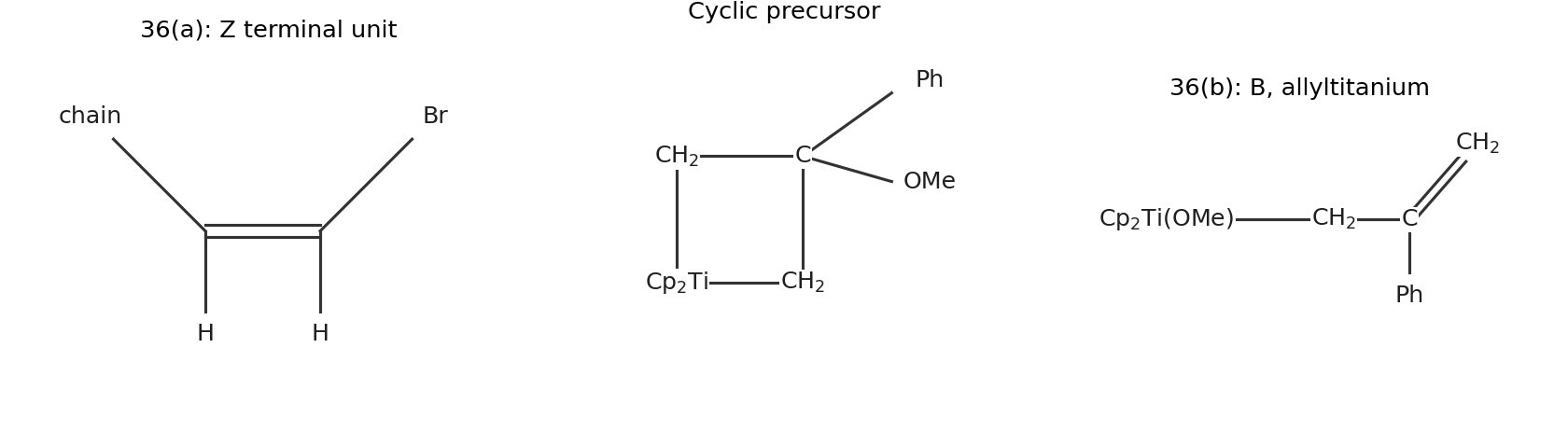
Original product and metallacycle connectivity drawings for the organometallic transformations
. Details. 
The first equivalent of titanocene methylidene methylenates the ester: the carbonyl oxygen and titanium form an oxatitanacyclobutane, whose fragmentation gives and a titanium–oxygen product. The second equivalent adds across this electron-rich double bond. The initial adduct is a titanacyclobutane with cyclic connectivity , closing from the last methylene to titanium. The ester's phenyl-substituted carbon lies opposite Ti; the two new methylenes originate from the two methylidene equivalents.
Beta-methoxy elimination opens that metallacycle to B, , the allyltitanium reagent. The C–OMe bond breaks, OMe transfers to Ti, one Ti–C bond becomes the new C=C bond, and the other Ti–C bond remains as the allylic nucleophile. The cyclic adduct is therefore a precursor to the opened reagent B; treating B as merely the one-equivalent enol ether loses the second reagent carbon.
The aldehyde oxygen coordinates to titanium. Allylic carbon transfer to its carbonyl carbon, accompanied by movement of the C=O pi electrons to oxygen, gives the titanium alkoxide . Acidic aqueous workup cleaves O–Ti and protonates oxygen, giving . A six-membered allyl-transfer arrangement is a convenient mechanistic model. No enantioselectivity is imposed by these achiral reagents.
Schwartz reagent adds syn across the terminal alkene, placing zirconium at its terminal carbon and hydrogen at the substituted carbon. The organozirconium intermediate is . The two faces of the achiral starting alkene give enantiomeric organometallic intermediates.
Boron trifluoride coordinates the ether oxygen, making the benzylic C–OMe bond susceptible to cleavage. The C–Zr bond then transfers its carbon terminus intramolecularly to the benzylic carbon as the activated methoxy group departs, closing a cyclopropane. This can be represented as a concerted, strongly assisted displacement rather than requiring a freely equilibrating long-lived benzylic carbocation. hydrozirconation fixes the relative disposition of the new C–H and C–Zr bonds, and the preferred closure conformation places the bulky phenyl and methyl groups on opposite faces. The result is racemic trans-1-methyl-2-phenylcyclopropane, with much less steric crowding than the cis alternative. The ring contains the original two alkene carbons and the original benzylic carbon; no carbene carbon is added.
Let -dimethylphenyl and -methoxyphenyl. After conversion of the Pd(OAc) precatalyst into an active phosphine–Pd(0) species, oxidative addition of gives . Carbonate-assisted replacement of chloride by the alcohol's alkoxide produces .
In the key beta-carbon elimination, the alkoxide oxygen forms a C=O bond while the bond between its carbinol carbon and cleaves, transferring to palladium. This gives acetone and a diarylpalladium(II) complex, . reductive elimination creates the new biaryl bond and regenerates Pd(0). Thus the tertiary alcohol functions as an aryl donor by carbon–carbon bond cleavage, rather than being incorporated as a carbinol substituent. The overall organic products are the cross-coupled biaryl and acetone. The carbinol carbon has no hydrogen, so ordinary beta-hydride elimination from this alkoxide cannot explain the observed aryl transfer. The bulky electron-rich phosphine helps access the aryl-chloride oxidative addition and the sterically congested biaryl-forming elimination.
Both free primary allylic alcohols undergo Sharpless asymmetric epoxidation. With slightly more than two equivalents of hydroperoxide, the expected fully oxidized product is the diepoxide, with both original C=C bonds converted to epoxides and both primary alcohols retained. The two central pre-existing stereocentres and their ether substituents are retained.
The stereochemical construction is unambiguous by applying the L-(+)-tartrate mnemonic separately at each end: orient that alkene horizontally with its CHOH group at lower right, and deliver oxygen from the back face. In the source's original in-plane orientation this gives the left epoxide oxygen behind the plane and the right epoxide oxygen in front. The methyl and hydroxymethyl groups retain their original relative arrangement about each former double bond. One cannot simply draw both oxygens on the same face of the original extended chain: the two allylic-alcohol ends have opposite drawing orientations. titanium binding to each free hydroxyl directs oxygen transfer; the pre-existing stereocentres can create matched/mismatched rate differences, but the stated reagent control predicts the stereochemistry of both epoxidations. Molecular sieves maintain a dry active titanium–tartrate system.[ref]
The first practical method for asymmetric epoxidation by Tsutomu Katsuki and K. Barry Sharpless. JACS 102, pp. 5974–5976: tartrate-controlled allylic-alcohol epoxidation
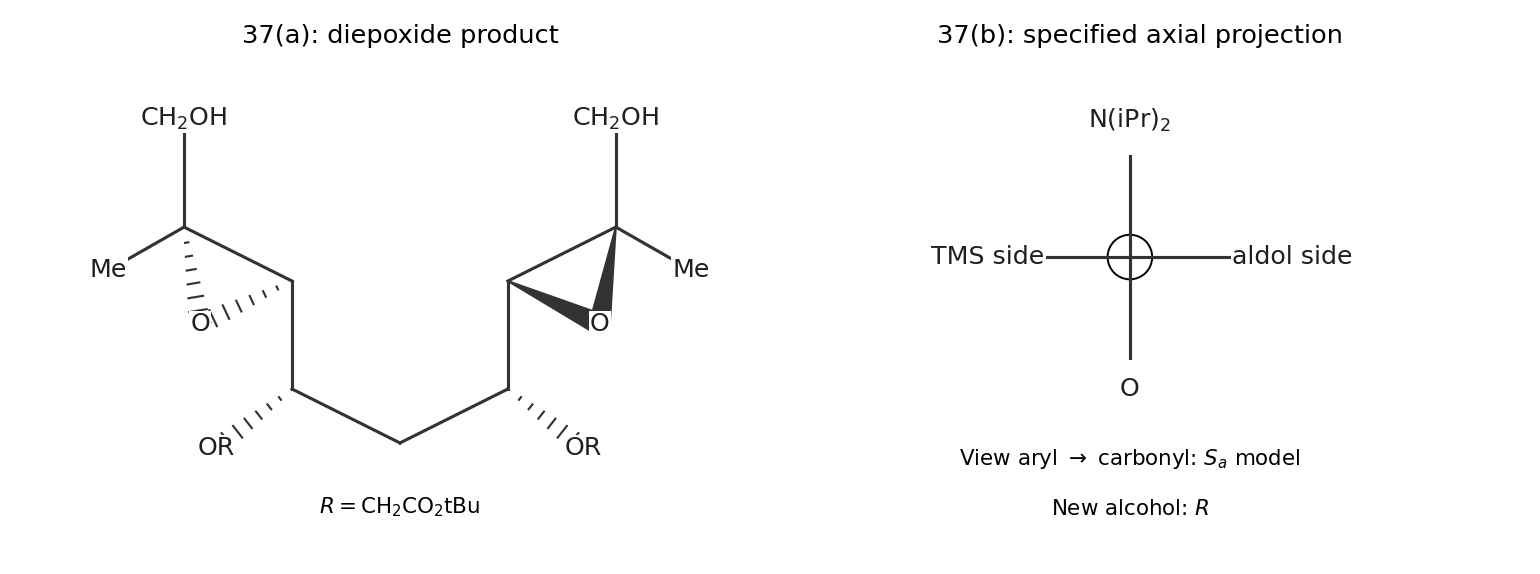
Original facial-selectivity and axial-projection solution models
. Details. 
acetone first forms a proline enamine by reversible iminium formation and alpha-deprotonation. The enamine attacks the aromatic aldehyde in a hydrogen-bonded arrangement involving the catalyst's carboxylic acid. hydrolysis of the resulting iminium releases the beta-hydroxyketone and regenerates proline. The usual L-proline arrangement gives the secondary alcohol.
The sterically crowded aryl–amide axis is selected at the same bond-forming step: rapid rotation in the aldehyde permits the catalyst to react preferentially with the conformer that puts the smaller carbonyl-oxygen side of the amide towards the approaching aldol transition structure and the bulky diisopropylamino side away. A chair-like enamine–aldehyde model minimizes the interaction of the amide with the catalyst-side axial hydrogen; reversing the amide orientation creates the less favourable diastereomeric transition state. Replacing planar CHO by tetrahedral CH(OH)CHCOMe then raises the rotation barrier and traps the axis. This is a dynamic kinetic resolution, not resolution of two configurationally stable starting atropisomers.
To specify the predicted major axis without relying on a flat bond-line formula, look from the aromatic ipso carbon towards the amide carbonyl carbon. Put the higher-priority aryl path, the trimethylsilyl-bearing ortho side, at nine o'clock. The preferred model puts the carbonyl oxygen at approximately six o'clock and the diisopropylamino group at twelve o'clock. This is using the near-to-far high-priority convention; oxygen outranks nitrogen at the far end. Coupled with the alcohol assignment, the model predicts . The drawing defines the configuration even if an alternative viewing direction is used. The dynamic-resolution mechanism is established by the primary aldol study; the product-axis assignment here is a stereochemical-model prediction for the printed substrate.[ref]
Dynamic kinetic resolution of atropisomeric amides by Vincent Chan and others. Organic Letters 6, pp. 2051–2053: simultaneous alcohol and amide-axis control
An unsaturated Rh(I)–BINAP complex undergoes oxidative addition of the aldehydic C–H bond, giving a Rh(III) acyl hydride. Coordination of the tethered alkene brings it into the chiral coordination sphere. hydride migration to the internal, tert-butyl-substituted alkene carbon places Rh on the terminal methylene. The resulting acyl–alkyl complex has the connectivity required for a five-membered ring. reductive elimination between its acyl and alkyl carbons closes the C–C bond, releases the cyclopentanone and regenerates Rh(I).
The aldehyde carbon becomes the ketone carbonyl carbon; its hydrogen ultimately reaches the alkene-derived internal carbon. The original tert-butyl substituent remains attached to the internal alkene carbon, which becomes the beta stereocentre of the cyclopentanone. alkene coordination and insertion favour the chiral pocket arrangement with the bulky tert-butyl group in the less crowded region of the BINAP complex. For the stated (S)-BINAP system the observed product is the beta-tert-butylcyclopentanone, equivalently the product with tert-butyl on the solid-wedge face in the supplied ring orientation. Its priorities are tert-butyl, the shorter carbonyl-side ring path, the other ring path, and hydrogen. The ligand's S label alone is not a general rule that every product stereocentre must be S; the substrate orientation in the catalyst must also be specified. No decarbonylation is needed in the productive hydroacylation cycle.
One valid asymmetric route uses N-Boc-(R)-proline as a chiral starting material. Convert its acid to the Weinreb amide with N,O-dimethylhydroxylamine and a coupling reagent such as EDC, then add phenylmagnesium bromide at low temperature. chelation of the magnesium tetrahedral intermediate prevents a second addition; aqueous workup releases the phenyl ketone. Reduce it with sodium borohydride, separate the resulting alcohol diastereomers, and retain the one with configuration at both pyrrolidine C2 and the benzylic carbinol. This is an asymmetric synthesis through a pre-existing enantiopure centre, even though the final reduction need not be perfectly diastereoselective. If the other protected alcohol is isolated, Mitsunobu esterification with a carboxylic acid followed by ester hydrolysis inverts just the carbinol centre. Keeping nitrogen Boc-protected during that inversion avoids neighbouring-amine participation. Mild Boc removal followed by reductive benzylation with benzaldehyde and sodium triacetoxyborohydride gives D, the amino alcohol. Use conditions that avoid epimerizing the amino ketone.
For ring expansion, activate D's alcohol with methanesulfonyl chloride and a tertiary amine base. Its own tertiary nitrogen attacks the benzylic carbon from the back, displacing mesylate with inversion and making a fused aziridinium ion. Acetate, supplied as a soluble acetate salt, attacks the original pyrrolidine C2 from the opposite face and breaks the old C2–N bond. The new N–benzylic-C bond is retained, incorporating that side-chain carbon into the six-membered ring. Inversion at the two successively attacked carbons gives the cis acetate/phenyl piperidine E in the displayed orientation. Attack at the benzylic carbon instead would simply open the three-membered ion back to a five-membered-ring derivative; specifying the attacked carbon is the crucial regiochemical step.
The binding energies are referred to the common Fermi level. Immediately outside the copper surface, conservation of energy givesThis is the emitted photoelectron energy at the sample. On reaching the electrically connected, unbiased analyser, its energy is instead . The 0.4 eV difference is the contact-potential correction, not an additional binding-energy shift. Distinguishing these two reference positions is essential for the retarding-voltage calculation.
The hemispherical component needs 100.0 eV electrons, whereas electrons arrive at its entrance optics with 111.4 eV. The optics must therefore remove 11.4 eV, requiring a retarding-potential magnitude of 11.4 V. For a negative electron, moving to a more negative electrostatic potential increases potential energy, so the retarding region is 11.4 V negative relative to the analyser entrance. Equivalently the hemisphere entrance is 11.8 V negative relative to the sample vacuum reference after including the 0.4 V contact step. Reporting 11.8 V as the additional instrument retardation would count the contact correction twice.
Fixed entrance retardation and fixed pass energy select the same pre-retardation kinetic energy, 111.4 eV. The required photon energy is thereforeIt is lower than the original excitation by exactly the difference between the two core binding energies, 114.4 eV.
Define the retard ratio using the kinetic energy at the analyser entrance before the deliberate retardation: . Initially . With the original excitation, a carbon photoelectron arrives with . ThusThe new deliberate retardation is . For fixed slits, angular acceptance and hemisphere radii, the geometrical fractional energy width is approximately constant, so the absolute analyser width grows in proportion to pass energy: about 2.03 times poorer absolute energy resolution. Counts may improve, but closely separated chemical shifts become harder to resolve. An alternative definition gives 0.114 rather than 1.114 for the same physical setting and leads to the same final pass energy when used consistently.
The large resonance at the smallest field-to-normal angle identifies an unoccupied orbital whose transition dipole is mainly normal to the surface. An N 1s initial state is approximately spherical; the dipole matrix element for a transition is directed along the normal to the adsorbate's aromatic plane. Consequently the adsorbate rings lie predominantly parallel to the copper surface. For perfectly flat molecules the resonance strength scales as , which decreases strongly from to as observed.
For azimuthally disordered molecular normals tilted by from the surface normal, averaging gives . Strong dichroism therefore implies a large orientational order parameter, but the plotted qualitative curves alone do not determine a unique tilt angle or distribution. Background subtraction, incident polarization and intensity normalization would be needed for such a fit. This experiment identifies the orientation of the pi system; it does not by itself identify a particular nitrogen–copper bonding topology.
The initial nitrogen environment loses intensity on heating, and a lower-binding-energy component becomes prominent near the highest temperatures. A change of surface chemical species accompanies loss or conversion of the original adsorbate. Plausible processes include thermally activated decomposition with nitrogen-containing fragments remaining on copper, desorption of intact material or fragments, and rearrangement of the coordination environment. The extra components at intermediate temperatures suggest coexistence rather than a rigid, uniform shift of every molecule.
The individual curves have vertical offsets, so their baseline height is not a coverage measurement. Integrated, sensitivity-corrected N and C peak areas, a clean heated substrate control, and evolved-gas mass spectrometry would help distinguish loss of material from chemical conversion. binding energy alone cannot establish a unique fragment structure: local charge, metallic screening and coordination all affect it.
A step elastically reflects a surface-state wave. Interference between and produces a local density oscillation at , so the measured spatial period is , not . Thus and . Write with . The two points giveHere . The fitted minimum is above the Fermi level. This assumes the bias measures sample excitation energy, parabolic dispersion over the measured interval, and no wave-vector-dependent phase contribution that changes the fitted period.
inverse photoemission spectroscopy is appropriate: the fitted minimum lies above the Fermi level, so the state is unoccupied in equilibrium. Injection of electrons followed by photon emission probes unoccupied states. Ordinary ultraviolet photoemission removes electrons from occupied states and cannot map this empty minimum without an additional population mechanism.
The same wave vectors now differ in energy by only 0.070 eV, so the curvature is . ThereforeThe nearly free-electron in-plane mass and high unoccupied energy suggest an image-potential-derived state, with an electron confined outside the film by its image attraction and surface barrier but relatively free parallel to it. Relative to the supplied clean-platinum vacuum level, its minimum is 0.84 eV below vacuum, a plausible scale for an image state. gold adsorption can change the work function, so 0.84 eV is conditional on using the supplied clean-surface value; an adsorbate work-function measurement is needed for a quantitative assignment. The dispersion alone supports the interpretation without proving it uniquely.
An Au(111) Shockley state requires the near-surface band structure and projected bulk gap of a sufficiently thick gold region. In an ultrathin film, its wavefunction reaches the platinum interface, where hybridization and leakage into platinum states can shift, broaden or destroy the bound surface state. As the gold thickness exceeds the relevant decay length, the top surface becomes electronically decoupled from the substrate and the gold-like state emerges. A monolayer's atomic identity is insufficient to guarantee a bulk-gold surface electronic structure.
When reaches a vibrational quantum, a tunnelling electron can lose energy by exciting that vibration. Opening an inelastic channel changes at both voltage polarities. If the conductance increases in each direction, has a positive feature at positive threshold and a negative feature at the corresponding negative threshold. Approximate antisymmetry follows from approximate symmetry of the conductance; unequal tip and sample electronic structures can make amplitudes unequal.
The three energy scales are 8, 48 and 375 meV, corresponding to about 65, 387 and 3025 cm. A plausible assignment is a low-energy frustrated lateral translation or rotation, an adsorbate–metal stretch or hindered molecular mode at 48 meV, and a C–H stretching vibration at 375 meV. The terminal carbon of methyl isocyanide supplies a plausible adsorption contact, but exact mode assignment requires calculated normal modes or independent vibrational measurements. In particular the 48 meV band should not be labelled a C–N stretching vibration simply because the molecule contains that bond: its frequency is far too low for the usual internal stretching mode.
The 375 meV pair should shift most fractionally, towards zero bias, because C–H stretching has strong hydrogen displacement. A reduced-mass estimate givesso the pair would move approximately from to mV. A frozen-carbon estimate gives , or about 265 mV; the actual normal mode includes coupled motion. Whole-molecule modes change much less: the molecular mass rises only from approximately 41 to 44, giving a translational estimate .
TODO — user-deferred biological subquestion. This part is outside the current nonbiology scope; no biological solution or research has been undertaken.
TODO — user-deferred biological subquestion. This part is outside the current nonbiology scope; no biological solution or research has been undertaken.
TODO — user-deferred biological subquestion. This part is outside the current nonbiology scope; no biological solution or research has been undertaken.
TODO — user-deferred biological subquestion. This part is outside the current nonbiology scope; no biological solution or research has been undertaken.
TODO — user-deferred biological subquestion. This part is outside the current nonbiology scope; no biological solution or research has been undertaken.
TODO — user-deferred biological subquestion. This part is outside the current nonbiology scope; no biological solution or research has been undertaken.
TODO — user-deferred biological subquestion. This part is outside the current nonbiology scope; no biological solution or research has been undertaken.
TODO — user-deferred biological subquestion. This part is outside the current nonbiology scope; no biological solution or research has been undertaken.
TODO — user-deferred biological subquestion. This part is outside the current nonbiology scope; no biological solution or research has been undertaken.
TODO — user-deferred biological subquestion. This part is outside the current nonbiology scope; no biological solution or research has been undertaken.
TODO — user-deferred biological subquestion. This part is outside the current nonbiology scope; no biological solution or research has been undertaken.
TODO — user-deferred biological subquestion. This part is outside the current nonbiology scope; no biological solution or research has been undertaken.
The gyromagnetic ratio is the signed proportionality coefficient between a nuclear magnetic moment and its spin angular momentum. With the angular-frequency convention, , and is expressed in rad s T.
For a positive gyromagnetic ratio the magnetic moment is parallel to the spin angular momentum; for a negative ratio it is antiparallel. The Hamiltonian gives . Thus is lower for the proton, whereas is lower for nitrogen-15. Their spin precession senses are opposite for a common positive field convention; measurable absorption frequencies and energy separations remain positive.
The energy separation is . At 10 T this givesAt 300 K, , so the splitting-to-thermal-energy ratios are and . The two spin levels therefore have nearly equal populations. Their equilibrium population polarizations are approximately half these ratios, and , explaining weak thermal NMR sensitivity despite well-defined resonant transition energies.
NMR probes the chosen isotope's local environments and motion in the bulk without electrical contacts. Line narrowing, relaxation and exchange measurements can expose hopping across a broad range of timescales, separate sites with resolved shifts, and provide microscopic activation energies. Pulsed-field-gradient measurements can sometimes measure longer-range displacement directly; local relaxation measurements usually infer it through a model.
Limitations include low sensitivity for dilute or low-abundance nuclei, overlap of inequivalent sites, quadrupolar broadening for spins above one-half, and contributions from paramagnetic impurities or other relaxation mechanisms. Heating can change defect populations or phase composition. Most importantly, local hopping need not produce long-range ionic conductivity: back-and-forth motion, correlated jumps and trapped ions can relax spins without carrying charge over macroscopic distances. Connecting to a diffusion coefficient requires an explicit jump model and comparison with a bulk transport measurement.
For an exponentially correlated local field, a single-frequency illustrative relaxation rate is . Its derivative with respect to changes sign at . Slow motion gives , and fast motion gives ; an Arrhenius plot consequently has a minimum of between opposite-slope limits.
For identical spin-one-half nuclei with homonuclear dipolar relaxation, include both transition frequencies:Writing , the maximum of the rate satisfiesLet be jump length, the total waiting time, , and the diffusion jump correlation factor. In three dimensions . Combining this with givesThe numerical constant is one for the single-frequency illustration and 0.616 for the homonuclear dipolar model. Assumptions are a single activated process, exponential field correlations, a temperature-independent prefactor and coupling amplitude, and an established relation between local correlation and translational motion. Defect creation can enter the measured activation energy; it cannot automatically be identified with a bare migration barrier. The fluctuation-spectrum approach originates in the relaxation theory of Nicolaas Bloembergen, Edward Mills Purcell and Robert Pound.[ref]
Relaxation Effects in Nuclear Magnetic Resonance Absorption by Nicolaas Bloembergen and others. Physical Review 73, pp. 679–712: dipolar relaxation and motional correlation
The fluorine sites form a simple cubic sublattice of spacing . Adopt uncorrelated nearest-neighbour hopping, identify the field-correlation time with the total jump waiting time, and use homonuclear dipolar relaxation: and . ThenIf the simplified single-frequency condition is used instead, the corresponding estimates are and . These are explicit model-dependent estimates, not a uniquely measured tracer diffusivity: a different correlation-time-to-jump-time conversion or defect correlation factor multiplies them by . The lattice constant supplies a jump distance, not proof that all possible neighbouring sites are vacant.
The conventional lattice-defect description is vacancy-mediated diffusion: an ion moves into a neighbouring vacancy and leaves a vacancy behind. sodium chloride is another familiar example. In a real alpha-alumina specimen the dominant species and transport path depend on oxygen chemical potential, dopants and grain boundaries, so this label should not be read as a universal microscopic assignment for every aluminium and oxygen diffusion experiment. A vacancy mechanism is different from an interstitial ion moving between otherwise empty interstitial sites.
Here is electric current density, the number density of independently mobile ions, their charge, absolute temperature and the Boltzmann constant. The sum runs over all nearest-neighbour destinations of site , and is the displacement from to . The applied field is , is an attempt frequency, and is the zero-field reaction energy barrier for the indicated jump. With the normalization of the supplied equation,It has units s; it is not an equilibrium occupation probability. The current formula is the linear-response result of a small field-induced asymmetry in forward and reverse rates, requiring . Use its explicit factor consistently rather than absorbing it into a redefined jump rate.
Expanding the scalar product gives . Comparing coefficients of the independently variable field components yieldsThe tensor is symmetric and positive semidefinite because its contraction with any vector twice is a nonnegative sum of squares.
Articles were limited to the first 100 out of 233 total.
Articles by others on the same topic
There are currently no matching articles.