zinc(II) should bind more strongly to 1. The macrocycle presents six amine donors that can chelate the dication in a roughly octahedral environment. Multiple donor contacts, the chelate effect and preorganization favour this binding. lithium is small and strongly prefers an appropriately sized oxygen-rich pocket; it gains less from this large nitrogen-donor cavity. Charge density alone is insufficient to rank the complexes: donor type, geometry, solvation and the strain of wrapping the host around each ion also matter.
The predominant self-sorted distribution is , and free 3, so the reporter remains mainly in its 554 nm state. zinc benefits from the six amine donors of 1 without forcing 2 into its strained zinc-binding conformation. lithium occupies 2 because its lithium affinity exceeds that of 3. Each metal is consumed in the preferred complex, leaving the reporter unoccupied.
This is a dominant-species prediction. A tenfold affinity difference alone would not guarantee quantitative lithium sorting if the absolute affinities were weak or if free metal and all competing complexes had appreciable populations. Concentration and equilibrium constants are not supplied, so an exact species fraction is not justified.
protonation of the basic amine host weakens its zinc binding. zinc transfers to 2, displacing lithium, which can then bind the crown-like site of 3. The predicted switched distribution is protonated 1, and , giving 512 nm emission. The strain penalty for zinc binding 2 is accepted when the better competing host is protonated.
Without fluorescence, compare H NMR spectra of the mixture with independently prepared free and metal-bound hosts, looking for changes near the amine, pyridyl and crown-ether donors. Li NMR can follow lithium environments; chemical-shift changes and exchange-dependent line shapes should be interpreted using titrations rather than treating one peak as definitive proof of one complex. zinc(II) is diamagnetic, so ordinary NMR observation is possible. UV–visible absorption can independently track changes in 2 and 3. Acid-only controls for each component test whether direct protonation shifts the reporter independently of lithium; metal-only and acid titrations test the proposed redistribution. The stipulated one-equivalent response is an idealized acid–base sorting cycle, not a pH measurement in aqueous buffer.
DBU removes the proton from 1, restoring its zinc-binding ability. zinc returns from 2 to 1; the regenerated free 2 captures lithium from 3, restoring the preferred initial sorting. Thus the reporter returns predominantly to 554 nm, while DBU becomes its conjugate acid and trifluoroacetate remains as counterion. This assumes the added base is strong enough under the solvent conditions and does not itself compete effectively for either metal. Reversing a fluorescence shift without checking speciation would not establish all these transfers on its own.
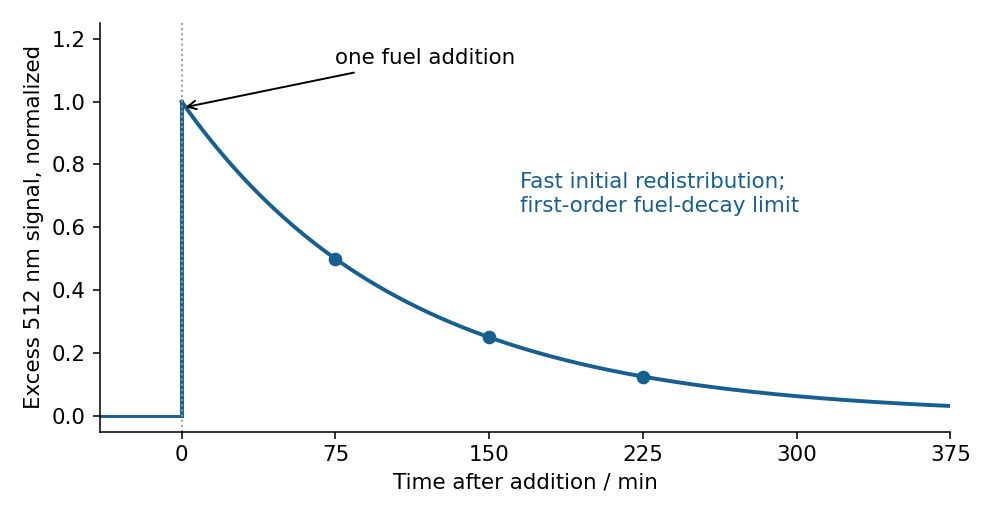
The acid initially protonates 1 and switches the system into the lithium-bound reporter state, so 512 nm intensity rises rapidly. The resulting carboxylate then decarboxylates irreversibly. Its carbanion removes the proton from 1, giving neutral waste 5 and restoring the original zinc/lithium distribution. Thus the 512 nm signal is a transient pulse followed by recovery to its initial low baseline; no repeated oscillations follow from one fuel addition.
For first-order decarboxylation the surviving fuel-derived carboxylate fraction is with . If proton exchange and metal redistribution are fast, background is subtracted, and the population of the switched state is proportional to remaining protonated 1, the illustrative recovery isHalf the initial excess signal remains after 75 min and one quarter after 150 min in that limiting model. Actual binding equilibria can make the intensity nonlinear in remaining fuel; the supplied half-life fixes the fuel decay, not an exact reporter-intensity law. Monitor H NMR fuel consumption and waste formation alongside the optical trace to distinguish dissipation-driven recovery from photobleaching or simple dilution.
Each primary amine arm of 2 condenses with one aldehyde 1, eliminating three waters overall and forming a tripodal tris(pyridylimine) ligand . The three imine nitrogens and the three adjacent pyridine nitrogens chelate one Fe(II), giving , with three outward-facing terminal pyridines still free. The central tertiary amine is the tethering apex, not a seventh donor in the six-coordinate model.
The Fe coordination is approximately octahedral and is propeller-chiral: three bidentate chelates can have or configuration. Achiral starting components and conditions give a racemic population unless a separate resolving influence is introduced. imine condensation and metal coordination cooperate in subcomponent self-assembly; the metal template selects the convergent ligand arrangement.
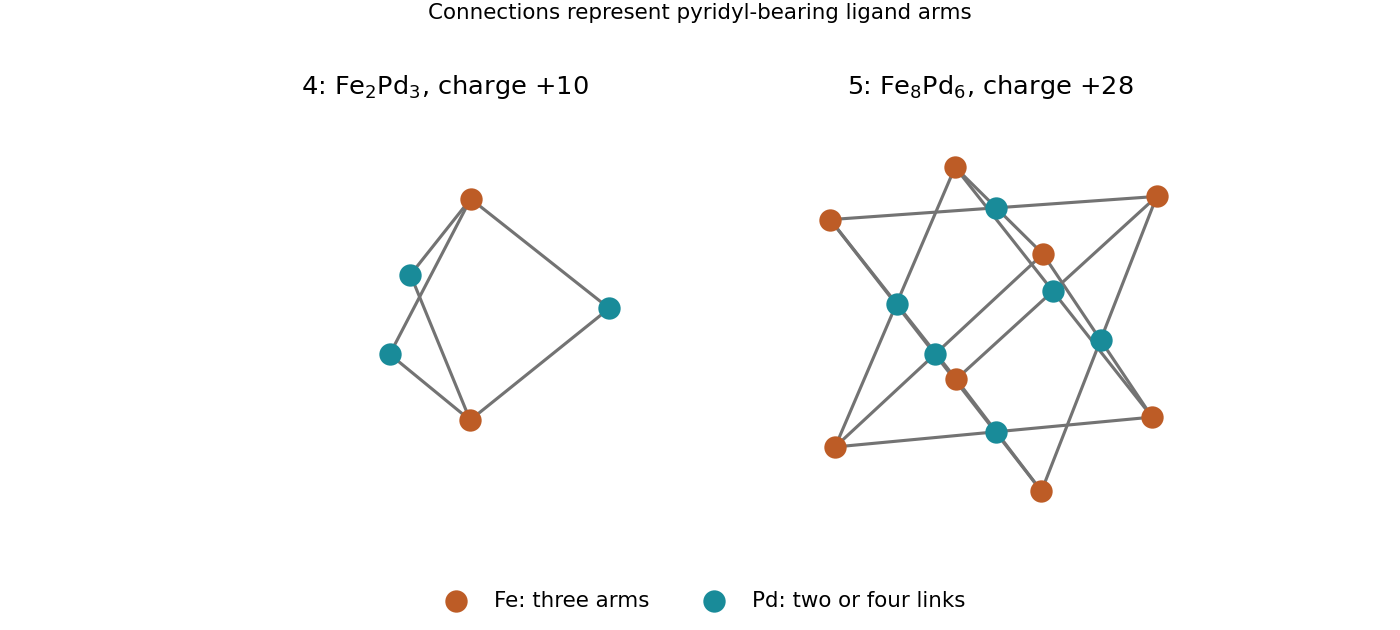
Each Pd(dppp) unit retains its chelating phosphine and offers two adjacent pyridyl binding sites at an approximately right angle. Three such units bridge pairs of metalloligands, giving , a trigonal bipyramid with two Fe vertices and three equatorial Pd vertices. All six outward pyridines are used: . The Pd/Fe ratio is , matching the reagent dose, and the cation charge is because the organic ligands are neutral.
The two donor sites left by dppp are cis, so each equatorial Pd joins one arm from each Fe cap. A mere mass-spectral maximum charge is not an independent structure determination, but its consistency with donor counting and binding geometry strongly selects this model.


An individual bipyramid is chiral. Matching helicities at the two iron centres give the homochiral and enantiomers, with the three spanning connections winding in opposite senses in the two structures. The idealized molecular framework has a threefold axis but no mirror plane, inversion centre or improper rotation that converts it into itself. Achiral synthesis can give a racemic mixture of these chiral cages; racemic bulk composition does not make each cage achiral. The corresponding experimentally characterized methyl-substituted Fe–Pd bipyramid contains both homochiral enantiomers in its crystal.[ref]
Without a blocking diphosphine, square-planar Pd(II) can bind four terminal pyridines. If there are Fe units and Pd centres, saturation requires . The given ratio and charge yield , . Thus has Fe at the eight cube corners and Pd at the six face centres. Each corner Fe connects through its three arms to the three neighbouring face-centre Pd atoms; each Pd accepts four pyridines around its square face.
There are 24 Fe-unit-to-Pd connections, checked independently as . It is useful to distinguish the cube of eight Fe nodes from its dual octahedron of six Pd nodes: both describe the same assembly, with different node sets.
The idealized cage is chiral, with point group , rather than . The eight iron tris-chelate units have the same helicity within one cage; the two enantiomers are all- and all-. The fourfold axes pass through opposite Pd face centres, and the threefold axes pass through opposite Fe corners. There are also proper twofold rotations through opposite cube-edge midpoints. These proper rotations preserve the local handedness. Mirror planes, inversion and improper rotations would reverse each Fe propeller and are absent from an individual homochiral cage. The proper cubic group has 24 operations: , , , along the face axes and along edge axes. Real conformations and crystal packing can lower this idealized molecular symmetry.
The six diphosphines bind the six Pd centres, occupying two adjacent sites on each and displacing two pyridines per Pd. Reassembly therefore favours the two-connected Pd nodes of the bipyramid instead of the cube's four-connected nodes. The balanced transformation isThus two cages of type 4 and four free metalloligands of type 3 form per cage 5. iron, palladium, ligand and charge balances all close. Strong phosphine chelation drives the donor replacement, while the release of additional discrete species can favour entropy. The analogous conversion is observed experimentally in the cited heterobimetallic system.[ref]
Articles by others on the same topic
There are currently no matching articles.