For , put with . Since , both signs in the quotient change andIt is finite and positive for nonzero incident energy and finite width: this is quantum tunnelling. In a thick barrier . Inside, the scattering wave is a combination , not an isolated real decaying exponential; their complex coefficients allow a nonzero conserved current.
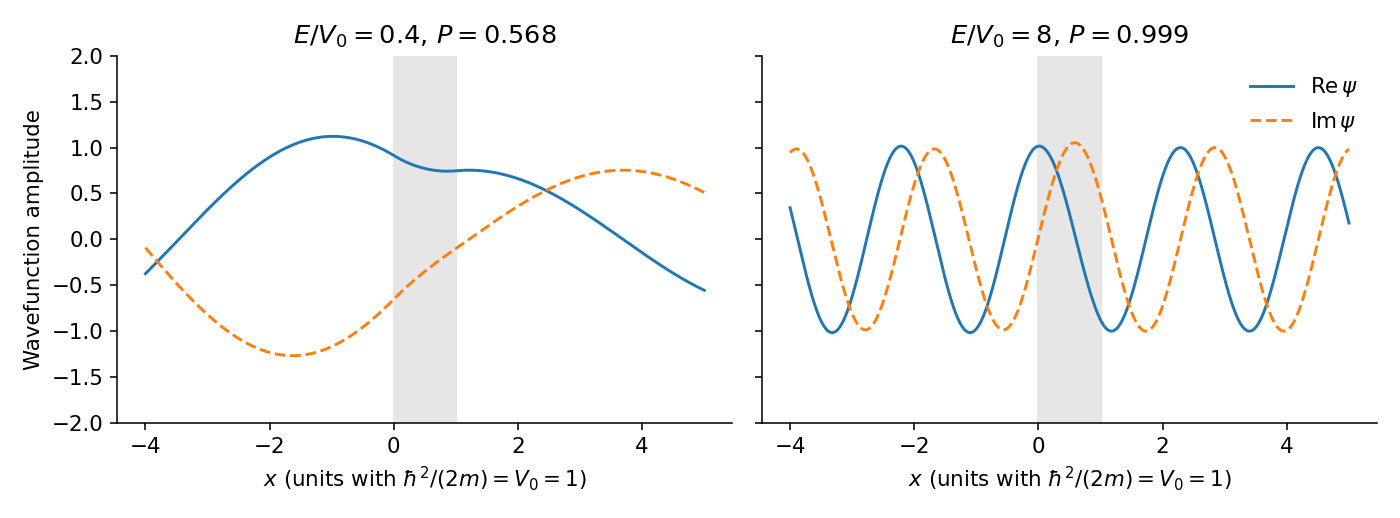

Let . As , while the large denominator term scales as . HenceThe limit is linear in incident energy for fixed positive height and nonzero width. A below-barrier wave has nonzero penetration at finite energy, but that does not imply a finite zero-energy transmitted flux.
For , expand the reciprocal to obtainRetain the exact in the bounded oscillatory factor unless a further phase expansion is controlled. Reflection is small, with an oscillatory interference correction of order . The wavefunction is nearly a travelling wave throughout; its wave number inside is slightly smaller than outside, so its wavelength is slightly larger there. The reflected wave adds weak standing-wave modulation on the incident side.
Articles by others on the same topic
There are currently no matching articles.