Take incidence from the left and set the reactant and product potentials to zero. The asymptotic scattering boundary conditions are for and for , with . There is no incoming wave from the product side. At each finite potential step, and are continuous for the same mass on both sides.
The probability current isFor the incident and transmitted travelling waves, and . Thus here. If the asymptotic wave numbers differed, the ratio of outgoing to incoming velocities would also be required. Current conservation gives for a real nonabsorbing barrier.
Write inside the barrier. Matching the wavefunction and derivative gives the four equationsFor sub-barrier energy the same equations hold by analytic continuation to imaginary . No coefficient solution is needed for these matching conditions.
For , put with . Since , both signs in the quotient change andIt is finite and positive for nonzero incident energy and finite width: this is quantum tunnelling. In a thick barrier . Inside, the scattering wave is a combination , not an isolated real decaying exponential; their complex coefficients allow a nonzero conserved current.

Let . As , while the large denominator term scales as . HenceThe limit is linear in incident energy for fixed positive height and nonzero width. A below-barrier wave has nonzero penetration at finite energy, but that does not imply a finite zero-energy transmitted flux.
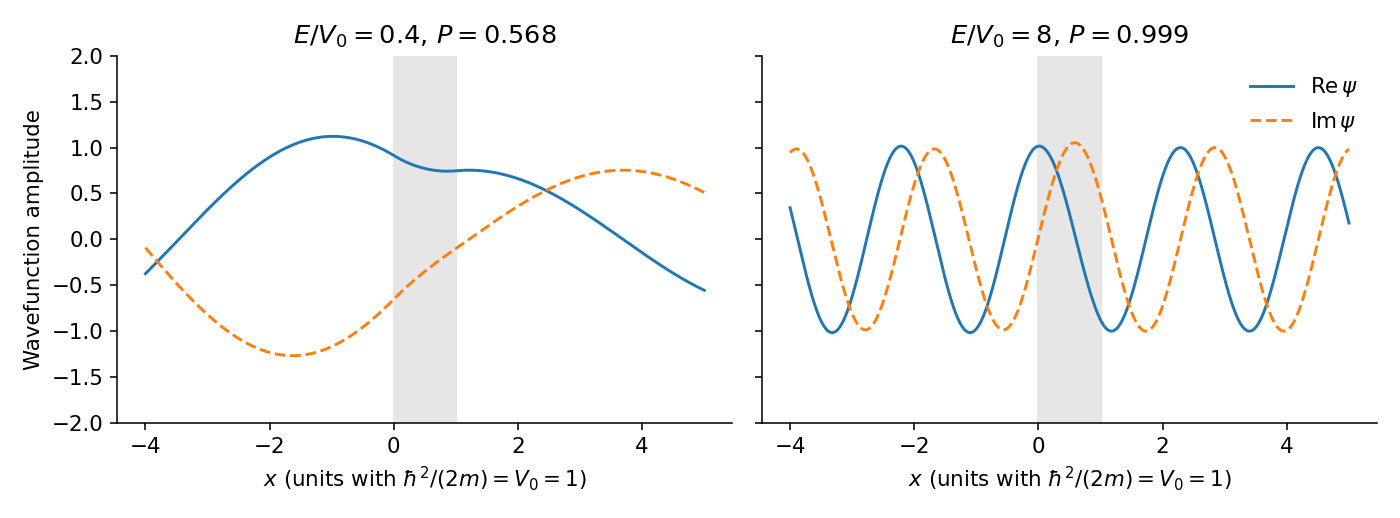
For , expand the reciprocal to obtainRetain the exact in the bounded oscillatory factor unless a further phase expansion is controlled. Reflection is small, with an oscillatory interference correction of order . The wavefunction is nearly a travelling wave throughout; its wave number inside is slightly smaller than outside, so its wavelength is slightly larger there. The reflected wave adds weak standing-wave modulation on the incident side.
For fixed and , while the multiplier of this bounded factor tends to zero as . Consequently , even though the sine factor itself does not have a limit. This is the high-energy classical transmission limit.
The classical transmission probability is ; the convention exactly at the threshold does not affect a thermal integral. Below the barrier it is zero, whereas the quantum result permits tunnelling. Above the barrier it is one, whereas quantum reflection is generally nonzero except at transmission resonances. Both descriptions tend to unit transmission at arbitrarily high energy, and both have zero transmitted probability in the zero-energy limit for this positive barrier.
With and a consistently normalized reactant partition function , the one-dimensional channel formula isClassically the integral starts at , givingAn infinite free reactant half-line has no finite canonical population, so define a reactant normalization length , for which . Then . Equivalently is a one-dimensional thermal flux per unit reactant density, with dimensions of velocity. A rate constant without either this normalization or a specified reactant well is not dimensionally complete.
Choose a reaction coordinate that is negative in the reactant region and positive in the product region; defines a dividing surface. With unnormalized canonical phase-space averaging, defineThe signed initial flux counts both directions, while the later side function tests product commitment. The rate is on a plateau after microscopic recrossings have died away but before reactant depletion and global equilibration become important. The limit instead gives the transition-state-theory positive flux and can overcount trajectories that later return. A suitable dividing surface changes that early flux but not a correctly evaluated committed plateau rate. This correlation formulation provides the dynamical correction to a transition-state estimate.[ref]
Statistical mechanics of isomerization dynamics in liquids and the transition state approximation by David Chandler. Journal of Chemical Physics 68, pp. 2959–2970: rate correlation functions and recrossing
Take with . A trajectory crossing to the right at the barrier top goes downhill on exit and cannot return in this model. Its initial Boltzmann weight contains ; negative-velocity trajectories are on the reactant side at the commitment time. ThereforeDividing by the same gives the result in the energy-integral calculation. No width appears in the classical rate because every classically allowed trajectory passes through the flat barrier.
Put the dividing surface at . The immediate positive flux includes all positive momenta and gives , an overestimate. Trajectories with hit the barrier, return across this surface, and cease contributing to the later product-side indicator. After their recrossing transient, only survives:The exact rate is again unchanged; the transmission correction to the reactant-side transition-state estimate is . The return time depends on surface placement and velocity, so the plateau means a timescale-separated limiting flux, not the claim that every trajectory has one identical finite recrossing time.
Articles by others on the same topic
There are currently no matching articles.