Expanding the squared Euclidean norm givesIn lifted coordinates , this is the closed half-spaceEvery labelling of the original points obtainable by a Euclidean ball is therefore obtainable on their lifted images by an affine linear classifier. The feature map is injective, since it preserves the first coordinates; distinct original points remain distinct. If the original points are shattered, every labelling of the lifted points is realized, as required.
Here “linear separator” means a separator with an intercept, namely an affine hyperplane. If a convention demands strict separation on the finite sample, increase the constant term of the positive score by a sufficiently small positive amount. Positive points then have strictly positive score, and the finitely many negative scores remain strictly negative. A homogeneous separator can alternatively be obtained after adjoining one more constant coordinate; this distinction matters for dimension counts.
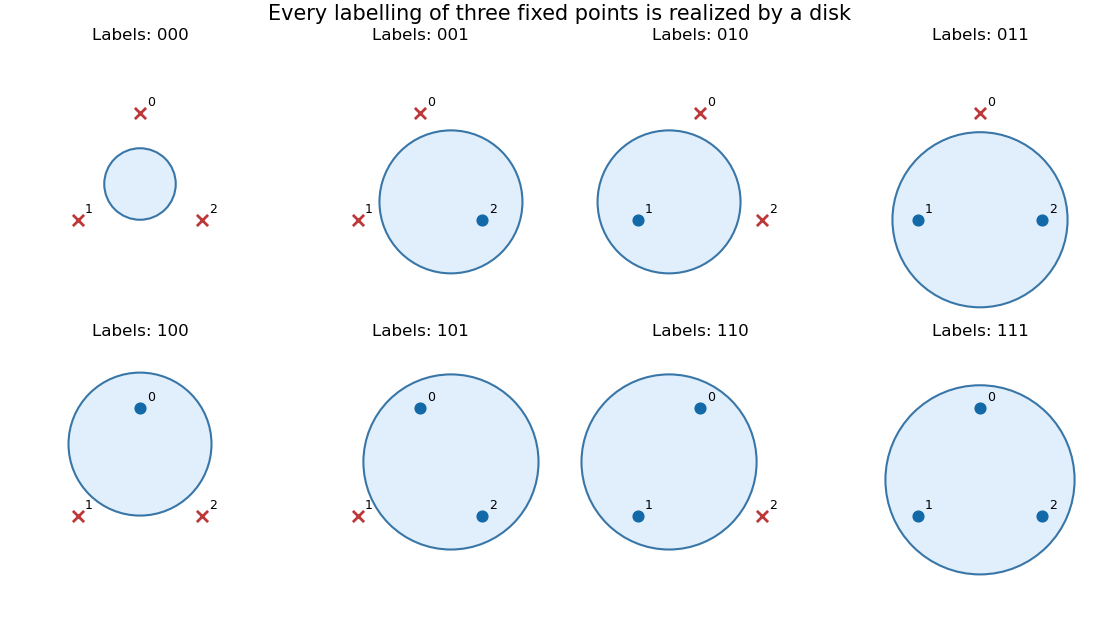
For , take the vertices of a regular simplex in , centered at zero and scaled so that . For example, realize them asin the -dimensional vector subspace , identified isometrically with . These vertices are affinely independent.
Assign arbitrary desired signs , positive for inclusion. Affine independence implies that there is an affine function with for every : the interpolation conditions form an invertible linear system. For a sufficiently small , chooseAt every vertex,Thus the Euclidean ball contains exactly the positively labelled vertices, with none on its boundary. This construction also covers the all-positive and all-negative labellings. Therefore

An affine linear classifier in has VC dimension . The upper bound follows from the intersecting convex hull partition theorem: for any points, label the two parts oppositely. The two convex hulls cannot be strictly separated by an affine hyperplane, since they intersect. A weak boundary convention gives the same contradiction: an affine score is nonnegative on the positive convex hull and strictly negative on the negative convex hull. The lower bound comes from the affinely independent vertices of a simplex, because an affine score can interpolate arbitrary signs there.
Consequently, parts (i) and (ii) immediately giveThe one-sided orientation of the lifted separators permits the sharper, exact conclusionTo prove the remaining upper bound, take any distinct points and a nonzero affine dependence as in part (c). Write . Reverse every coefficient if necessary so that . Prescribe positive labels when and negative labels when ; zero coefficients may be labelled arbitrarily. If a Euclidean ball realized these labels, its score would satisfyIndeed, every positive-coefficient term is nonnegative and every negative-coefficient term is strictly positive, with at least one of the latter. On the other hand, expanding the score and using the two affine dependence identities givesa contradiction. No points are shattered, completing the exact determination of the VC dimension of Euclidean balls. In the exceptional zero-dimensional Euclidean space, every positive-radius Euclidean ball is the whole singleton space, so the VC dimension is zero.
Articles by others on the same topic
There are currently no matching articles.