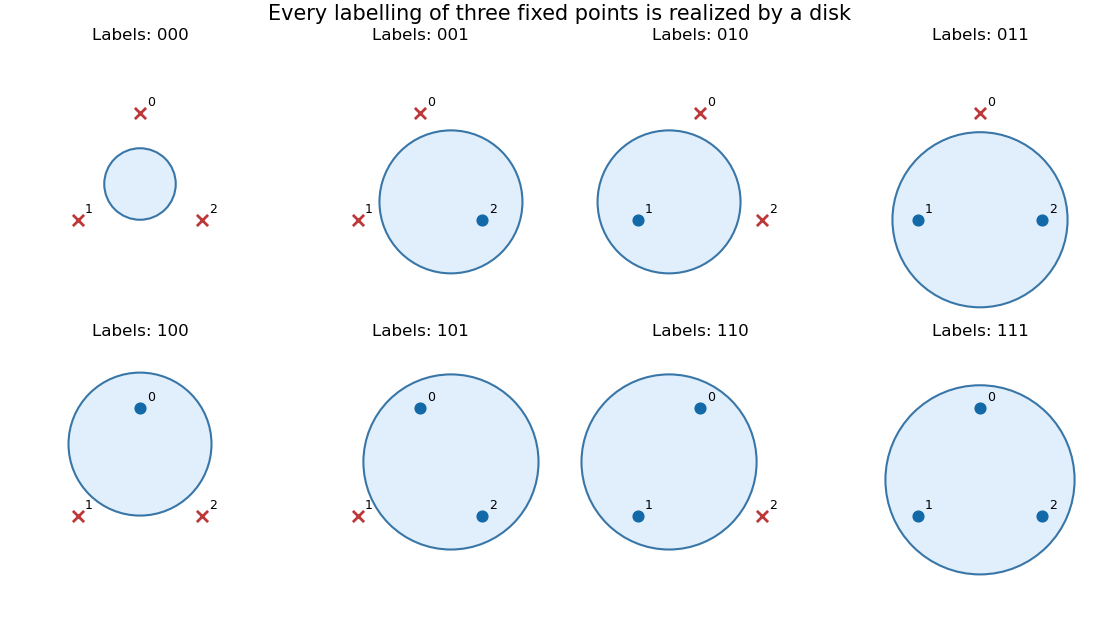
For , take the vertices of a regular simplex in , centered at zero and scaled so that . For example, realize them asin the -dimensional vector subspace , identified isometrically with . These vertices are affinely independent.
Assign arbitrary desired signs , positive for inclusion. Affine independence implies that there is an affine function with for every : the interpolation conditions form an invertible linear system. For a sufficiently small , chooseAt every vertex,Thus the Euclidean ball contains exactly the positively labelled vertices, with none on its boundary. This construction also covers the all-positive and all-negative labellings. Therefore

Articles by others on the same topic
There are currently no matching articles.