Write for the table. The positive initial planning fluents read from the original figure areThe static type facts are , and ; the table is not a block. With an explicit table-availability predicate, take to be permanently true. Under the closed-world assumption, all other well-typed initial planning fluents are false; in particular, is not clear.
The goal is the partial-state conjunctionIt need not redundantly prescribe every final fact. With only these three blocks and a valid blocks world state, the completed stack also places on the table and leaves clear.
Use direct-transfer STRIPS actions: one action includes picking up a block and putting it down again. There is no separate holding state. Ground as distinct blocks and as a support, either a block or the table, with and .
For , takeThe preconditions ensure that can be picked up and that the destination has room. Moving it frees a block source and occupies the destination, while persists. When , table availability remains true; its redundant addition is simply omitted. Since is fixed in each ground action, this case distinction constructs ordinary add lists rather than introducing conditional action effects. The search transition model is .
Ground as distinct blocks. For , takeThus a clear block leaves its block support, makes that support clear, and joins the unlimited table. persists, and table availability is never deleted. Requiring to be a block excludes a redundant table-to-table action. The static predicates need not be stored as time-varying planning fluents.
If one first constructs the obvious isolated plan for , it moves off and then puts on . Now is not clear, so achieving requires taking off , undoing . If one first achieves the isolated directly, it puts on while is still on . To free , it must move , which first requires moving off , undoing . Therefore neither ordering of those independent subplans works while protecting the first achieved goal.
The literal concatenation-only definition in the question is too weak to imply the requested impossibility. A valid plan isThe first two actions constitute a plan for from the original state, and the last action is a plan for from the resulting state, preserving . Thus this is itself a concatenation of the stated kind. Its crucial first action prepares for the later subgoal before completing .
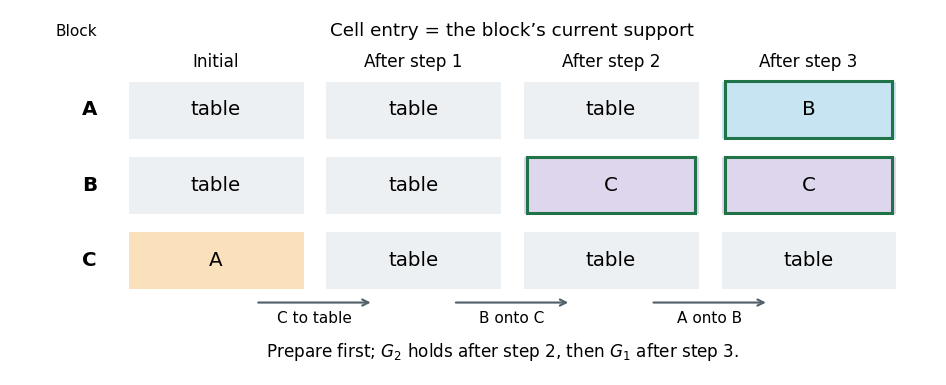

The green-outlined cells mark achieved goal facts. This original solution timeline makes the distinction explicit: independent goal-directed subplanning fails, but unrestricted concatenation does not. To obtain the intended impossibility claim, “non-interleaved” must also forbid anticipatory preparation or require the isolated subplans described above. No source input is missing; the issue is the breadth of the printed definition.
Use a sequential SATPlan encoding with times . The fluent universe isThere are nine support Boolean variables and three clearance Boolean variables per time layer. Static block types, parameter inequalities and permanent table availability are handled during action grounding. For each well-typed ground action from parts (b)–(c), introduce an occurrence Boolean variable for . Allow at most one action per layer, including no action, so that a horizon of encodes at most physical actions.
The complete initial-state formula isEvery well-typed fluent not initially true is explicitly false. The final goal formula is simply . Leaving unrelated final facts unconstrained is appropriate; leaving unrelated initial facts unconstrained would introduce imaginary starting states.
For each , include all action precondition axioms , after removing static true conditions. For example,The precondition axiom for similarly requires .
For every fluent , let be the logical disjunction of actions at adding , and the logical disjunction deleting it. Include the successor-state axiomIt combines action effects with the frame axiom, preventing unsupported changes. A fully grounded example isApply the same construction to every support and clearance fluent, using the exact add/delete lists. If no action occurs, both effect logical disjunctions are false, so all fluents persist.
The sequential action exclusion axioms are for every pair of distinct grounded actions . For example,forbids selecting those two occurrences together. Do not add a requirement that some action occur in every layer: that would remove idle padding and change “at most ” into an exact-length requirement. One may additionally include true planning state invariants, such as a block having at most one support and a block support carrying at most one block; the unlimited table must be exempt from the latter restriction.
Finally, conjoin , , and all precondition, successor and exclusion formulas over the layers to obtain . It is a propositional formula; if a solver requires conjunctive normal form, use a satisfiability-preserving Tseitin transformation with auxiliary Boolean variables. The equivalence between this encoding and real action sequences follows from sequential SATPlan correctness: a satisfying assignment induces exactly the stated STRIPS trajectory, and every sufficiently short valid plan supplies such an assignment.
Read the satisfying assignment in increasing time order. In layer , output the unique ground action whose occurrence Boolean variable is true, or output nothing if all are false. Discard idle layers. The result is a sequence of at most actions.
For correctness, the layer-zero planning fluents are exactly the actual initial state. The action precondition axioms make the selected action applicable, while the successor-state axioms give precisely its add/delete update; the action exclusion axioms prevent simultaneous competing actions. By induction, every following time layer is the real state reached by the decoded prefix. The final goal formula therefore proves that the extracted plan reaches both required goals.
Conversely, execute any valid plan of length at most , assign each layer its actual fluent values and pad with idle layers. These values satisfy every component of . In this instance, decoding the three-action trajectory in part (d) gives a model at and at every larger horizon after padding; direct state-space and propositional checks find no model for .
Articles by others on the same topic
There are currently no matching articles.