A Bravais lattice is an infinite periodic set of equivalent points , with integer and independent primitive translations . It describes translation symmetry, without assigning a chemical species to a point. An atomic basis of a crystal is the motif of atoms, with their species and relative positions, repeated identically at every lattice point. The resulting crystal structure consists of the lattice decorated by that basis; the basis can contain several atoms even when the lattice is primitive.
A primitive unit cell tiles space under lattice translations and contains exactly one lattice point, counting shared boundary points fractionally. Its volume is . A conventional unit cell is chosen to display useful crystal symmetry and may contain several lattice points. Thus a centered conventional cell is not primitive, but the crystal still has a primitive cell. Neither cell size nor the number of dots drawn on its boundary should be confused with the number of atoms in the crystal basis.
Use fractional coordinates relative to conventional cubic vectors . A body-centered cubic lattice has representative pointsso its conventional cell contains two lattice points: eight shared corners contribute one and the interior point contributes one. A face-centered cubic lattice hasso its conventional cell contains four: one from the shared corners and three from six half-shared faces.
For atoms at fractional positions , the geometric structure factor and the atomic-factor-weighted amplitude are respectivelyFor identical atoms . Applying the conventional-cell lattice factors givesandThese are lattice selection rules; an additional nontrivial crystal basis structure factor can extinguish further allowed reflections.
Of the eight equally represented parity triples, four satisfy the BCC condition and two the FCC condition. Thus the fractions among integer index triples are and , respectively. This reflects the two and four equivalent lattice points in the conventional cells: their reciprocal lattices occupy corresponding subsets of the conventional reciprocal grids. In primitive reciprocal coordinates every integer triple denotes a reciprocal-lattice vector; lattice-centering absences are then built into the grid rather than an extra rule. A multi-atom chemical basis can still cause genuine additional absences. If permutations means merely reordering one fixed triple, its allowedness never changes: the quoted fractions concern all index triples, not reordering a chosen .
After compression along , let the original conventional edges be with . This gives exactly the specified volume reduction. The compressed FCC points admit the alternative translation vectorsThey are mutually perpendicular, have equal length , and form a right-handed cube. Besides its corners, the lattice has the pointwhich is the compressed image of an original FCC face centre. All compressed FCC sites are generated by the cube's integer translations and this body-centre coset. ThereforeThe old compressed tetragonal conventional cell has volume and four sites; the new BCC cube has half that volume and two sites. This verifies the same physical site density rather than silently losing atoms during the change of cell. The continuous uniaxial deformation is the Bain path, named for Edgar Bain.
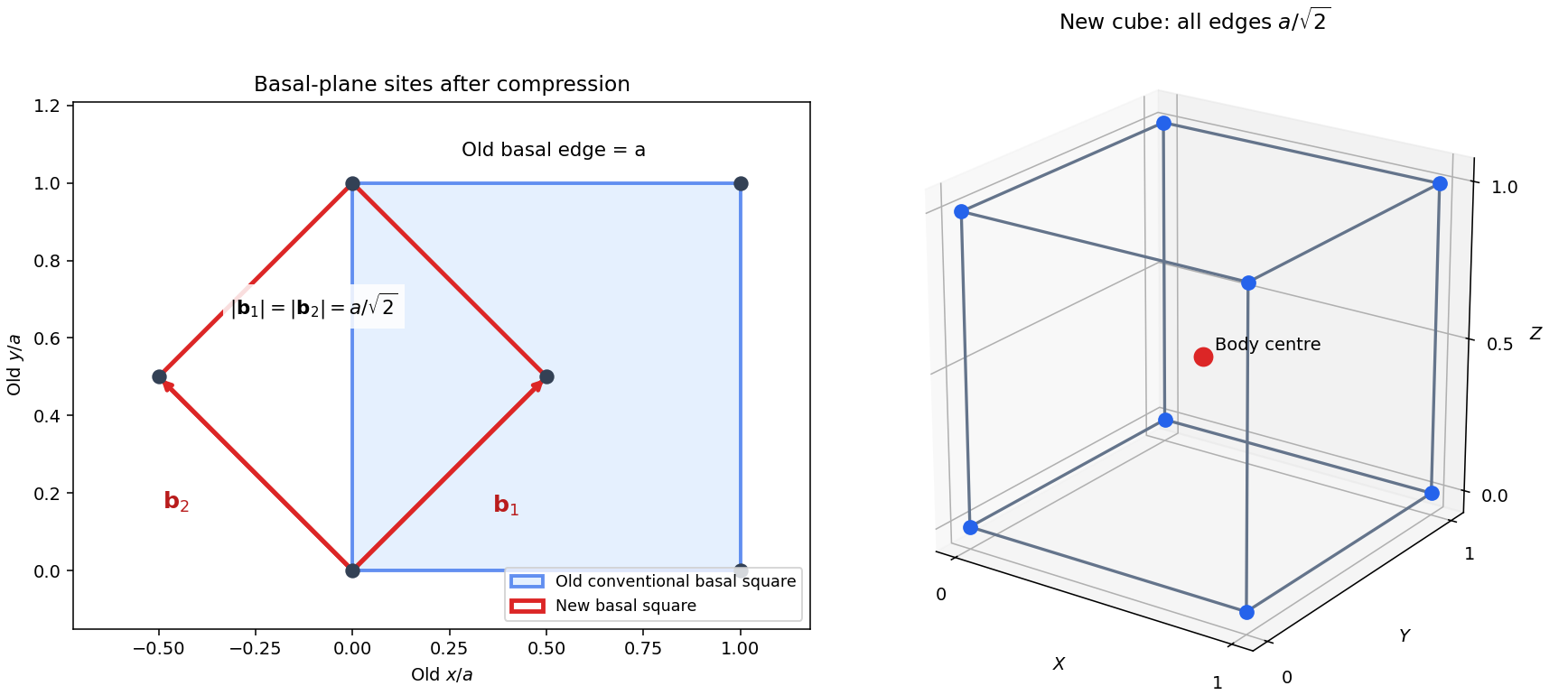

The FCC parity rule forbids and and allows and . To follow each same plane family through the deformation, use fractional coordinates in the compressed old cell and in the new cube. The preceding vectors giveThus becomes , withCrucially, this transformation retains the plane spacing and diffraction order, not just a normal direction:
| Old FCC reflection | New-cell reciprocal coordinates | Status |
|---|---|---|
| Not a new reciprocal-lattice vector; absent | ||
| Odd index sum; absent | ||
| Even index sum; allowed | ||
| Even index sum; allowed |
The two physically allowed reflections remain allowed, and the two absent ones remain absent. Their angles and spacings change under strain; their allowedness as tracked reciprocal vectors does not.
The half-integer entry is deliberate. It cannot be relabeled as the ordinary BCC reflection while claiming to track the same diffraction order. Multiplying its indices by two doubles the reciprocal vector and halves the spacing; that new allowed reflection is the image of old FCC , not old . If only an orientation label is wanted, the old and planes both have the new orientation, but are distinct orders. This is the distinction between diffraction indexing under a cell change and merely reducing a plane normal to the smallest integer ratio.
Articles by others on the same topic
There are currently no matching articles.