Take as fractional coordinates in the chosen unit cell. In the kinematic approximation the crystal basis structure factor isEquivalently, in Cartesian coordinates the phase is . Reversing every phase sign complex-conjugates the nonabsorbing amplitude and leaves its intensity unchanged. The atomic scattering factor is the Fourier transform of the atom's electron density, in electron scattering units:At zero scattering angle the normal form factor counts electrons: for a neutral atom, modified by the ionic charge for an ion. At increasing , different parts of the electron cloud scatter with different phases, reducing the coherent amplitude. Typical nonresonant atomic curves fall from their forward value toward small values at large angle. A localized cloud falls more slowly in reciprocal space. Anomalous scattering near an absorption edge adds energy-dependent complex terms and is excluded from this simple sketch.
For a fixed reflection and fixed instrumental and geometric corrections,The full amplitude also contains the lattice sum. At its reciprocal-lattice peak, coherently illuminated identical cells give a peak amplitude ; peak height and integrated peak intensity have different size dependences because the peak narrows with crystal size. Powder multiplicity, polarization, absorption, thermal motion and measurement geometry also affect observed intensities. The basis factor determines relative interference, not every experimental prefactor.
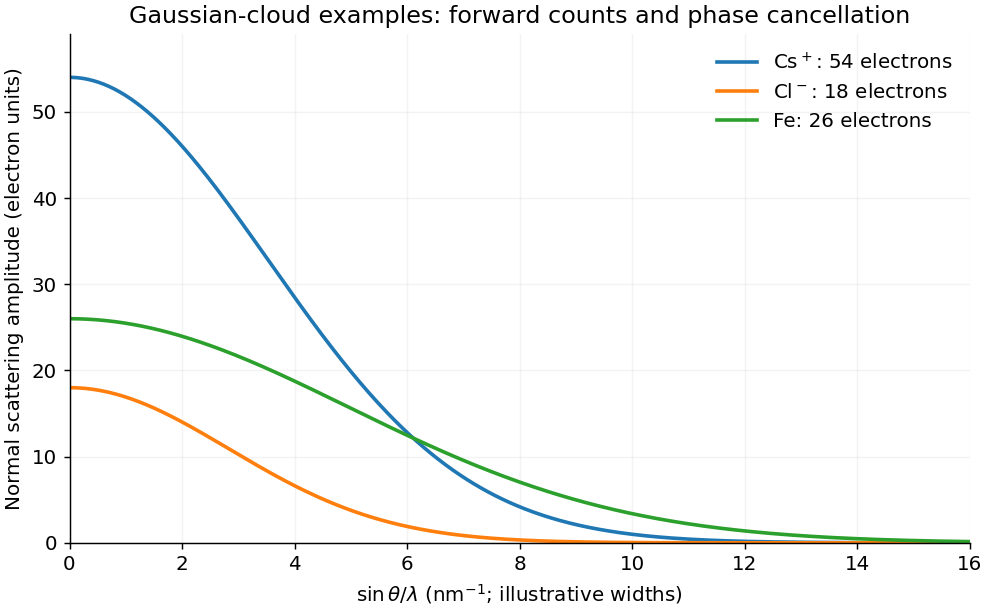
Forward electron counts and decreasing atomic scattering amplitudes
. Original Gaussian-cloud illustrations for Cs+, Cl- and Fe, with their correct electron counts at zero transfer. Cloud widths are illustrative rather than tabulated atomic form-factor fits; the horizontal variable increases with scattering angle at fixed wavelength. Details.
Articles by others on the same topic
There are currently no matching articles.