Take as fractional coordinates in the chosen unit cell. In the kinematic approximation the crystal basis structure factor isEquivalently, in Cartesian coordinates the phase is . Reversing every phase sign complex-conjugates the nonabsorbing amplitude and leaves its intensity unchanged. The atomic scattering factor is the Fourier transform of the atom's electron density, in electron scattering units:At zero scattering angle the normal form factor counts electrons: for a neutral atom, modified by the ionic charge for an ion. At increasing , different parts of the electron cloud scatter with different phases, reducing the coherent amplitude. Typical nonresonant atomic curves fall from their forward value toward small values at large angle. A localized cloud falls more slowly in reciprocal space. Anomalous scattering near an absorption edge adds energy-dependent complex terms and is excluded from this simple sketch.
For a fixed reflection and fixed instrumental and geometric corrections,The full amplitude also contains the lattice sum. At its reciprocal-lattice peak, coherently illuminated identical cells give a peak amplitude ; peak height and integrated peak intensity have different size dependences because the peak narrows with crystal size. Powder multiplicity, polarization, absorption, thermal motion and measurement geometry also affect observed intensities. The basis factor determines relative interference, not every experimental prefactor.
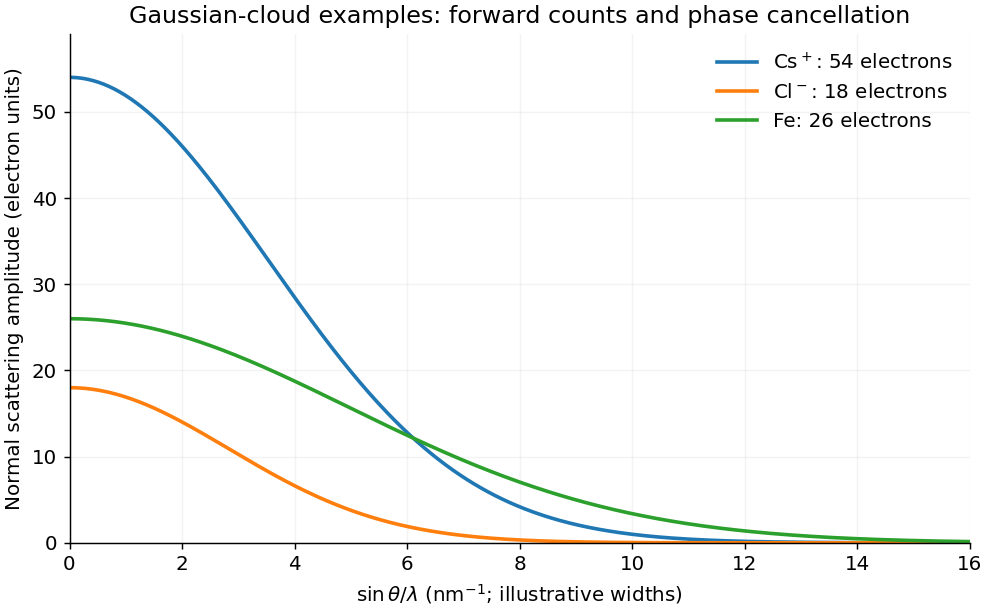
Forward electron counts and decreasing atomic scattering amplitudes
. Original Gaussian-cloud illustrations for Cs+, Cl- and Fe, with their correct electron counts at zero transfer. Cloud widths are illustrative rather than tabulated atomic form-factor fits; the horizontal variable increases with scattering angle at fixed wavelength. Details.
The two sites give phases one and . ThusFor real nonresonant form factors, even gives the square of the sum and odd the square of the difference. The factor represents the remaining experimental corrections, not another basis-interference term. Since the two ions differ, a half-body-diagonal translation does not preserve the decorated crystal. Its Bravais lattice is therefore simple cubic, with a two-ion basis; CsCl is not a monatomic body-centered cubic Bravais lattice.
Replacing both sites by identical Fe atoms changes the amplitude toNow the body-centering translation does preserve the structure. It is a body-centered cubic lattice with one Fe atom per primitive cell, or two per conventional cubic cell.
For 111 the parity is odd: CsCl generally has a nonzero amplitude , whereas the identical-Fe 111 reflection is systematically absent. A numerical absolute CsCl intensity requires the angle-dependent form factors and experimental normalization; no such values are supplied. Forward electron counts, 54 for Cs+ and 18 for Cl-, explain why their amplitudes are substantially unequal, but are not substituted for the actual finite-angle factors without an additional approximation.
The isothermal volume compressibility is . For isotropic cubic compression and , soDifferentiate Bragg's law at fixed incident wavelength and fixed reflection:This derivative uses radians. It remains locally valid with a pressure-dependent compressibility, provided the cubic isotropic phase is retained. For a constant stipulated , integration givesThus is only the first-order approximation, not the exact consequence of a constant logarithmic compressibility. The finite-pressure calculation also assumes that the reflection still exists, the crystal remains in the same structure and . These limitations matter for a large extrapolation.
The 110 plane spacing of the conventional cubic cell isFor the first-order Bragg condition,The quoted experimental deflection is twice the angle between the beam and the reflecting planes; reporting only would report the Bragg angle instead of the requested scattering angle. The 110 reflection is allowed for the identical-Fe body-centered lattice because is even. Wavelength and spacing have been expressed in the same units, so their ratio is dimensionless. Higher Bragg orders are conventionally represented by the corresponding higher-index reflection, rather than inserted as an unannounced extra order here.
Use the integrated constant-compressibility model from c, with :ThereforeCompression reduces the spacing and moves the same allowed reflection to larger deflection, as the positive pressure derivative predicts. The input compressibility corresponds to a constant bulk modulus GPa in this ideal model.
This is the stipulated unchanged cubic-phase, constant-compressibility extrapolation, rather than a reliable prediction for real Fe at 100 GPa. Real Fe exhibits a pressure-induced body-centered-cubic to hexagonal-close-packed transformation, and compressibility can change with pressure.[ref]
https://journals.aps.org/prb/abstract/10.1103/PhysRevB.78.220101. 2008 primary diffraction study, abstract: pressure-driven structural transformation in Fe
A real high-pressure diffraction interpretation would require its actual phase and equation of state. The source gives neither, so its numerical exercise is answered within its explicitly stated idealization. Articles by others on the same topic
There are currently no matching articles.