With equal constant electron mobility and hole mobility , the sheet electrical conductivity is . In the intrinsic regime, , soIt decreases steeply with increasing on the high-temperature side. There is a small logarithmic curvature rather than a perfectly straight activation line.
In the fully ionized extrinsic regime, charge neutrality and the semiconductor mass-action law give , , henceThis gives a nearly horizontal region passing through . At lower temperatures semiconductor carrier freeze-out decreases the ionized donor density and bends the curve downward again.
To locate that bend realistically, include donor charge-state degeneracy. For a neutral donor with two spin states and an empty donor with one state, the ionized density isSolve for the mobile density. In the asymptotic freeze-out regime, where is negligible and ,Its activation scale is much smaller than the intrinsic scale .
Within the specified interval the low-temperature downturn is modest: , and the partial-ionization equation gives . The sample is not yet deep in the asymptotic freeze-out limit at 30 K. Calibrating the mobility to the stated 200 K value gives representative valuesThe donor statistical weights were not explicitly supplied, so they are a stated assumption for these illustrative curve details; a one-state donor approximation changes the low-temperature rounding but not the three physical regimes or their activation scales.
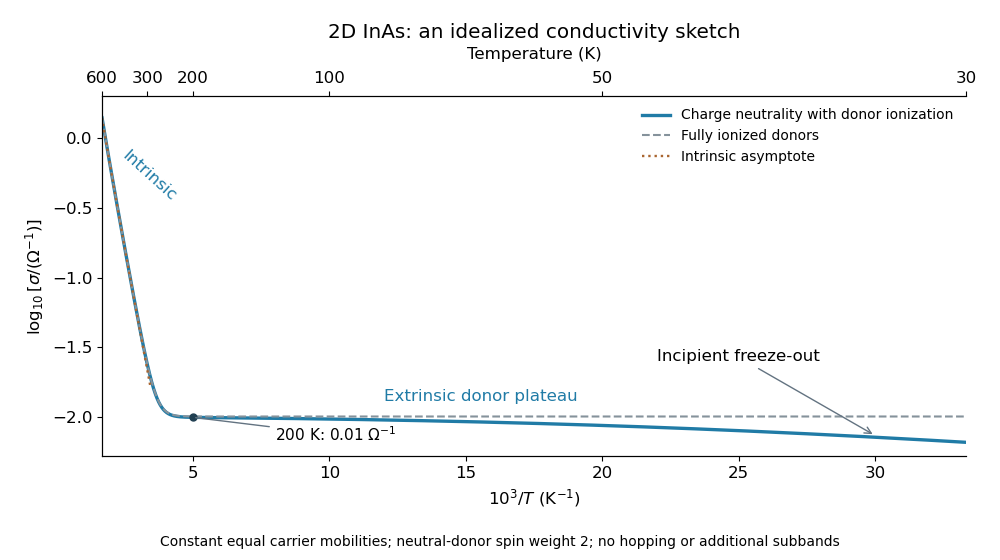
Two-dimensional InAs conductivity from intrinsic carriers to incipient donor freeze-out
. Original ideal-model calculation using the supplied gap, masses and donor density, the derived 2D donor binding energy, twofold neutral-donor spin weight and equal temperature-independent carrier mobilities. The vertical scale is normalized to the stated 200 K conductivity. The plotted range is 30 to 600 K; donor freeze-out is only beginning at its cold end. The dashed line is the fully ionized extrinsic approximation. Details.
Articles by others on the same topic
There are currently no matching articles.