The cover establishes Part B, Trinity Term 2019, 13 June 2019, A13485W1; the annual bundle's 2018 filename does not determine the examination year. This is distinct from the Part C major option. All four questions are solved. Use SI magnetic susceptibility, , and write for the elementary electric charge. In question 3, and are densities per area, and the band model has one parabolic extremum per carrier species with twofold spin degeneracy.
A Bravais lattice is the set of pointswhere the primitive lattice translation vectors are linearly independent. Every lattice point has the same translational environment.
An atomic basis is the motif of atoms attached to each point of the Bravais lattice, specified by positions and atomic species. The full crystal consists of atoms at , with . The Bravais lattice describes translations; the atomic basis describes what is repeated. A primitive cell contains one lattice point but can contain several atoms.
Put . DefineThe scalar triple product gives . Consequently every integer combination satisfiesThis proves that the proposed vectors generate points in the reciprocal lattice, but primitiveness also requires the converse. Let satisfy the exponential condition for every lattice vector, and in particular for . ThenSince the form a basis of three-dimensional space, the vector has the same dot products with each as . Their difference is orthogonal to three independent vectors and is zero. Henceand no additional reciprocal lattice vectors lie outside that integer span. Thus the are primitive, not merely three possible reciprocal translations.
Translate the integration variable by an arbitrary lattice vector and use the periodicity of :Thus for every . A nonzero coefficient requires for every lattice translation, which is precisely the defining condition for .
For an infinite crystal the integral is a Fourier transform of a periodic distribution, rather than an ordinary convergent integral. More explicitly, the Fourier seriesgivesThis is the precise meaning of zero away from the reciprocal lattice. A finite specimen instead has broadened reciprocal-lattice peaks of a finite crystal; exact delta-function support is an infinite-periodicity idealization.
Separate the entire-system atom index into a cell translation and an index within a single primitive unit cell. The potential becomesThe same is used in every translated cell because the atomic basis repeats. Normalize plane waves in volume by . For , substitution and giveFor a real static scalar potential, define the atomic scattering factor in the positive-exponent convention of the question byThe second bracket in the matrix element is . At a reciprocal lattice vector every term of the first bracket is one, giving the number of cells . Therefore the stated transition-rate rule, equivalently the first Born approximation and Fermi's golden rule up to the final-state kinematic factors, yieldsThe harmless complex conjugation records the distinction between the source's positive-exponent Fourier transform and the usual positive-exponent incoming plane wave. Reversing every Fourier sign gives the equivalent amplitude convention. Only the cell-translation sum ranges over the full crystal; the crystal basis structure factor contains the atoms of one cell.
In cubic coordinates write . The face-centred cubic selection rule allows integer triples only when are all even or all odd. One way to derive it is to sum the four conventional-cell lattice positions:This vanishes for mixed parity and equals four otherwise. The two-atom diamond atomic basis adds the factorFor all-odd indices this is nonzero. For all-even indices it vanishes when and survives when the sum is divisible by four: this is diamond-basis diffraction extinction.
Exclude the forward beam and order the remaining families by . The first is , with squared length three. The candidate , with squared length four, is extinguished by the diamond atomic basis. The next allowed family is , with squared length eight. ThusFor fixed incident wavelength, increases with scattering angle, so these are the two lowest-angle powder rings. The two atoms are counted per primitive cell; a conventional silicon cube contains four lattice points and eight atoms.
The Einstein model of a solid replaces the vibrations of identical atoms by independent quantum harmonic oscillators with a common frequency . Each atom has three displacement directions; the restoring force is harmonic, coupling between different atoms is replaced by a fixed local restoring potential, and anharmonicity and frequency dispersion are neglected. The crystal volume and are held fixed when calculating the vibrational heat capacity at constant volume.
The one-oscillator partition function isConsequently, with ,Differentiating at fixed volume givesThe zero-point energy does not contribute to this derivative. The result tends to the Dulong-Petit law at high temperature and vanishes exponentially at low temperature; the latter is a limitation of the single-frequency model for a real acoustic spectrum.
Apply the given small- expansion with to the internal energy, including its zero-point energy:The temperature-independent terms cancel. Taking the derivative gives the Einstein high-temperature heat-capacity expansionThusThere is no correction to the heat capacity even though the internal energy has a correction.
Use the ratio of the two measured coefficients so that the sample size cancels:HenceThe units of the coefficient are , so that its division by has the same heat capacity units as the leading term.
The leading coefficient fixes the atom count:With molar mass , the sample mass isOne atom belongs to each primitive unit cell of monatomic argon on a face-centered cubic lattice, but the conventional cube contains four atoms. If its side is , , and nearest neighbors lie across half a face diagonal. Thereforeusing . The corresponding conventional lattice constant is . Treating the source's one-atom cell as the conventional cube would omit the factor four and give a wrong nearest-neighbor distance.
For one Cartesian displacement, the harmonic potential is . At , the equipartition theorem assigns to this quadratic potential term. HenceThis is a one-coordinate mean squared displacement, not the total three-dimensional displacement variance, which is three times larger in the isotropic model.
For comparison, the exact Einstein mean-square displacement isUsing recovers the requested high-temperature result. Its nonzero zero-temperature limit is the displacement contribution of the zero-point energy.
Square the stated Lindemann melting criterion and insert the high-temperature displacement:Thus, with ,Here , so the use of the high-temperature approximation is only moderately justified. It is an estimate, not a controlled limit. Retaining the exact Einstein mean-square displacement in the same heuristic criterion gives about , indicating the size of that particular correction. The empirical threshold and the independent-oscillator model introduce additional uncertainty.
The Boltzmann carrier density of a two-dimensional parabolic band can be derived directly. Use one isotropic parabolic conduction band, , with two spin states per wave vector. In the nondegenerate limit the Fermi-Dirac distribution reduces to its Boltzmann factor. The number per area is thereforeThe integral uses . ThusEquivalently, the two-dimensional density of states is constant, , and with . These expressions include twofold spin degeneracy and one valley. With a general total band degeneracy , replace the factor by ; extra valleys or occupied confinement subbands would change the coefficient.
Near a parabolic valence band maximum , the missing-electron effective mass is . The same two-dimensional state counting givesMultiplication eliminates the chemical potential, giving the semiconductor mass-action lawFor an intrinsic semiconductor, charge neutrality imposes , soThe intrinsic chemical potential is not exactly midgap when the two effective masses differ: . The exponential suppression still justifies the assumed nondegenerate regime here.
At , the two-dimensional effective density of states values areUsing and givesFor the doped sample, estimate the intrinsic-to-extrinsic crossover by . With the masses and gap held fixed, , whereSolving givesIt is a smooth carrier crossover, not a thermodynamic phase transition. Donors are essentially ionized near this temperature because their binding energy, calculated next, is much smaller than . At substantially higher temperatures intrinsic pairs dominate; below the crossover and above appreciable donor freeze-out, the majority density approaches .
Take the screened Coulomb potential of a singly ionized donor as , with and . The electron's motion is two-dimensional, but its electrostatic interaction is the ordinary three-dimensional interaction restricted to the layer; it is not a logarithmic two-dimensional electrostatic potential.
For the rotationally symmetric bound state, the two-dimensional radial Schrödinger equation isFor , the radial Laplacian is . Cancel the term to obtainThus the positive two-dimensional hydrogenic donor binding energy is four times the three-dimensional effective Rydberg:The decay length is . Normalization, if desired, follows from , giving up to a constant phase. This ideal result neglects finite well thickness, dielectric mismatch at the interfaces and short-range impurity corrections.
With equal constant electron mobility and hole mobility , the sheet electrical conductivity is . In the intrinsic regime, , soIt decreases steeply with increasing on the high-temperature side. There is a small logarithmic curvature rather than a perfectly straight activation line.
In the fully ionized extrinsic regime, charge neutrality and the semiconductor mass-action law give , , henceThis gives a nearly horizontal region passing through . At lower temperatures semiconductor carrier freeze-out decreases the ionized donor density and bends the curve downward again.
To locate that bend realistically, include donor charge-state degeneracy. For a neutral donor with two spin states and an empty donor with one state, the ionized density isSolve for the mobile density. In the asymptotic freeze-out regime, where is negligible and ,Its activation scale is much smaller than the intrinsic scale .
Within the specified interval the low-temperature downturn is modest: , and the partial-ionization equation gives . The sample is not yet deep in the asymptotic freeze-out limit at 30 K. Calibrating the mobility to the stated 200 K value gives representative valuesThe donor statistical weights were not explicitly supplied, so they are a stated assumption for these illustrative curve details; a one-state donor approximation changes the low-temperature rounding but not the three physical regimes or their activation scales.
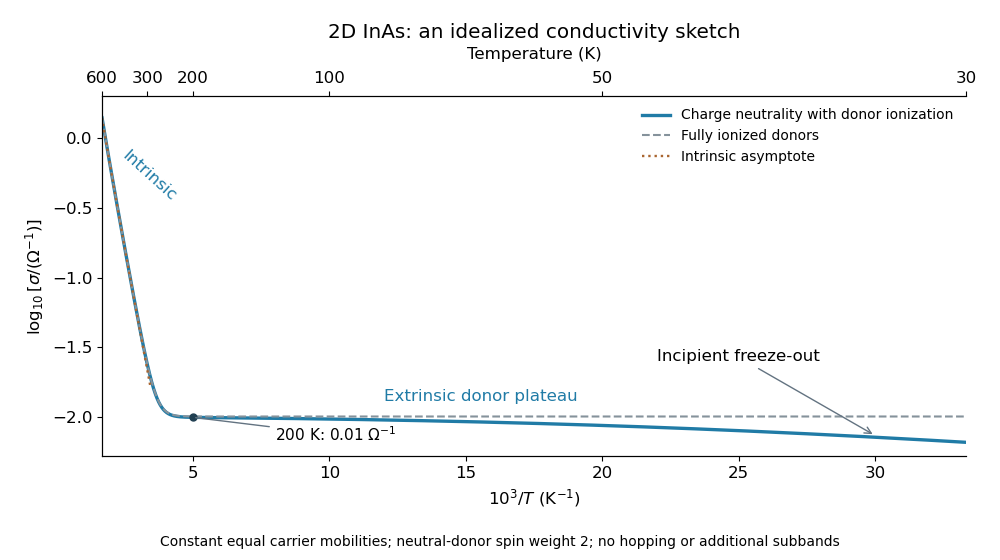
Two-dimensional InAs conductivity from intrinsic carriers to incipient donor freeze-out
. Original ideal-model calculation using the supplied gap, masses and donor density, the derived 2D donor binding energy, twofold neutral-donor spin weight and equal temperature-independent carrier mobilities. The vertical scale is normalized to the stated 200 K conductivity. The plotted range is 30 to 600 K; donor freeze-out is only beginning at its cold end. The dashed line is the fully ionized extrinsic approximation. Details.
A material showing paramagnetism has an induced magnetization in the direction of a weak applied field, giving positive magnetic susceptibility, and no spontaneous magnetization once the field is removed in the paramagnetic phase. Alignment of permanent atomic or nuclear moments is one mechanism.
A material showing diamagnetism develops an induced moment opposing the applied field, giving negative magnetic susceptibility. Closed electronic shells supply a familiar orbital contribution; the response need not require permanent moments.
A ferromagnet has a phase with a spontaneous ordered magnetization below its Curie temperature, produced by cooperative alignment of moments. Its magnetic domains can cancel in a macroscopic zero-field sample, so a measured zero net moment alone does not show that the material lacks ferromagnetism.
The helium atom has a closed electronic shell with total electronic spin and orbital angular momentum zero. The nucleus of helium-4 also has spin zero. At low temperature there is no Curie response from permanent atomic or nuclear moments; the leading atomic response is diamagnetism.
Let denote the number of atoms per volume and let be the mean squared radius of one electron. Use the symmetric magnetic vector potential . Expanding the electron kinetic Hamiltonian gives the quadratic field termwhere isotropy gives . The term linear in orbital angular momentum vanishes in the spherical electronic ground state. ThusFor weak susceptibility, , so the Langevin diamagnetic susceptibility isIf the supplied density is a mass density , use , with the atomic mass unit. The result is approximately temperature independent at fixed density. The factor two for the two electrons is already included; has not been defined as their summed radius.
Let be the magnitude of the saturated nuclear moment of helium-3, with . A spin-one-half nucleus has the two Zeeman energies . For independent nuclei the one-site partition function and magnetization density areIn the weak-field limit , expand the hyperbolic tangent:The nuclear moment's negative sign means that its moment points oppositely to its spin; it does not make the thermal magnetic susceptibility negative. The response is paramagnetism governed by Curie's law.
There is no extra factor here: the stated is the moment of a fully polarized spin-one-half state. Equivalently, writing the moment operator as requires , and . The formula presumes independent localized nuclear moments; exchange correlations invalidate it close to the much lower ordering scale discussed in part (e).
Add the electronic diamagnetism of each helium atom to the nuclear magnetic susceptibility, using the same for both contributions in the helium-3 sample:The density cancels when the two terms balance. The sign-change temperature in the independent-atom approximation is thereforeNo numerical atomic radius was supplied, so the exact numerical value remains conditional on that electronic length scale. Taking , where is the Bohr radius, gives . A slightly more explicit estimate uses the helium variational effective charge , for which a hydrogenic orbital has , givingAbove this scale the electronic contribution is negative and dominates; below it the positive nuclear contribution dominates within the independent-moment approximation. The estimate is not a precision prediction of a real interacting helium phase.
Let be uniform, with dimensionless spin operators . The factor in the source Hamiltonian removes double counting of pairs. Decoupling about a uniform polarization gives the one-site mean-field theory HamiltonianA body-centred-cubic site has eight nearest neighbors and six next-nearest neighbors, soFor a spin one half in this effective field, the mean-field self-consistency equation isLinearizing at the continuous onset gives , henceEquivalently, the general spin- result is . The antiferromagnetic next-nearest-neighbor exchange reduces the uniform ordering scale rather than contributing its absolute magnitude. The negative nuclear g-factor does not change this exchange instability; aligning the spins also aligns their moments with one another.
For these particular competing couplings, the uniform mode is indeed the largest exchange eigenvalue. Writing , and giveswith equality at modulo reciprocal lattice vectors. To see the bound, replace a negative by its absolute value for an upper bound, let , and use . The expression is at most , whose maximum on is five. Thus another modulation does not preempt the stated ferromagnetic onset at this level of mean-field theory. Fluctuations can change the actual transition temperature.
Articles by others on the same topic
There are currently no matching articles.