For a partially filled shell, electron–electron Coulomb repulsion and Hund's rules first favour particular total spin and orbital terms. The crystal field splitting is substantial because these orbitals overlap the ligand environment; it normally exceeds the spin-orbit coupling and often quenches the orbital moment. Competition between the splitting and the electron pairing energy determines high-spin versus low-spin filling. A common hierarchy is Coulomb term energies, then crystal-field and Hund-exchange scales, then spin–orbit and weak-field Zeeman energies; the relative sizes of crystal-field splitting and pairing are material-dependent. Hyperfine coupling, if the nucleus carries spin, adds a smaller splitting. An isolated ion has no inter-ion exchange ordering field.
For a partially filled shell, the outer and shells shield the localized orbitals from the ligands. Coulomb interactions establish through Hund's rules, and spin-orbit coupling usually exceeds the much smaller crystal field splitting. First form a ground multiplet using , then split that multiplet by the crystal environment. The orbital contribution is therefore generally retained, and the g-factor is a multiplet Landé factor rather than an almost spin-only value. Weak external Zeeman and hyperfine interactions can subsequently resolve the remaining states. Exceptions with or unusual valence require separate treatment.
The tetrahedral crystal field splitting places the two orbitals below the three orbitals. In the weak-field, high-spin limit the occupancy is , with . Its lowest cubic term is : an orbital triplet, before spin degeneracy is counted. In the hypothetical sufficiently strong-field limit the occupancy is , with and an orbital doublet . This latter limit requires overcoming pairing/Hund energy; ordinary tetrahedral oxide complexes generally remain high-spin.
Both orbital degeneracies permit a Jahn-Teller effect, so a regular tetrahedron is not a stable static equilibrium in the elementary adiabatic treatment. The sign of a particular distortion requires an electron–lattice coupling model, not just the degeneracy count. To make that dependence explicit, let stretch while contracting . In a leading point-charge quadrupole model write the shiftsIn the high-spin configuration the two shifts cancel. For the remaining electron selects , gaining ; for it selects the doublet, gaining . Adding gives a tetragonally elongated minimum at , with energy gain , versus only along the compressed branch. The elongated branch has an orbital singlet. This is the usual elementary elongation argument; quantitative coupling includes higher crystal-field multipoles and configuration mixing.
For the strong-field configuration the lower orbital is doubly occupied. The shift of the three electrons is , so the same model has both an elongated and a compressed minimum, , with equal stabilization. Elongation favours double occupation of ; compression favours double occupation of . This tetrahedral doublet distortion-sign ambiguity prevents a unique choice from the supplied data. For example, a small symmetry-allowed cubic elastic invariant selects opposite tetragonal signs when changes sign, while leaving the regular-site electronic configuration unchanged. Higher couplings or host constraints are needed to choose. Dynamic motion between equivalent minima may also restore an average regular shape without stabilizing the undistorted adiabatic configuration.
Once a static axial distortion removes the orbital degeneracy, second-order spin-orbit coupling produces a time-reversal-even quadratic spin Hamiltonian operator. The residual tetragonal symmetry requires equal coefficients. Dropping a multiple of leaves for the weak-field state. The sign and magnitude of depend on excited-state splittings. For the strong-field Kramers doublet, is constant: this term cannot cause zero-field splitting, although the Zeeman g-factor can be anisotropic.
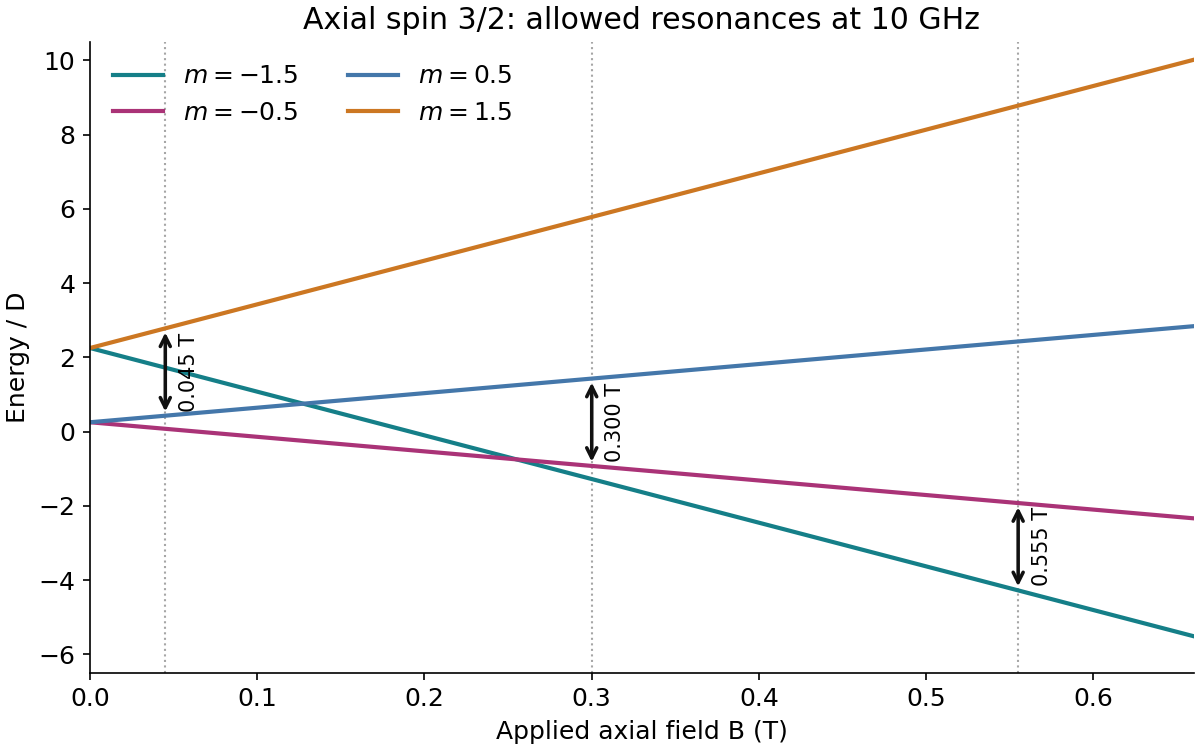
Take dimensionless spin operators and , with . The four wavefunctions are , , withAt zero field they form doublets at and . A transverse microwave magnetic field drives transitions. When , their positive resonance fields in ascending order areThey connect , , and , respectively. ThusHere and the zero-field doublet gap is .
At lower frequency it is essential to use absolute energy gaps, not discard a transition after its levels cross. For , the distinct candidate positive fields areThe first two coincide whenThis axial spin-three-halves resonance coincidence leaves two distinct resonance positions, at and , with two transitions superposed at the lower position. At there are also only two strictly positive-field lines, but an additional zero-field resonance remains; this is a different counting convention. Observable intensities also require thermal occupation of the relevant lower levels.

Articles by others on the same topic
There are currently no matching articles.