Source paper: www.whatdotheyknow.com/request/physics_past_exam_papers_2015_16/response/973997/attach/3/Cowell%20Attachment.zip?cookie_passthrough=1. The dated cover identifies the Part C Major Option sitting of 15 June 2016. All eight options are treated below.
Away from an absorption edge, the scalar atomic scattering factor is the Fourier transform of an approximately spherical, real atomic electron density. Opposite points contribute conjugate phases, so their sum is real. In Thomson scattering the electronic response is also effectively in phase with the driving field in this nonabsorbing approximation. Near an absorption edge, resonantly driven electronic excitations introduce a phase lag and absorption. The atomic scattering factor becomes , with describing the absorptive component and its dispersive companion. The sign of the imaginary part depends on the time and scattering-phase conventions; here it is the source's convention. This discussion concerns scalar charge scattering, without magnetic or tensor resonant contributions.
Use fractional coordinates and the structure factor conventionFor real atomic scattering factors, , immediately proving Friedel's law. If an inversion centre is chosen as origin, each site at has an identical partner at , with the same possibly complex atomic scattering factor. Each pair contributes ; sites fixed by inversion modulo a lattice translation also have even phase factors at reciprocal-lattice vectors. Henceeven for scalar anomalous X-ray scattering in a centrosymmetric structure. This last equality is an equality of amplitudes, not generally complex conjugacy.
Write , where the four-site orbit has structure factorA cyclic permutation of fixes the first term and permutes the remaining three. Thus . Substituting exchanges the first and second exponentials and the third and fourth, with the common coefficient :The two forms of this phase, and , agree for integer indices. Multiplication by a unit-modulus phase preserves intensity, irrespective of whether is real or complex. Since the phase is independent of and atomic species, it also multiplies the total structure factor of the crystal.
With and ,For , the transformation in part c maps onto its Friedel pair with only a phase factor. Cyclic permutations give the same result when either other index vanishes. Friedel's law therefore survives for every such reflection, including any systematic absences.
For the reflection set . ThenSince the purely positional sums obey , the scalar resonant Friedel-pair intensity difference isup to the same positive experimental scale factor. In particular,Different positional phases can therefore produce a nonzero resonant intensity difference at , allowing the opposite structural handednesses to be distinguished. The claimed violation is generic, not an unconditional identity: the source supplies no numerical internal coordinates. For a concrete noncentrosymmetric counterexample, take and . Their orbit sums at are and , so the difference vanishes even if ; each generic chemical orbit is noncentrosymmetric, so this cancellation does not require inversion symmetry. Accidental cancellation, or , must be excluded before asserting a violation for a particular specimen.
Under spatial inversion the electric polarization, a polar vector, changes from to . Neumann's principle requires an equilibrium property of a phase retaining inversion symmetry to be unchanged. Thus , forcing : a centrosymmetric phase cannot itself be ferroelectric. A transition can, of course, remove that symmetry.
For an inversion-symmetric parent phase the Landau theory free energy satisfies . Every polynomial term of odd total degree changes sign and must have zero coefficient. Restricting to one fixed direction gives an even scalar expansion in .
For the full prism point group, a threefold rotation eliminates any invariant basal component of a polar vector, while the horizontal mirror eliminates its axial component. Therefore the phase preserving all of is nonpolar, despite lacking inversion. A polar phase would have to break some of these symmetries.
The indicated six vertex directions comprise three basal directions and their horizontal-mirror partners. Crucially, this orbit does not contain the negatives of those vectors. Choose along the prism and toward one basal vertex. The cubic polynomialis invariant under the prism's rotations and mirrors. Along a vertex direction with a nonzero basal component, it is proportional to , so odd scalar terms are symmetry-allowed. Along the prism axis the horizontal mirror instead sends , forcing an even free energy. Merely omitting inversion is insufficient to decide either polarity or the allowed invariants.
Differentiating the Landau theory free energy givesIts stationary values arewhen the discriminant is nonnegative. At , the curvature is : a local minimum above and a local maximum below it. Exactly at , , so the origin is a stationary inflection point, not a stable minimum.
At a nonzero stationary point, eliminating yields . Between and the upper spinodal, is a minimum and a maximum. Below , becomes another local minimum, while is the lower minimum. Thus loss of local stability at is distinct from the equilibrium transition temperature.
The two nonzero stationary points merge when their discriminant vanishes, giving the upper spinodalAt a nonzero stationary point, , so its free energy reduces to . Equality with therefore requires . Substitution givesBoth have positive curvature at coexistence. The intervening maximum is at . For the positive-polarization minimum is metastable; for the zero-polarization minimum is metastable.
In equilibrium without hysteresis, the system selects the lower free-energy minimum. At the order parameter jumps between and , which identifies a first-order phase transition. Differentiating the minimized free energy does not add a contribution because . Thus the polarization-dependent entropy is , givingThe heat absorbed on heating from the ordered to the disordered phase isThe same amount is released on cooling. If is defined in the opposite direction, the signed transition heat is correspondingly negative.
For a partially filled shell, electron–electron Coulomb repulsion and Hund's rules first favour particular total spin and orbital terms. The crystal field splitting is substantial because these orbitals overlap the ligand environment; it normally exceeds the spin-orbit coupling and often quenches the orbital moment. Competition between the splitting and the electron pairing energy determines high-spin versus low-spin filling. A common hierarchy is Coulomb term energies, then crystal-field and Hund-exchange scales, then spin–orbit and weak-field Zeeman energies; the relative sizes of crystal-field splitting and pairing are material-dependent. Hyperfine coupling, if the nucleus carries spin, adds a smaller splitting. An isolated ion has no inter-ion exchange ordering field.
For a partially filled shell, the outer and shells shield the localized orbitals from the ligands. Coulomb interactions establish through Hund's rules, and spin-orbit coupling usually exceeds the much smaller crystal field splitting. First form a ground multiplet using , then split that multiplet by the crystal environment. The orbital contribution is therefore generally retained, and the g-factor is a multiplet Landé factor rather than an almost spin-only value. Weak external Zeeman and hyperfine interactions can subsequently resolve the remaining states. Exceptions with or unusual valence require separate treatment.
The tetrahedral crystal field splitting places the two orbitals below the three orbitals. In the weak-field, high-spin limit the occupancy is , with . Its lowest cubic term is : an orbital triplet, before spin degeneracy is counted. In the hypothetical sufficiently strong-field limit the occupancy is , with and an orbital doublet . This latter limit requires overcoming pairing/Hund energy; ordinary tetrahedral oxide complexes generally remain high-spin.
Both orbital degeneracies permit a Jahn-Teller effect, so a regular tetrahedron is not a stable static equilibrium in the elementary adiabatic treatment. The sign of a particular distortion requires an electron–lattice coupling model, not just the degeneracy count. To make that dependence explicit, let stretch while contracting . In a leading point-charge quadrupole model write the shiftsIn the high-spin configuration the two shifts cancel. For the remaining electron selects , gaining ; for it selects the doublet, gaining . Adding gives a tetragonally elongated minimum at , with energy gain , versus only along the compressed branch. The elongated branch has an orbital singlet. This is the usual elementary elongation argument; quantitative coupling includes higher crystal-field multipoles and configuration mixing.
For the strong-field configuration the lower orbital is doubly occupied. The shift of the three electrons is , so the same model has both an elongated and a compressed minimum, , with equal stabilization. Elongation favours double occupation of ; compression favours double occupation of . This tetrahedral doublet distortion-sign ambiguity prevents a unique choice from the supplied data. For example, a small symmetry-allowed cubic elastic invariant selects opposite tetragonal signs when changes sign, while leaving the regular-site electronic configuration unchanged. Higher couplings or host constraints are needed to choose. Dynamic motion between equivalent minima may also restore an average regular shape without stabilizing the undistorted adiabatic configuration.
Once a static axial distortion removes the orbital degeneracy, second-order spin-orbit coupling produces a time-reversal-even quadratic spin Hamiltonian operator. The residual tetragonal symmetry requires equal coefficients. Dropping a multiple of leaves for the weak-field state. The sign and magnitude of depend on excited-state splittings. For the strong-field Kramers doublet, is constant: this term cannot cause zero-field splitting, although the Zeeman g-factor can be anisotropic.
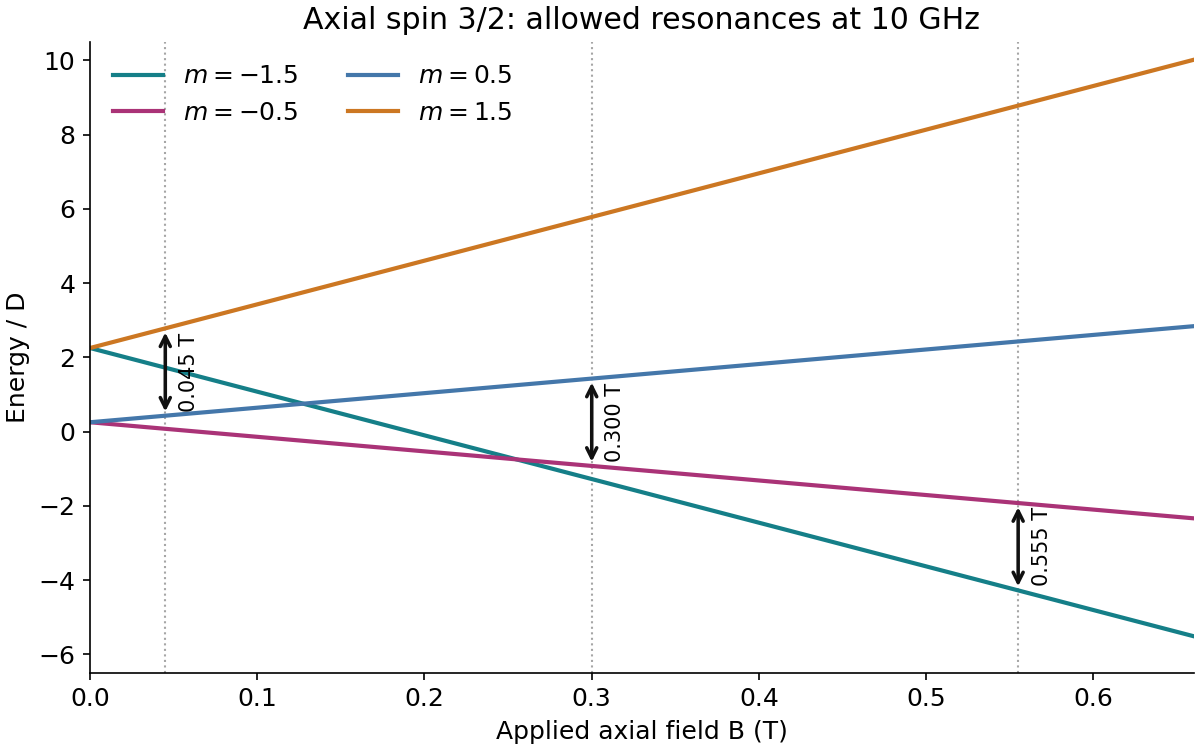
Take dimensionless spin operators and , with . The four wavefunctions are , , withAt zero field they form doublets at and . A transverse microwave magnetic field drives transitions. When , their positive resonance fields in ascending order areThey connect , , and , respectively. ThusHere and the zero-field doublet gap is .
At lower frequency it is essential to use absolute energy gaps, not discard a transition after its levels cross. For , the distinct candidate positive fields areThe first two coincide whenThis axial spin-three-halves resonance coincidence leaves two distinct resonance positions, at and , with two transitions superposed at the lower position. At there are also only two strictly positive-field lines, but an additional zero-field resonance remains; this is a different counting convention. Observable intensities also require thermal occupation of the relevant lower levels.
For competing exchanges on a body-centred cubic antiferromagnet, use the Heisenberg model convention , with each bond counted once, dimensionless spins, and positive antiferromagnetic . There are eight nearest and six next-nearest neighbours. Bond counting in the two classical collinear structures givesFor type II the eight contributions cancel, while all six bonds are antiparallel. Their crossing yields . One can also exclude a lower spiral within the classical bilinear model: writing givesFor a favourable sign of the product, . Hence when its minimum is at , the type-II ordering vectors. When , compare with the type-I value and use to obtain the complementary bound. ThusThis is a classical/mean-field energy comparison; an exact quantum ground state is not generally a collinear product state.
For type I a magnetic cell is the simple cube of side , with opposite moments at and . Its magnetic structure factor is proportional to . Allowed magnetic reflections have integer with odd. The first two families are and , with symmetry-equivalent members understood.
For type II choose magnetic primitive translations , and , enclosing four spins in volume . Equivalently, a side- cube is a convenient nonprimitive magnetic cell. On each original simple-cubic sublattice the moment at is proportional to . Accordingly,The translated body-centre basis gives , so there is no further extinction. The first two families are and . The neutron polarization factor may additionally suppress a reflection for a particular moment direction; the stated rules are the positional selection rules.
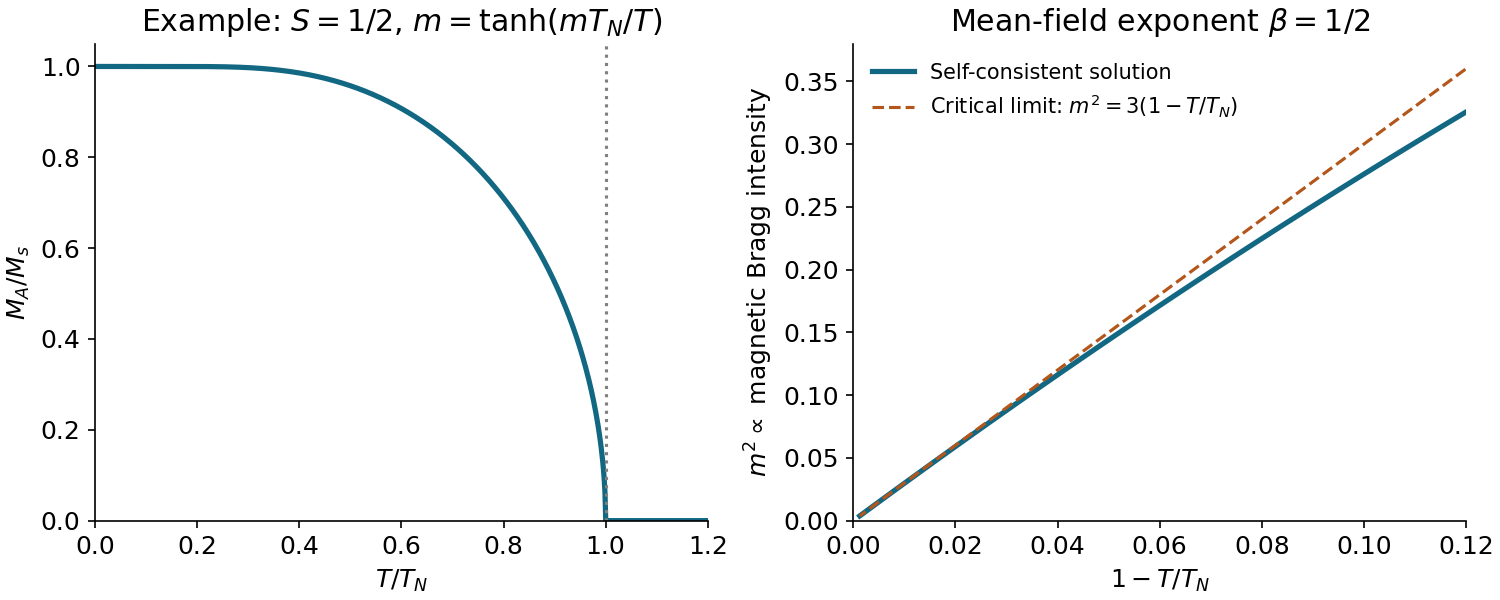
Each sublattice has number density and saturation magnetization . Replacing neighbouring spins by their averages makes their exchange energy equivalent to a molecular magnetic field. Its minus sign expresses antiferromagnetic exchange, not an externally applied field. Since ,For , . Linearizing the Brillouin magnetization formula givesThe g-factor cancels because exchange is specified in energy units. A convention with doubles these exchange energies and .
Let , and let denote the cubic coefficient of the Brillouin magnetization formula. The argument is . Thus impliesConsequently in mean-field theory. The positive branch falls from saturation at zero temperature to zero at and remains zero above it. An elastic magnetic neutron-reflection intensity scales as ; a log–log fit against has slope . Background subtraction and a suitable critical interval are needed. Fluctuations can change the measured exponent from its mean-field value; uniform bulk magnetization vanishes for a compensated antiferromagnet and is not itself this order parameter.
For a periodic single-electron Hamiltonian operator, Bloch's theorem givesTwo bands at the same have the same translation eigenvalues but different cell-periodic eigenfunctions, generally different energies and different orbital/nodal character. They may be chosen orthogonal even at a band degeneracy. The basis choices are treated in the two scoped branches below.
For a slowly varying external potential , the semiclassical wavepacket Hamiltonian is . Hamilton's equation for the conjugate variables gives . Equivalently the electric perturbation changes the translation phase at the rate . This is the single-band acceleration theorem, requiring a slowly varying field and negligible interband tunnelling/scattering; it refers to crystal momentum, not free-space mechanical momentum.
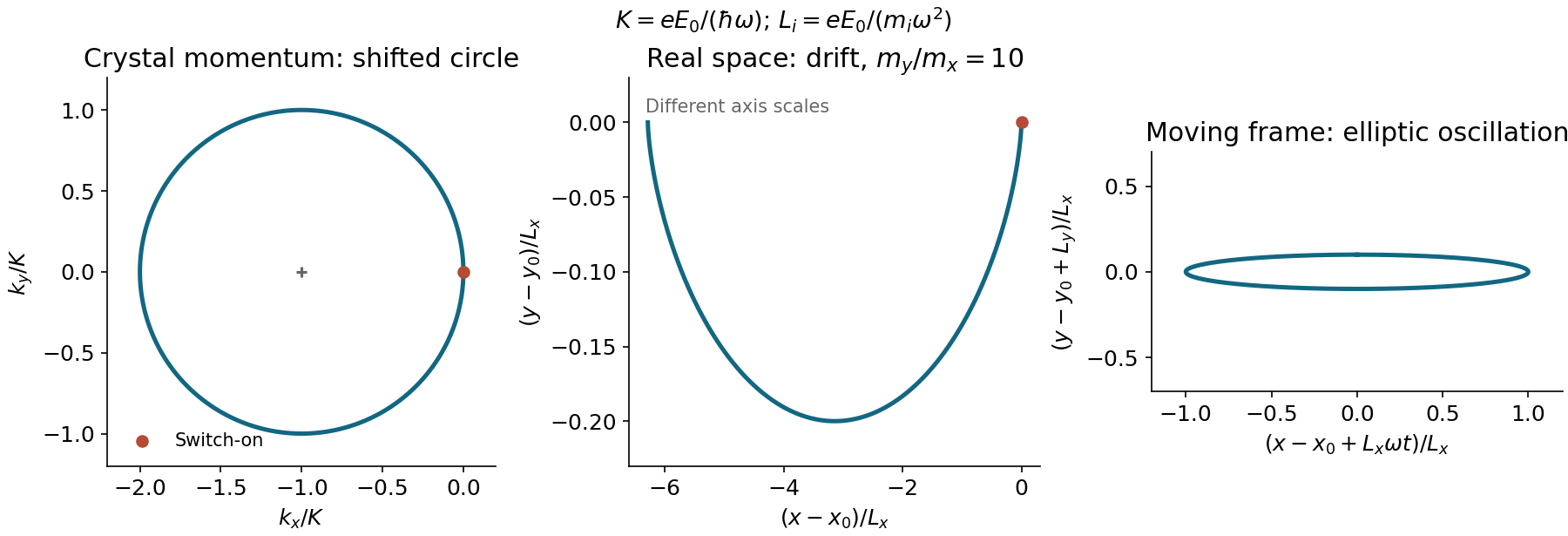
Let and . Integrating from the specified initial condition gives, with the first field alone,With both components switched on,This is a circle centred at , not at the band minimum. Since , integration givesThe switch-on drift in a circularly driven parabolic band accompanies unequal transverse scales: it is a stretched cycloid. In a frame moving with that drift, the oscillation is an ellipse with semiaxis ratio . A closed real-space ellipse would require different initial momentum. Indeed, after one period , an explicit check against that interpretation.
Writing , the kinetic energy above the band minimum isFor it is largest at , with value . Equating this to the optical-phonon energy gives the emission threshold estimateThis treats the optical branch as approximately dispersionless and assumes a momentum-allowed final state, a cold initial electron, and negligible phonon absorption. It is the amplitude of each Cartesian field component; the circular field has constant magnitude . A steady periodic orbit centred at would instead give twice this amplitude, but fails the stated switch-on condition.
The nearly-free electron model expands the Bloch state in plane waves,All basis functions have the same translation eigenvalues because . A weak periodic potential mixes them most strongly near Bragg degeneracies and opens band gaps. Delocalized conduction states of simple metals, such as sodium and aluminium, are typical applications; the approximation need not describe tightly bound core states.
The tight-binding model uses Bloch sums of localized atomic-like or Wannier orbitals,Including in the phase is an equivalent basis convention. Overlap and hopping between these localized orbitals create dispersive bands. Narrow transition-metal bands and the bonding/antibonding bands of covalent solids are natural examples; graphene's bands are another. The model can be accurate beyond weak hopping when enough orbitals and hopping integrals are retained.
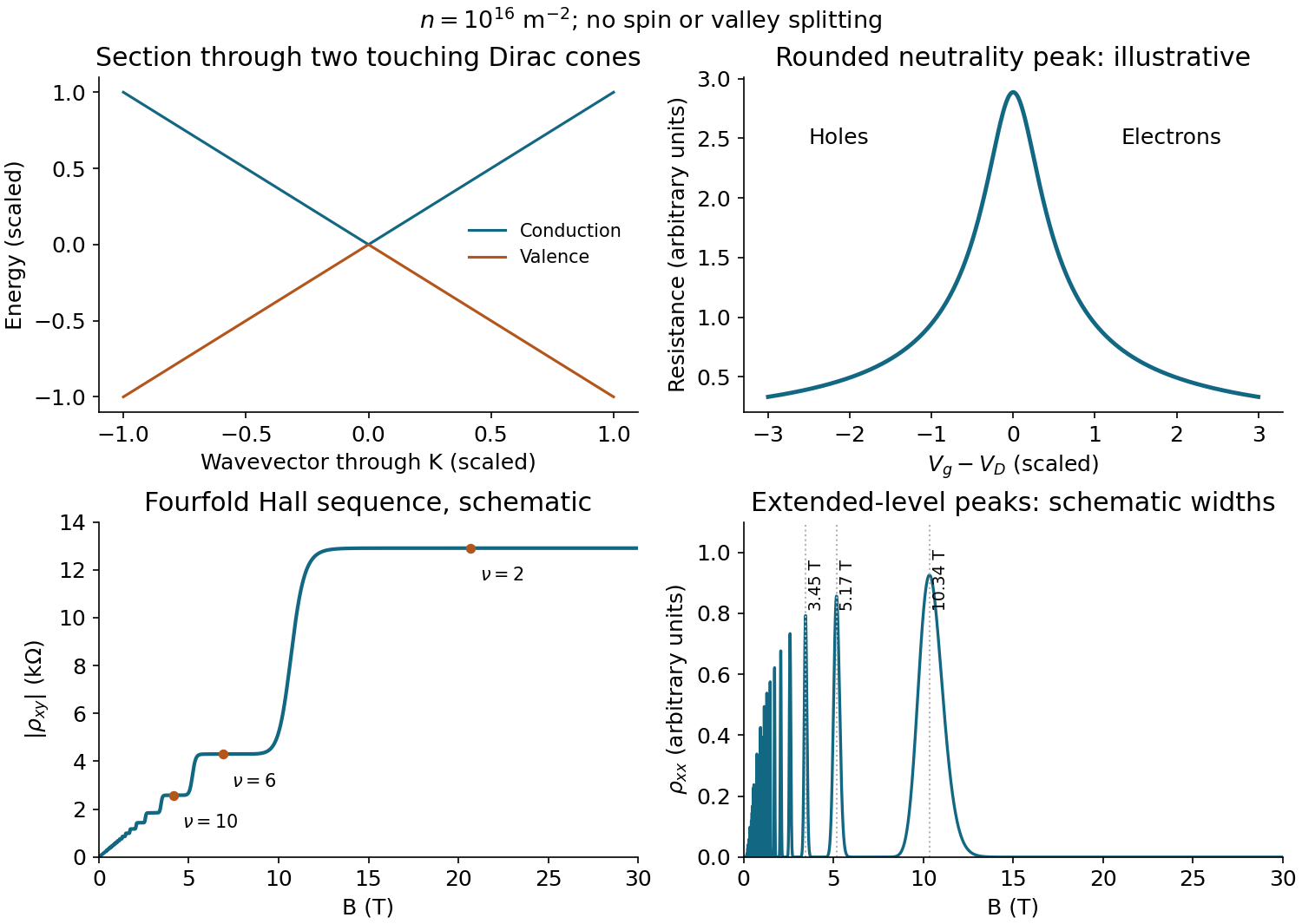
The conduction and valence dispersions are two cones touching at the Dirac point, with slopes . Here is measured relative to one valley centre. Each cone has a density of states proportional to , which vanishes at the touching energy. Gate-induced carriers satisfy approximately per unit area. Negative and positive offsets from produce holes and electrons, respectively. Away from neutrality a simple charge carrier mobility model gives , so resistance decreases on either side of a maximum near . Disorder, electron–hole puddles, contacts and quantum transport round the peak; the cone dispersion alone fixes neither its height nor its width, nor does it require exact electron–hole symmetry in a real device.
A direct derivation of the magnetic spectrum starts from the single-valley Dirac Hamiltonian operator . Introduce oscillator operators using the magnetic length . Up to exchanging sublattices or valleys,Squaring gives adjacent oscillator number operators, henceThe positive expression printed in the source describes the electron branch only; the negative-energy partners must also be included. The same square-root dependence follows from quantizing circular orbit area, with the Dirac Berry phase cancelling the usual half-integer offset.
Each spin and valley contributes states in area . Including two spins and two valleys gives , or areal degeneracy . The zero-energy level is half-filled at charge neutrality: the carrier density counts departures from that state.
For , the filling factor and fourfold graphene Hall sequence areIn a plateau, and . The Hall sign reverses between electron and hole doping; the sketch uses its magnitude to avoid tensor-index sign conventions. Representative plateau-centre fields are , , and for . Between plateaux, crossing extended states in broadened levels gives longitudinal peaks and Hall steps. Their ideal filling-centre positions have , namelyThus peaks near , and separate the first prominent plateaux as field increases. Many weak oscillations accumulate toward zero field and are damped there. Finite-width plateaux require localized states between extended-state energies; an exactly clean Landau spectrum does not by itself prescribe plateau widths. The illustration uses an explicitly schematic broadening, not inferred experimental widths.
At , , close to the plateau. With , and . The relevant adjacent gap near the chemical potential is therefore , rather than the gap from the zero level. Resolving levels requires quantum-lifetime broadening and thermal broadening appreciably smaller than , giving the order-of-magnitude limitsThe upper temperature is an energy-scale estimate, not a guaranteed sharp-feature temperature. For oscillation amplitudes the thermal damping factor is , , with and . Requiring gives the more conservative scale for little thermal damping. Visible weaker features may persist above that scale; their actual cutoff depends on resolution, disorder and temperature-dependent scattering. The transport lifetime and quantum lifetime also need not coincide.


For ion pairs per unit volume, a relative displacement produces ionic polarization . Solving the driven Lorentz oscillator model with the source's convention givesThe constant includes the fast electronic response: infinity here means well above the phonon band but below electronic resonances. Writing makes the numerator . In an undamped longitudinal mode the bulk displacement field vanishes without an external free charge, so a nonzero electric field requires . ThereforeThis is the Lyddane-Sachs-Teller relation for the single polar mode.
At normal incidence from vacuum the Fresnel equations giveBelow the transverse resonance the dielectric response increases, raising reflectivity. Between the transverse and longitudinal frequencies the undamped dielectric function is negative, giving an evanescent transmitted wave and nearly total reflection: the Reststrahlen band. Above the longitudinal edge it becomes small and positive, passing through at the reflectivity minimum and eventually approaching its electronic background.
Reading the original graph to its limited precision gives and , hence and . Extrapolating the low-energy reflectivity to roughly givesValues around – and – are appropriate to this graphical estimate. Neither the dip near nor the finite-energy right endpoint represents the high-frequency asymptote; treating that endpoint as would underestimate .
At , with . Weak damping gives , so for the complex refractive index ,Squaring and substituting provesUse the reflectivity at the estimated transverse resonance, not automatically the plateau maximum. A representative reading , with , gives , andGraphical uncertainty in the transverse edge makes this only a few-picosecond estimate: readings – give approximately –. The displacement amplitude decays as and has lifetime ; phonon occupation/energy decays as and has lifetime . Anharmonic forces allow an optical phonon to decay into two lower-energy phonons when energy and crystal momentum are conserved. Spontaneous decay can persist at low temperature; defects and electron–phonon scattering can add further linewidth.
In BCS theory, an electron distorts the positively charged lattice, and the retarded response can attract another electron. Within a phonon-energy shell around the Fermi surface, the effective attraction can overcome the screened Coulomb repulsion and destabilize the normal Fermi sea toward Cooper pairs. In conventional elemental superconductors the pairs predominantly join time-reversed states of opposite momentum and spin, forming a spin singlet.
In the weak-coupling approximation,Here is the appropriate single-spin density of states and the effective attractive interaction in a consistent normalization. Both the phonon scale and the exponential coupling matter. A large Fermi-level density of states, often associated with partially filled narrow bands, can raise ; weak coupling or a small density of states can suppress it even in a good conductor. With force constants and coupling fixed, gives the conventional isotope trend. This is not a universal monotonic ranking of elements by atomic mass: phonon stiffness, electron–phonon matrix elements, Coulomb effects and magnetism vary between elements. Magnetic pair breaking helps explain why some elements do not follow a naive density-of-states expectation.
Let denote pair mass, charge and number density, respectively. A uniform-phase condensate in the stated gauge has zero canonical momentum . ThereforeFor static fields, and . Taking a curl and using the vector identity for a double curl givesFor electronic pairs, and , while is the pair density, not twice that density. In a general gauge the canonical momentum is ; taking the curl away from vortices gives the same London equation.
The competition between magnetic screening over the London penetration depth and condensate recovery over the superconducting coherence length is measured by the Ginzburg-Landau parameter . In the single-component local theory the boundary is . For , a normal–superconducting interface has positive energy: a type-I superconductor favours macroscopic regions and a thermodynamic critical field . Demagnetizing fields may create an intermediate state of normal and superconducting domains.
For the interface energy is negative. A type-II superconductor admits flux vortices between the lower and upper critical fields, with normal-like cores of size and circulating screening currents over . Each singly quantized vortex carries ; a vortex lattice and pinning-controlled irreversible response can occur. Pairing strength, carrier density, Fermi velocity and impurity scattering affect these lengths; alone does not determine the type. The stated boundary is the standard Ginzburg–Landau result near .
For a laterally infinite slab in a parallel field there is no demagnetizing correction. The field has only its applied direction, varies with , and satisfies . Reflection symmetry gives , and continuity gives . ThusUniformly for , expanding numerator and denominator to second order yieldsOnly a small fraction of the applied field is screened in this limit; the almost uniform internal field is the origin of the enhanced parallel critical field.
Average the exact slab solution across its thickness:For , . The zero-field condensation free energy per volume is . Neglecting normal-state magnetic susceptibility, the Gibbs free-energy difference at fixed applied field follows from :Equating it to zero gives the constant- estimate for the parallel critical field of a thin London slabThe enhancement is equivalently for total thickness . It is an estimate assuming an intact, spatially uniform condensate density up to the transition. Field-induced pair suppression, the paramagnetic limiting field, and failure of bulk local electrodynamics in an extremely thin film limit an unlimited extrapolation as .
Articles by others on the same topic
There are currently no matching articles.