For a periodic single-electron Hamiltonian operator, Bloch's theorem givesTwo bands at the same have the same translation eigenvalues but different cell-periodic eigenfunctions, generally different energies and different orbital/nodal character. They may be chosen orthogonal even at a band degeneracy. The basis choices are treated in the two scoped branches below.
For a slowly varying external potential , the semiclassical wavepacket Hamiltonian is . Hamilton's equation for the conjugate variables gives . Equivalently the electric perturbation changes the translation phase at the rate . This is the single-band acceleration theorem, requiring a slowly varying field and negligible interband tunnelling/scattering; it refers to crystal momentum, not free-space mechanical momentum.
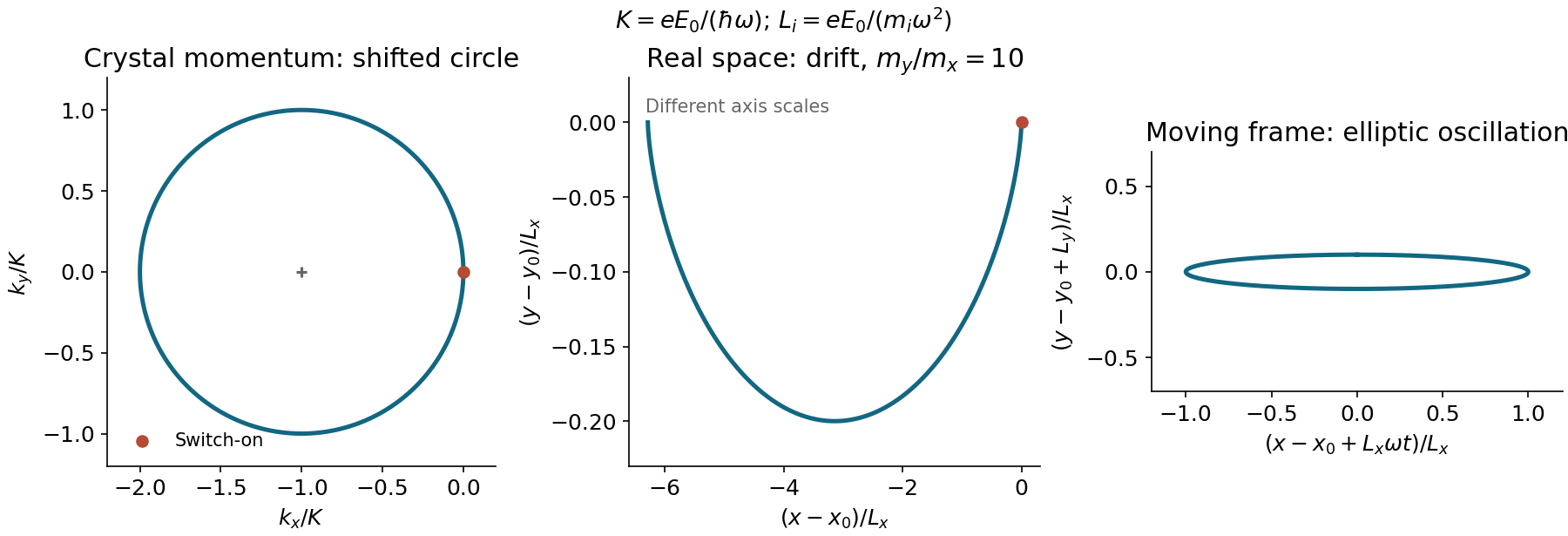
Let and . Integrating from the specified initial condition gives, with the first field alone,With both components switched on,This is a circle centred at , not at the band minimum. Since , integration givesThe switch-on drift in a circularly driven parabolic band accompanies unequal transverse scales: it is a stretched cycloid. In a frame moving with that drift, the oscillation is an ellipse with semiaxis ratio . A closed real-space ellipse would require different initial momentum. Indeed, after one period , an explicit check against that interpretation.
Writing , the kinetic energy above the band minimum isFor it is largest at , with value . Equating this to the optical-phonon energy gives the emission threshold estimateThis treats the optical branch as approximately dispersionless and assumes a momentum-allowed final state, a cold initial electron, and negligible phonon absorption. It is the amplitude of each Cartesian field component; the circular field has constant magnitude . A steady periodic orbit centred at would instead give twice this amplitude, but fails the stated switch-on condition.

Articles by others on the same topic
There are currently no matching articles.