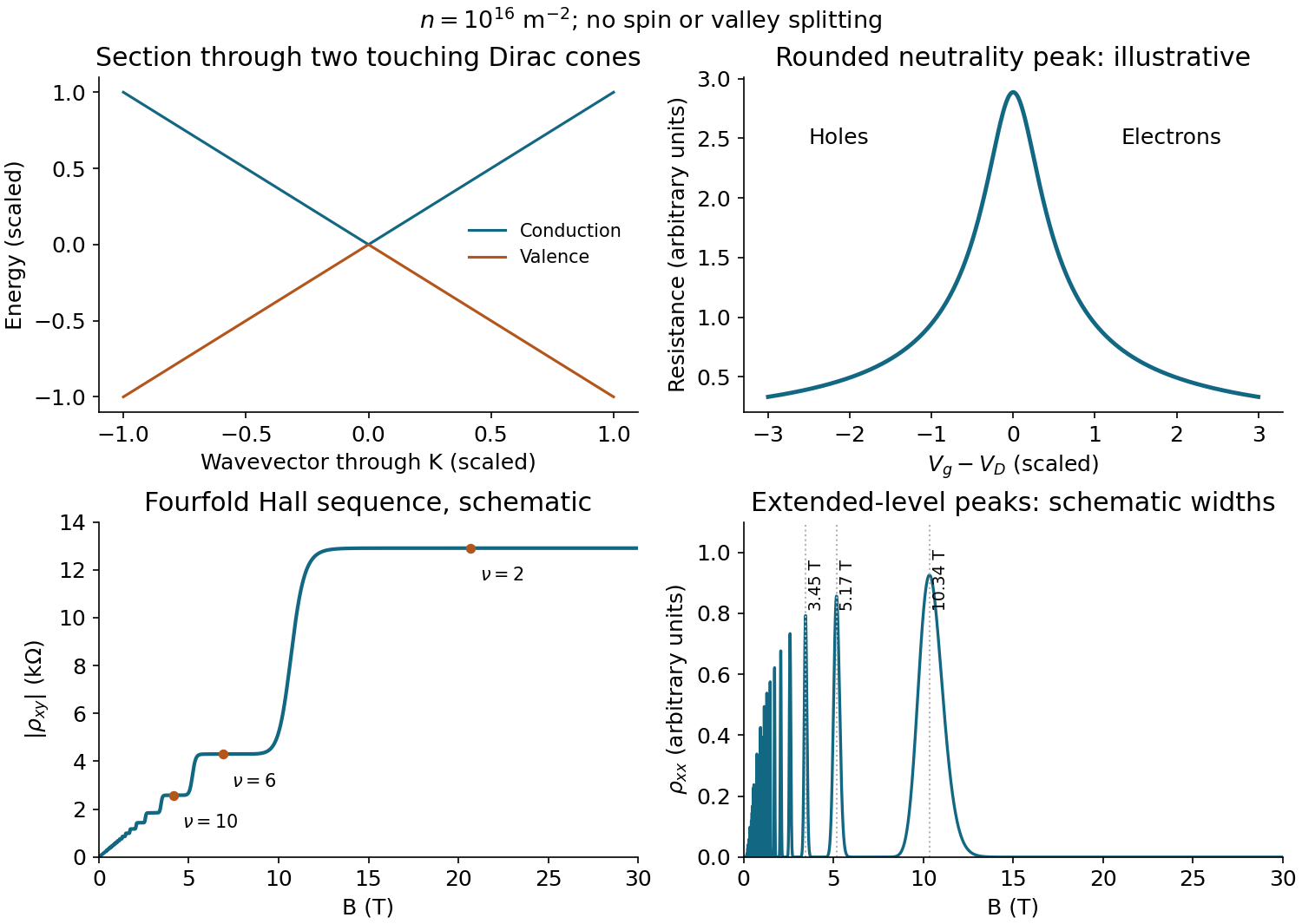
The conduction and valence dispersions are two cones touching at the Dirac point, with slopes . Here is measured relative to one valley centre. Each cone has a density of states proportional to , which vanishes at the touching energy. Gate-induced carriers satisfy approximately per unit area. Negative and positive offsets from produce holes and electrons, respectively. Away from neutrality a simple charge carrier mobility model gives , so resistance decreases on either side of a maximum near . Disorder, electron–hole puddles, contacts and quantum transport round the peak; the cone dispersion alone fixes neither its height nor its width, nor does it require exact electron–hole symmetry in a real device.
A direct derivation of the magnetic spectrum starts from the single-valley Dirac Hamiltonian operator . Introduce oscillator operators using the magnetic length . Up to exchanging sublattices or valleys,Squaring gives adjacent oscillator number operators, henceThe positive expression printed in the source describes the electron branch only; the negative-energy partners must also be included. The same square-root dependence follows from quantizing circular orbit area, with the Dirac Berry phase cancelling the usual half-integer offset.
Each spin and valley contributes states in area . Including two spins and two valleys gives , or areal degeneracy . The zero-energy level is half-filled at charge neutrality: the carrier density counts departures from that state.
For , the filling factor and fourfold graphene Hall sequence areIn a plateau, and . The Hall sign reverses between electron and hole doping; the sketch uses its magnitude to avoid tensor-index sign conventions. Representative plateau-centre fields are , , and for . Between plateaux, crossing extended states in broadened levels gives longitudinal peaks and Hall steps. Their ideal filling-centre positions have , namelyThus peaks near , and separate the first prominent plateaux as field increases. Many weak oscillations accumulate toward zero field and are damped there. Finite-width plateaux require localized states between extended-state energies; an exactly clean Landau spectrum does not by itself prescribe plateau widths. The illustration uses an explicitly schematic broadening, not inferred experimental widths.
At , , close to the plateau. With , and . The relevant adjacent gap near the chemical potential is therefore , rather than the gap from the zero level. Resolving levels requires quantum-lifetime broadening and thermal broadening appreciably smaller than , giving the order-of-magnitude limitsThe upper temperature is an energy-scale estimate, not a guaranteed sharp-feature temperature. For oscillation amplitudes the thermal damping factor is , , with and . Requiring gives the more conservative scale for little thermal damping. Visible weaker features may persist above that scale; their actual cutoff depends on resolution, disorder and temperature-dependent scattering. The transport lifetime and quantum lifetime also need not coincide.

Articles by others on the same topic
There are currently no matching articles.