As magnetic field grows from zero, a clean two-dimensional electron gas first has an ordinary finite longitudinal resistivity, then develops Shubnikov–de Haas oscillations as broadened Landau levels pass the chemical potential. Thermal and disorder broadening obscure the low-field oscillations; their visibility grows when the level spacing exceeds those broadening scales. In a well-developed integer quantum Hall regime, has minima close to zero on Hall plateaux and maxima during transitions between them, when extended states cross the chemical potential. Detailed peak heights and envelopes depend on disorder and scattering and are not fixed by quantization alone.
At fixed density the nominal filling is , so level-filling features are approximately periodic in , with period for resolved spin levels or for an unresolved spin pair. Increasing lowers the filling; spin splitting can create additional odd-index features. The original schematic below shows these relations without pretending to reconstruct the missing data.
TODO — missing source graph: the actual – positions and integer plateau labels require or surviving plateau fields from part (b). Neither is provided independently. Thus a uniquely labelled field-axis sketch for this sample cannot be completed. The following DOS diagram distinguishes extended centres and localized tails generically; its chemical-potential markers are illustrative and do not stand for the requested 8 T or 10 T assignments.
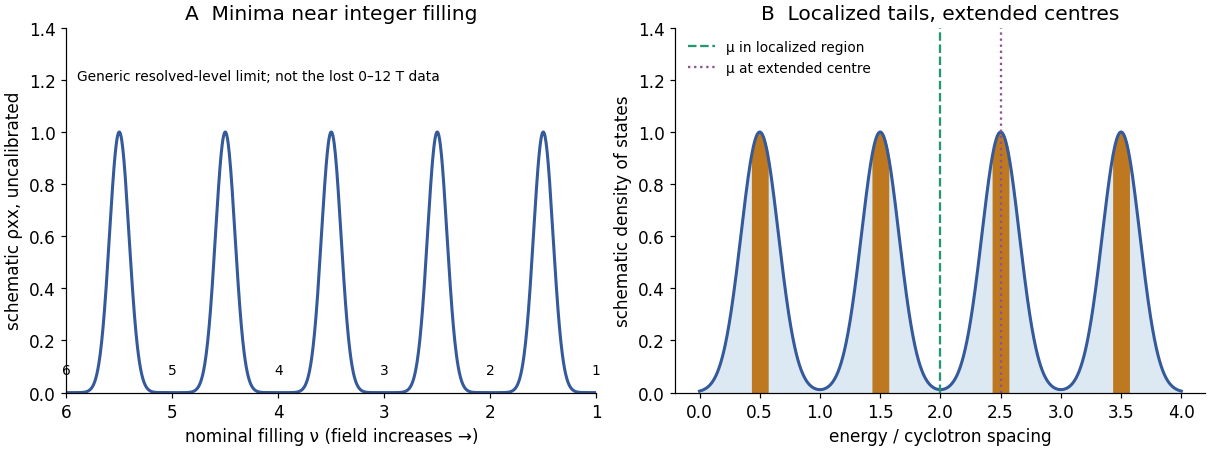
Generic longitudinal oscillations and broadened Landau levels without inventing the missing Hall data
. Original qualitative illustration. The horizontal filling scale is dimensionless and is not a reconstruction of the missing 0–12 T graph. Chemical-potential positions in the DOS panel illustrate two regimes, with no assignment to 8 T or 10 T. Details.
At , the nominal filling isA labelled density-of-states picture has disorder-broadened peaks at these orbital and spin energies, localized tails and extended states near their centres. A chemical potential in the localized region corresponds to a Hall plateau and small longitudinal resistivity; passing through an extended-state centre corresponds to a transition.
TODO — missing density/plateau assignment: there is no basis for choosing one of those positions at 10 T without the missing Hall graph. For example gives nominal , whereas gives . In an ideal resolved-level picture the first can put the chemical potential between filled levels, while the second leaves a level partly filled. Both are compatible with the surviving current and width, demonstrating why the requested placement is undetermined.
At ,The cyclotron spacing is , smaller than at 10 T, and each resolved level's degeneracy per area is also reduced by . Thus the same carrier density occupies more levels. This ratio is determined without the missing graph, but it does not specify whether the chemical potential lies in a localized tail or an extended-state centre.
TODO — missing density/plateau assignment: a numerical index and chemical-potential marker at 8 T require the unavailable density information. For example the first illustrative density in part (i) gives , while instead gives . These produce different schematic placements even though both satisfy every surviving sample parameter. Unresolved spin degeneracy and disorder add further qualifications; no unique 8 T label should be invented.
Articles by others on the same topic
There are currently no matching articles.