Extend the given functions continuously to zero by . This is forced by their stated differentiability. Their derivatives at zero are both zero, since the corresponding difference quotients tend to zero.
For , , and for , . At zero all four quantities vanish. Thus the Wronskian isNevertheless, if the constant linear combination vanishes identically, evaluation at gives , and evaluation at gives . Therefore the two functions are linearly independent.
This illustrates why a vanishing Wronskian does not imply linear dependence for arbitrary differentiable functions. Here both functions are continuously differentiable, but neither has a second derivative at zero. The common regular differential equation hypothesis in the next part is absent.
Differentiate the Wronskian using the product rule and substitute the common homogeneous linear differential equation:Multiplying this first-order equation by the integrating factor and integrating gives Abel's identity:The exponential factor is finite and nonzero for every in the given interval, because is continuous on the compact interval between and . Hence implies everywhere in that interval. Using an integrating factor avoids dividing by , which would assume the conclusion.
Interpret the Dirac delta coefficient as a point interaction in a second-order differential equation. The solution is continuous at and is twice differentiable on either side, where . Its transmission conditions for a delta coefficient areIndeed, the distributional second derivative across a jump contributes , which must cancel the delta coefficient because has no point source.
Put and . Integrating the ordinary equation and inserting the required derivative jump giveswhere . This formula is continuous, has the stated jump, satisfies the equation, and parametrizes every solution with the left endpoint value. Imposing the right endpoint value gives the scalar equationConsequently a unique , and hence a unique solution for every , exists precisely whenAt the exceptional value, the nonzero homogeneous solution with zero endpoint values isIt has derivative jump . Thus uniqueness fails. More precisely, there are infinitely many solutions ifand none otherwise. This follows either from the scalar equation or by integration by parts against . It is the compatibility obstruction at Dirichlet resonance for a point interaction.
Use a Green function satisfying with homogeneous Dirichlet boundary conditions , for . Since away from and , it is continuous and piecewise affine, with possible derivative jumps at those two locations.
For , the transmission conditions for a delta coefficient and the unit source condition areIf , there is a single junction, and the correct combined condition isFor example, a suitable piecewise form when iswhere the coefficients depend on . The two continuity conditions, and determine them. When , use the same affine form on the intervals cut at , with and instead. This gives all requested boundary and jump conditions without needing the coefficients.
An explicit compact kernel also makes the construction transparent. The left and right homogeneous solutions at areThey obey the interaction jump and have Wronskian on either side. ThereforeDifferentiating its two branches at the source gives a unit derivative jump whenever . At , and , so the combined condition is also satisfied. This is the Dirichlet Green function for a point interaction specialized to the present parameters.
The Green kernel itself has zero endpoint values. The prescribed nonzero endpoint values enter through the homogeneous lift:Indeed, and . The kernel accounts for the forcing; the lift accounts for the boundary data. Uniqueness follows from part (i), since .
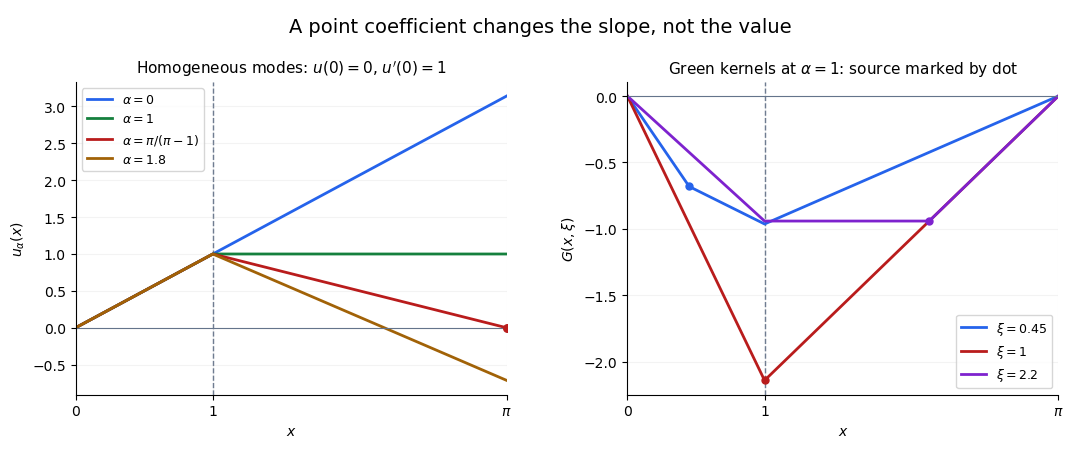
The resonant homogeneous mode and the derivative jumps of the Green kernel
. Original calculations for an interaction at on . The left panel varies the coefficient with a fixed initial slope; the resonant curve alone meets the zero right boundary. The right panel shows three source positions at coefficient one, including a source coinciding with the interaction. Details.
Articles by others on the same topic
There are currently no matching articles.