Let be the mean path length in the core. Neglect leakage and fringing across the narrow air gap, and assume a cross-section small compared with . Continuity of normal magnetic flux density then gives the same tangential magnetic field magnitude in the core and gap. Ampère's circuital law for the magnetic field strength isFor a linear core, and , givingHere follows the winding's right-hand rule. The gap has much larger than the core when , although is approximately continuous. Equivalently, the core and gap magnetic reluctances add in series.
On a magnetic hysteresis loop, remanence is the nonzero remaining at after magnetizing the sample. The normal magnetic coercivity is the magnitude of reverse at which on that branch. The intrinsic magnetic coercivity instead refers to zero magnetization; these two conventions should not be confused. A comparison of coercive with remanent requires a unit conversion or a specified constitutive scale, because their SI units differ. A soft ferromagnet is understood here to have a narrow loop and small coercive field.
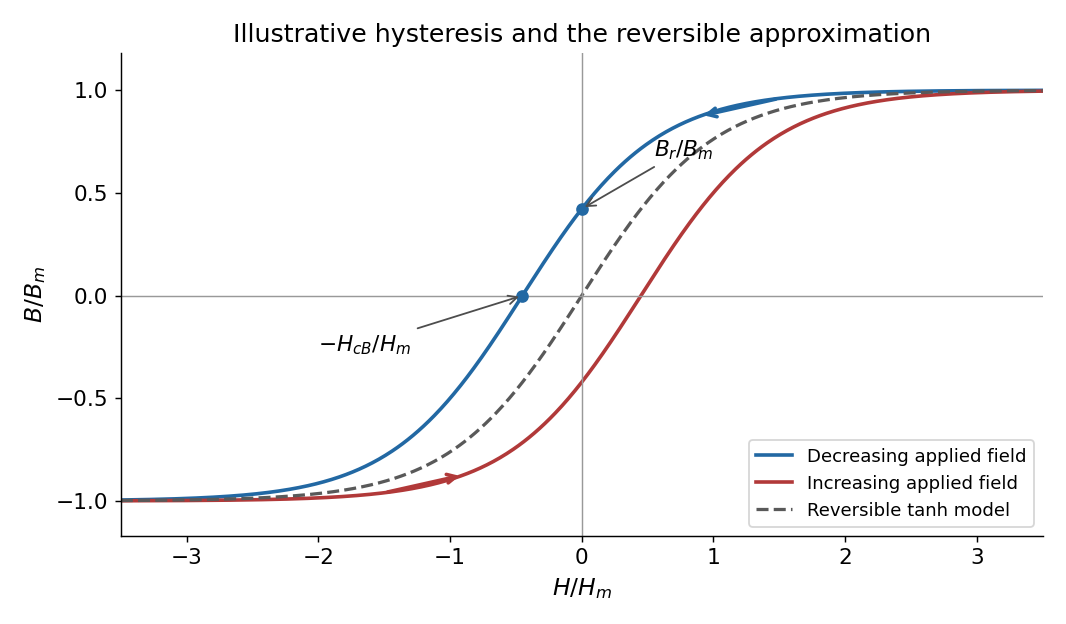
Magnetic hysteresis and the reversible tanh approximation
. Original illustrative magnetic hysteresis loop with the remanent magnetic field and normal coercive magnetic field strength marked. The dashed single-valued curve is the reversible approximation used in the calculation, rather than a hysteresis branch. Details.
Use the stated single-valued constitutive equation for the calculation. Inverting it gives , soSince , the small-signal response of a gapped magnetic core isThe small-field core magnetic permeability is . Strictly, is a reversible approximation: at it has , so it cannot itself model nonzero remanence. The displayed loop and this constitutive approximation serve different purposes. Keeping a genuinely remanent branch would generally add a history-dependent offset; it would not imply through the origin.
Articles by others on the same topic
There are currently no matching articles.