Core accretion builds a solid core and then a massive gaseous envelope before protoplanetary disk dispersal. The solid and gas stages overlap; this is not direct collapse of a whole disk patch.
In a protoplanetary disk, refractory grains and, beyond a snow line, condensed ices provide solids. Settling and protoplanetary dust coagulation build aggregates, but fragmentation, bouncing and radial drift of solids in a gas disk can interrupt simple sticking. Concentration processes such as the streaming instability can produce dense particle structures that collapse into planetesimals. Subsequent collisions build planetary embryos; alternatively, embryos can efficiently capture drifting particles through gas-assisted pebble accretion. Neither the initial planetesimal population nor unrestricted growth through every size should be assumed without a mechanism.
For gravitationally focused growth of a planetary core, the two-body capture cross-section isAn illustrative thin-disk estimate is , up to geometry and velocity-distribution factors. At fixed solid density and random speed, strong gravitational focusing gives : runaway planetesimal growth. As large embryos stir the smaller bodies, encounter speeds increase and focusing weakens, giving oligarchic growth. Consuming the local feeding zone leads toward an isolation mass; radial supply, migration and mergers can extend growth. Snow lines can increase the solid reservoir, but a distant core also grows more slowly because orbital times are longer.[ref]
Lecture notes on the formation and early evolution of planetary systems by Philip J. Armitage. Version1, sectionIII.B, pages27–31: gravitational focusing and planetesimal growth
A growing core binds gas over a scale limited by the smaller of its Bondi radius and Hill radius. The envelope approximately satisfiesAn equation of state, disk boundary conditions, and radiative or convective energy transport close the structure. In an optically thick radiative region,Here is opacity; an unstable radiative gradient instead drives convection. Solid accretion releases roughly , heating and supporting the envelope. Gas capture consequently depends on cooling, not just whether the potential can bind gas instantaneously.
The envelope loses energy on a Kelvin-Helmholtz cooling time, . Lower grain opacity, higher core mass, or reduced solid-accretion heating can accelerate contraction. The critical core mass for gas accretion is therefore model dependent; “of order ten Earth masses” is a common scale, not a universal switch. As envelope self-gravity becomes important and the gas and solid masses become comparable, contraction permits still more gas capture, producing runaway gas accretion. The classical sequence has a rapid solid-growth phase, a slower envelope-growth phase, and accelerated gas accumulation.[ref]
Formation of the giant planets by concurrent accretion of solids and gas by James B. Pollack and others. 1996 model: coupled solid and gas growth, three phases and crossover
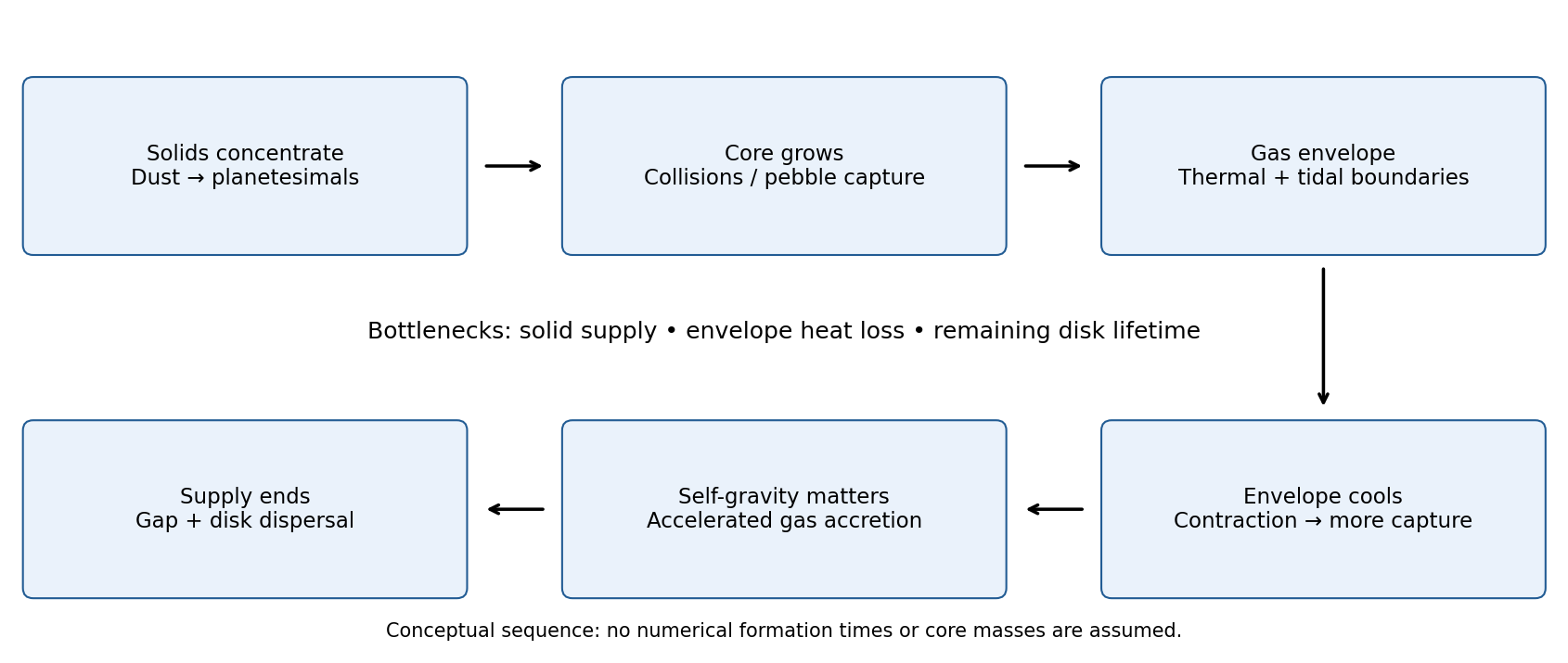

The decisive race is . Failure to cool or obtain a sufficiently large core before gas removal leaves a smaller solid or ice-rich planet. Successful growth is ultimately limited by disk supply, gap opening by a planet, and dispersal; a gap does not completely seal off accretion. Angular-momentum exchange drives planetary migration, so the observed orbit need not be the formation radius. Accretion-shock radiation and subsequent contraction set the young giant's entropy and luminosity; final core mass, envelope enrichment and orbital location depend on the whole growth history, not on one fixed threshold. The necessary cooling, supply and orbital constraints make the model testable rather than an assertion that every embryo must become a gas giant.
Articles by others on the same topic
There are currently no matching articles.