For constant positive reaction rates, the integrating factor for the RNA equation givesFor completeness, the protein transient when isAt equal degradation rates, the last term becomes , its continuous limit.
One transcript per minute means for a single active gene. A mean RNA lifetime of ten minutes means , not a ten-minute half-life. The steady mean is therefore RNA molecules per cell.
For the Fano factors below, denote molecule numbers in a fixed cell. If they instead denote dimensional concentrations, the same deterministic equations hold after rescaling, but the conversion to molecule-number variance introduces the cell-volume factor; variance divided by concentration is not intrinsically a dimensionless count Fano factor.
Write the source's noise terms consistently as . Subtract the steady mean to get . Use the Fourier convention . After initial transients decay,Fourier transforming the stationary white-noise covariance givesTherefore the RNA fluctuation power spectral density is . Its integral is the equal-time variance:The positivity of ensures a stationary limit. The same calculation gives the autocovariance : the decay rate filters the white forcing into a finite correlation time. Here the covariance convention is ; replacing it by would identify .
The protein fluctuation equation gives . With the stated independent noises,Partial fractions and the supplied integral give the general varianceThe specific count-noise formula in the question additionally uses the usual steady birth-and-death noise strengths and . Then reduces it to . Arbitrary unspecified do not by themselves imply this particular Fano factor.
The requested rewriting isHere is the translational burst size, the expected number of proteins produced during one RNA's mean lifetime. The ratio compares removal rates, equivalently RNA to protein mean lifetimes. Poisson molecule-number statistics have variance equal to mean, hence .
When RNA is much less stable than protein, and . At fixed degradation rates it rises linearly with the rate of biological translation, with exact slope . The formal intercept at zero rate is the limit from positive protein mean; at exactly zero production both mean and variance vanish and their ratio is undefined. A larger Fano factor need not imply a larger relative variance , because the mean also increases.
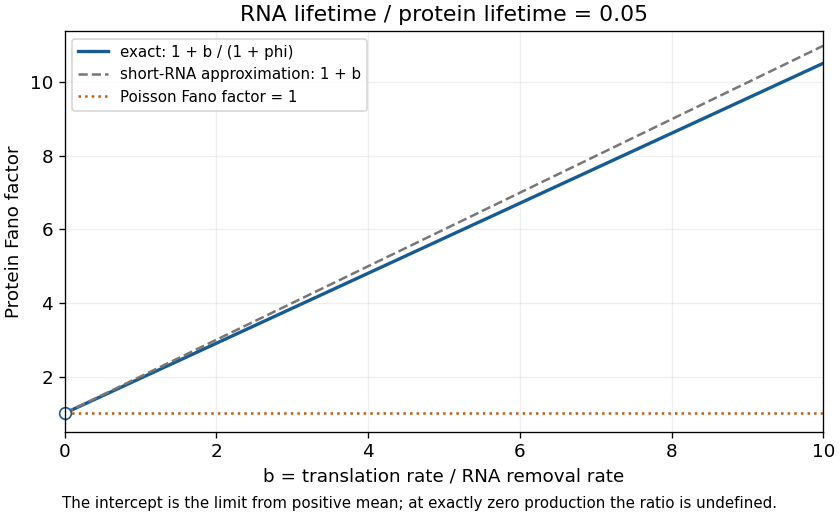
Protein Fano factor versus dimensionless rate of biological translation for a short-lived RNA and stable protein: exact two-stage result, burst approximation, and the Poisson baseline
. Details. 
Intrinsic gene-expression noise is variability from the random reaction events of the expression process itself, conditional on the cell's shared state: transcript production and removal, translation events and protein loss. It remains possible in nominally identical cells in the same environment and is particularly visible when molecule numbers are small.
Extrinsic gene-expression noise comes from fluctuations in shared cellular conditions, such as cell size, growth state, expression machinery abundance or environmental signals. It can correlate otherwise distinct expression processes. In a matched two-reporter measurement, reporter differences reveal an intrinsic component while correlated cell-to-cell changes reveal a shared component, after reporter-specific measurement noise is accounted for.[ref]
Stochastic Gene Expression in a Single Cell by Michael B. Elowitz and others. Matched fluorescent reporters separate within-cell reporter differences from correlated cell-to-cell variation
Intrinsic fluctuations can be beneficial when a population gains a diversity of temporary physiological states, or when a noisy threshold crossing helps a cell explore or select a state. They can be detrimental when an essential product transiently falls too low, when tightly coordinated components become imbalanced, or when a regulatory threshold is crossed at an inappropriate time. These are context-dependent effects: noise is not automatically adaptive, and increasing a Fano factor is not synonymous with improving a cellular function.
Articles by others on the same topic
There are currently no matching articles.