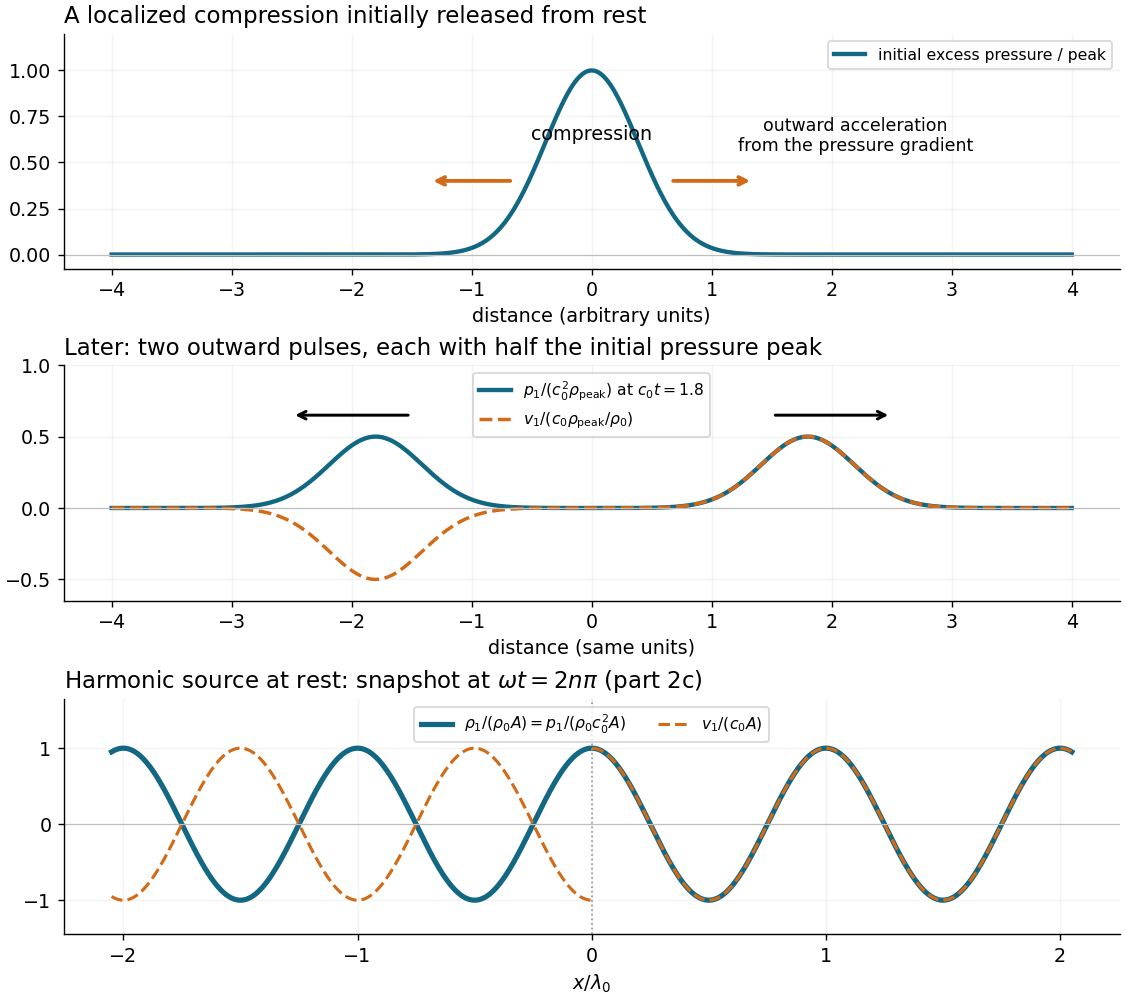
Compressing a small region raises its mass density and, for positive compressibility, its pressure. The outward pressure gradient force accelerates neighbouring fluid elements. Their outward motion compresses fluid farther away, carrying the disturbance outward. The original compressed region relaxes; inertia allows the fluid motion to continue beyond zero excess pressure, producing a rarefaction and a restoring pressure gradient force. Elastic compression and inertia therefore support a propagating longitudinal wave.
In a local planar description with acoustic displacement ,so . The speed of sound is a propagation speed, whereas the acoustic particle velocity is the small back-and-forth motion of the medium. In linear acoustics, energy travels with the disturbance without first-order net transport of the fluid over a wave period.

Articles by others on the same topic
There are currently no matching articles.