Let be a stable equilibrium separation: , . With bond extension , the Taylor expansion isThe harmonic approximation applies when the typical thermal and zero-point bond fluctuations satisfy and the higher terms are negligible, for example and . The relevant small quantity is the relative displacement of neighbouring atoms. Small bond excursions about a stable minimum give an amplitude-independent spring constant . Large thermal excursions, bond breaking or appreciable anharmonicity invalidate the approximation.
With atomic displacement , the harmonic potential energy is . Newton's second law givesFor a periodic chain of atoms, its normal modes are , with and one representative per Brillouin zone. Substitution yields the monatomic-chain dispersion relationA real general displacement is a superposition of these normal modes and their complex conjugates. The mode is a rigid translation. At small , the acoustic phonon branch is linear, with speed of soundFor , the group velocity is and vanishes at the zone boundary. The dashed initial tangent in the sketch has slope .
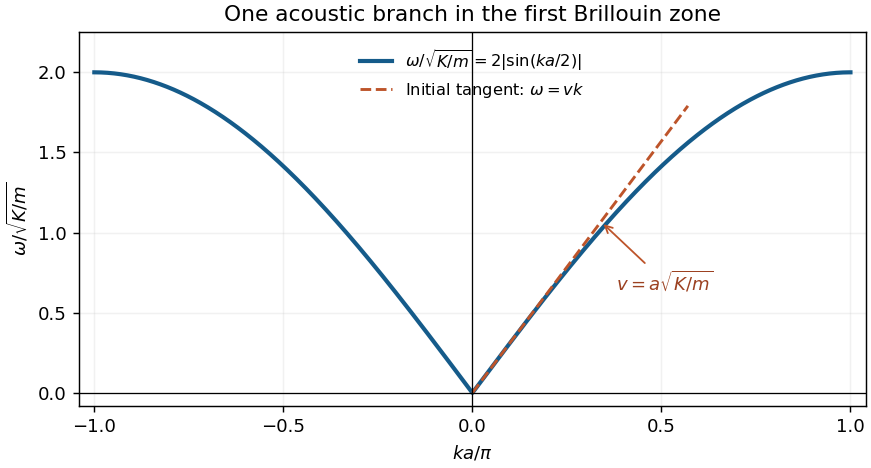

For the Lennard-Jones potential,Its minimum and harmonic spring constant areUsing the monatomic-chain dispersion relation,The maximum is at . Taking the argon atomic mass as and givesThese are the stipulated one-dimensional nearest-neighbour model estimates; a three-dimensional argon crystal has additional neighbours and phonon polarizations.
Articles by others on the same topic
There are currently no matching articles.