For the mutually orthogonal direct primitive lattice translation vectors , define the reciprocal lattice basis byThus , with integer , satisfies for every lattice vector .
Write . The electron density is periodic with period one in each , so its three-dimensional Fourier series has integer harmonics:If is a primitive unit cell of volume , Fourier orthogonality givesConversely, translation by multiplies a general plane wave by . Periodicity permits only , precisely the reciprocal lattice vectors. For a physical bounded periodic electron density, the expansion exists in the usual square-integrable sense.
Use the scattering vector ; reversing its sign conjugates the following amplitudes without changing the intensities. In the kinematic approximation, the atomic scattering factor of atom isAtoms at therefore give the scattering amplitudeHere is the single-electron amplitude; is the unit cell structure factor, and is the geometrical lattice sum. If the crystal has repeats along , the latter factor is a product of geometric series, whose magnitudes containThe sharp constructive peaks occur when every . Thus a permitted reflection has wavevector change equal to a reciprocal lattice vector, with and the additional elastic condition . A finite crystal broadens these peaks; it does not impose an exact delta-function selection on every scattered photon.
In the conventional cubic unit cell, the four face-centered cubic lattice positions contributeThe two-atom atomic basis of a crystal gives the zinc blende structure factorMixed-parity Miller indices have . With all indices even or all odd, . For real atomic scattering factors,Hence all same-parity reflections are generally permitted in GaAs, although the last class is weak when the two atomic scattering factors nearly coincide. These are the structural selection rules; a particular experiment must also satisfy the elastic Bragg scattering condition.
In the electron-count estimate , , the structure factors are and . Thus a single-directed-reflection estimate isA powder X-ray diffraction peak collects all equivalent reflections. The powder diffraction multiplicities are eight for and six for , so the multiplicity-and-electron-count estimate isAt the two sublattice amplitudes are opposite in phase and nearly cancel; at their relative phase is a quarter cycle, so this cancellation does not occur. In silicon, the two atomic scattering factors are identical and the diamond cubic structure has an exactly forbidden reflection, while remains allowed in the kinematic approximation.
The numerical ratio neglects the angular dependence of the atomic scattering factors, the Lorentz-polarization factor and thermal-motion corrections. No wavelength or measurement geometry is supplied to refine those factors. This is therefore a stated structural estimate, rather than a unique precision ratio of measured peak areas.
Let be a stable equilibrium separation: , . With bond extension , the Taylor expansion isThe harmonic approximation applies when the typical thermal and zero-point bond fluctuations satisfy and the higher terms are negligible, for example and . The relevant small quantity is the relative displacement of neighbouring atoms. Small bond excursions about a stable minimum give an amplitude-independent spring constant . Large thermal excursions, bond breaking or appreciable anharmonicity invalidate the approximation.
With atomic displacement , the harmonic potential energy is . Newton's second law givesFor a periodic chain of atoms, its normal modes are , with and one representative per Brillouin zone. Substitution yields the monatomic-chain dispersion relationA real general displacement is a superposition of these normal modes and their complex conjugates. The mode is a rigid translation. At small , the acoustic phonon branch is linear, with speed of soundFor , the group velocity is and vanishes at the zone boundary. The dashed initial tangent in the sketch has slope .
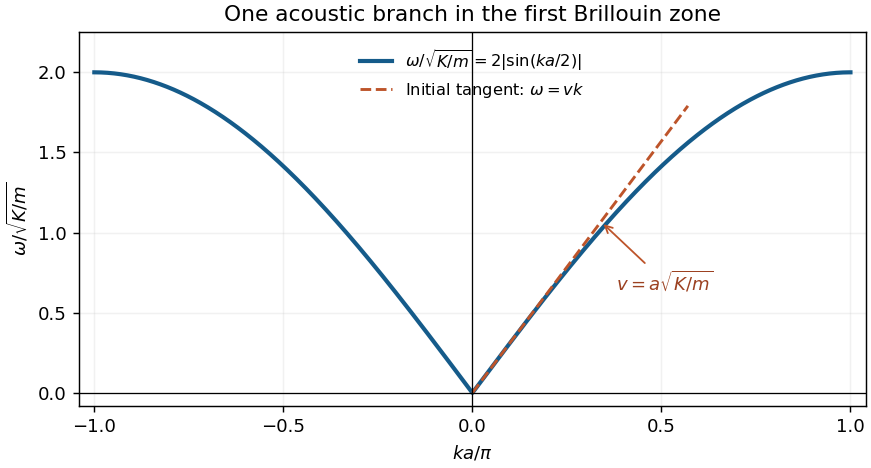

For the Lennard-Jones potential,Its minimum and harmonic spring constant areUsing the monatomic-chain dispersion relation,The maximum is at . Taking the argon atomic mass as and givesThese are the stipulated one-dimensional nearest-neighbour model estimates; a three-dimensional argon crystal has additional neighbours and phonon polarizations.
Normalize the plane waves in a periodic crystal of area or volume . The Fourier coefficients of the periodic potential obeyTranslation of the integral by any lattice vector leaves it invariant but multiplies it by . A nonzero result therefore requires to be a reciprocal lattice vector.
Near an isolated Bragg scattering degeneracy, ordinary nondegenerate perturbation theory fails because the free energies coincide. Retain the resonant plane waves , and apply degenerate perturbation theory. Absorb the constant into the energy origin. Since a real potential has , the projected Schrödinger equation has coefficient matrixA nonzero eigenstate requiresOff-resonant plane waves give higher-order energy shifts omitted in this leading nearly-free electron model.
Let andAt the two degenerate plane waves have momenta and and coupling . ThusTheir symmetric and antisymmetric combinations are the lower and upper states respectively. The local band gap is .
Put . At , the free energy is . The four cyclic combinations in the supplied secular equation give the four-plane-wave splitting at a square-zone cornerFor example, the normalized coefficient vectors in the source's cyclic basis are , , , and . Because , these are ordered as written: a lower singlet, a central doublet and an upper singlet. The sketch puts the and energies on one common scale; its representative negative couplings are stated in the caption.
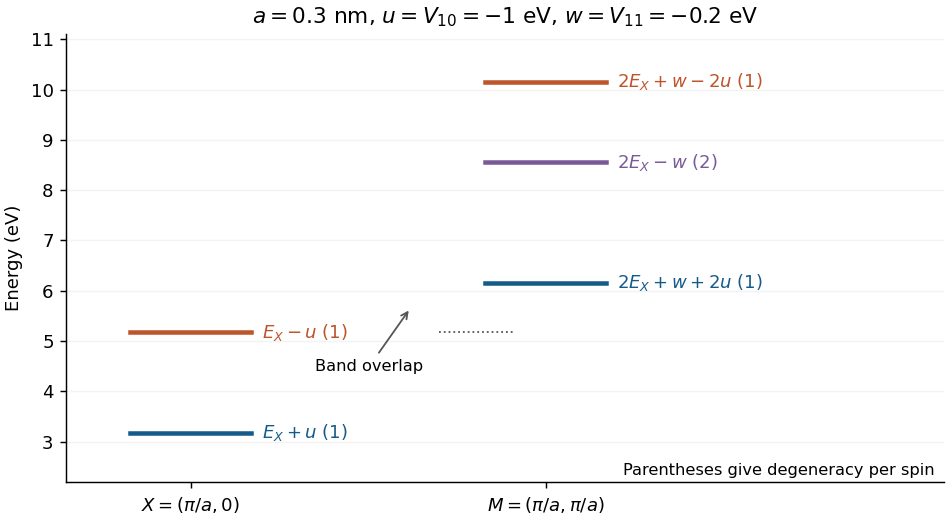
Common energy scale at the square-zone edge and corner, with illustrative couplings V10 = −1 eV and V11 = −0.2 eV
. Details. 
There are two electrons per primitive unit cell; a spin-degenerate energy band accommodates exactly that number. A semiconductor results when the first band is full and does not overlap the second. In the leading two-wave/four-wave approximation, compare the first-band maximum at with the second-band minimum at :This is an indirect band gap; a nonzero local splitting at alone is insufficient. At the onset,With , gives , henceFor more negative than this value the estimated indirect band gap is positive; at equality the bands just touch. This is the onset estimate within the source's nearly-free electron model truncation, not an exact critical potential after coupling all plane waves.
The Brillouin function is odd, increases monotonically through zero, and approaches for . Its small- slope is . For , the magnetic ions overwhelmingly occupy the largest field-aligned moment projection, so the magnetization reaches magnetic saturation:The sketch shows several values; all have the same limiting values, while their slopes differ.
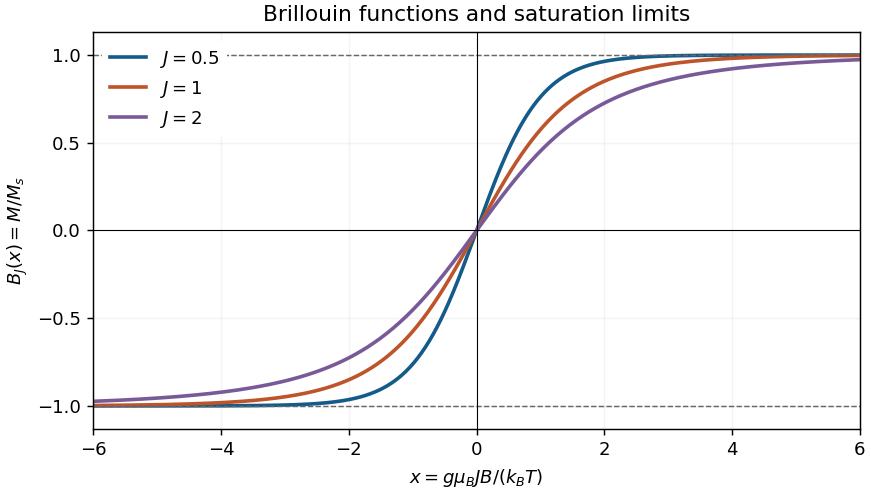
Brillouin functions approaching magnetic saturation
. Details. 
The terms in the Brillouin function cancel. Keeping the linear terms givesConsequently,Use the dimensionless SI magnetic susceptibility and , as in the source's molecular-field convention. The Curie law isIf susceptibility is instead defined as , its coefficient is and is dimensionful. The SI convention above makes the subsequent Curie–Weiss law and consistent.
For positive , a fluctuation of magnetization produces a Weiss molecular field in the same direction, reinforcing alignment. The mean-field self-consistency equation isLinearizing in the paramagnetic phase givesAt zero applied field, the right-hand side's slope at is . Below this exceeds one, and the saturation of the Brillouin function allows stable nonzero solutions of opposite sign: spontaneous ferromagnetism. Above , only the zero-field solution remains stable. The stated linear susceptibility is the paramagnetic branch for ; it must not be continued as a negative susceptibility below the transition.
Using the supplied iron parameters givesAn internal Weiss molecular field depends on temperature through . Its low-temperature saturation estimate uses :At and above the zero-applied-field magnetization vanishes in this model, so this is a saturation estimate, not the field at .
Use the paper's stipulated face-centered cubic lattice, which has twelve nearest neighbours. The saturated one-ion alignment scale isDividing the effective field among twelve equivalent neighbours gives the per-bond exchange interaction scaleTo specify the convention, write the Heisenberg model as , with dimensionless angular-momentum operators and each bond counted once. Then , so here. A convention with instead has . The total saturated interaction energy per ion is ; the factor of one half avoids counting each bond twice.
Articles by others on the same topic
There are currently no matching articles.