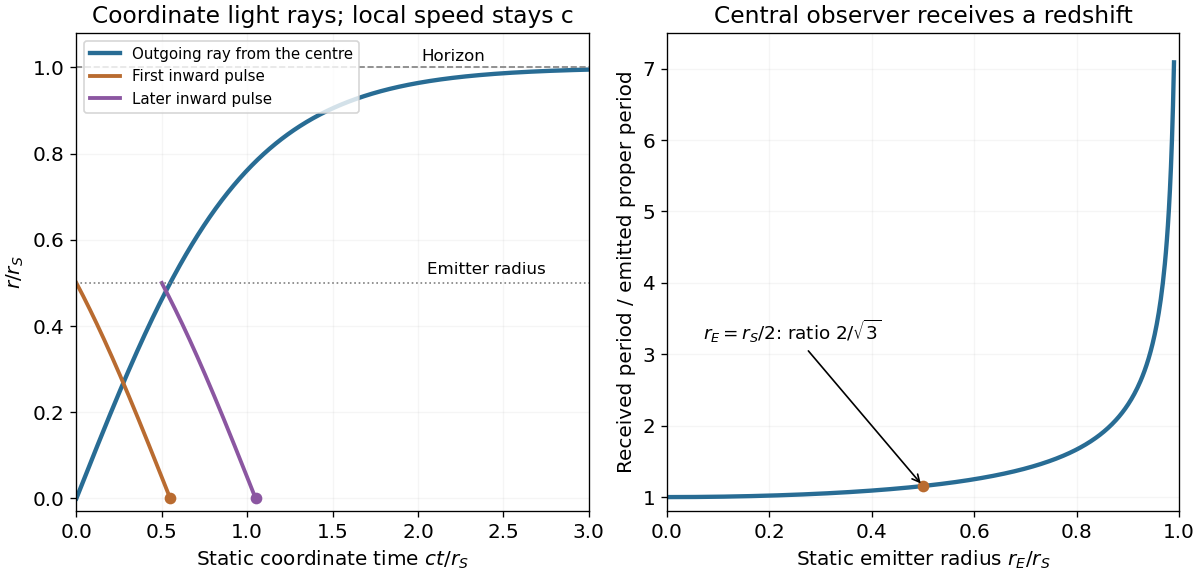
For radial null geodesics in a de Sitter static patch, the conserved time quantity and the stated normalization at the origin give . The null condition then givesThe emitted outgoing ray selects the positive branch, soThe ingoing branch would have instead. Set the affine parameter to zero at emission. Then , and integrating givesThe coordinate time diverges as , although the outgoing affine parameter reaches there. This is a coordinate-horizon effect: a local stationary observer inside the patch measures radial distance and proper time , whose ratio along the ray is still .

Articles by others on the same topic
There are currently no matching articles.