Take the unhalved geodesic LagrangianThe cyclic coordinates give and . The other two Euler-Lagrange equations areThese reproduce the supplied geodesic equations. Expanding the derivatives and comparing with , in coordinates , gives all nonzero Christoffel symbols:Here . This is the static patch of de Sitter spacetime, with for the stationary observers used below. Apparent divergences at the polar axis, origin or horizon belong to the chosen coordinate chart; they are not themselves evidence of a curvature singularity.
For radial null geodesics in a de Sitter static patch, the conserved time quantity and the stated normalization at the origin give . The null condition then givesThe emitted outgoing ray selects the positive branch, soThe ingoing branch would have instead. Set the affine parameter to zero at emission. Then , and integrating givesThe coordinate time diverges as , although the outgoing affine parameter reaches there. This is a coordinate-horizon effect: a local stationary observer inside the patch measures radial distance and proper time , whose ratio along the ray is still .
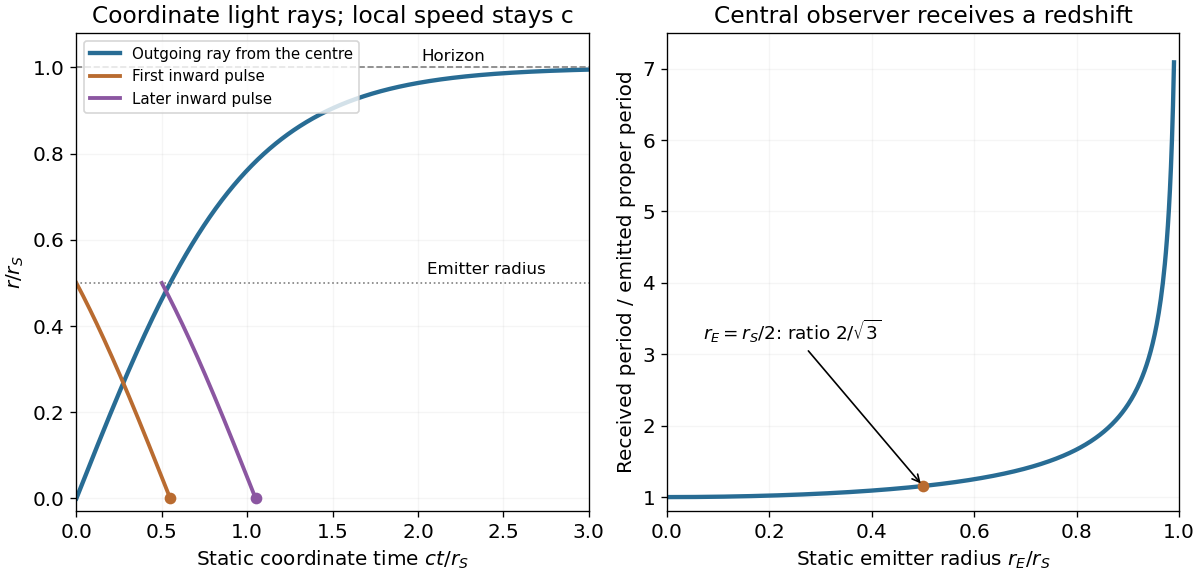

For the static-emitter redshift in a de Sitter patch, a stationary clock at radius satisfies . The geometry is stationary, so successive inward pulses emitted at the same radius have the same coordinate travel delay. Their coordinate arrival interval is therefore . At the central receiver , givingFor , this becomesThe pulses are redshifted at the centre. At fixed proper emission period, taking a stationary emitter toward the horizon gives , and . The inward coordinate travel delay also diverges. A stationary worldline at the horizon itself is not timelike, and the proper acceleration required to hold an emitter static diverges in this limit; the result concerns a sequence of idealized emitters with , not a stationary physical lighthouse exactly on the horizon.
Articles by others on the same topic
There are currently no matching articles.