For the A3 root system, take simple roots for in the hyperplane of an orthonormal . Its Dynkin diagram is the single-bond chain . The Cartan matrix has entries , givingFor a weight , use Dynkin labels . The four weights of the defining representation have labelsThey form the weight system with highest weight . Equivalently, subtract successive rows of from that highest weight. The dual representation negates every weight, so the weight system with highest weight isAll these weights have multiplicity one. The numbered Dynkin diagrams used in this solution and in solution are shown below.
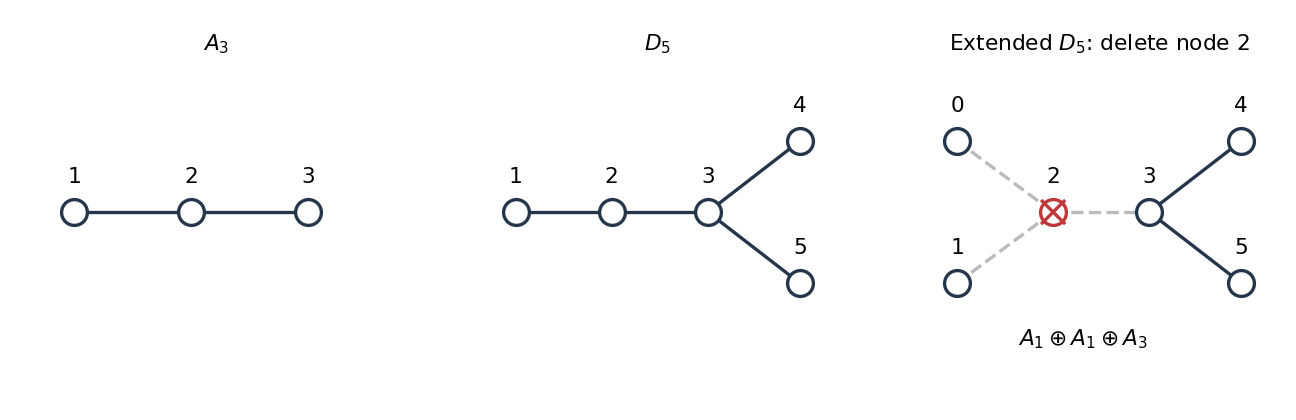
Numbered Dynkin diagrams for the A3 root system and D5 root system, with deletion from the Extended Dynkin diagram
. All bonds are single. In the Extended Dynkin diagram of the D5 root system, deleting node 2 separates nodes 0 and 1 and leaves the three-node chain 4-3-5, giving the root subsystem . Details.
For the D5 root system, take an orthonormal basis and simple roots for , together with . The Dynkin diagram has single bonds , , , , with the fork at node . Thus its Cartan matrix isThe fundamental weight has Dynkin labels . Its pairing with every positive coroot , , is zero or one. Hence its half-spin representation is a minuscule representation, so its weight system is a single Weyl group orbit with multiplicity one. The Weyl group of the D5 root system permutes coordinates and changes an even number of signs. Consequently its complete weight system isThere are such weights. Their Dynkin labels are , explicitlyHere the Lie algebra is , or its compact real form when discussing compact groups. Globally the half-spin representation is a representation of , and does not descend to ; the question only specifies the Lie algebra.
The highest root of the D5 root system in our numbering is . Adjoin . The Extended Dynkin diagram has an extra bond . Deleting node leaves the two isolated nodes and the chain , hence the root subsystem .
This is a maximal Lie subalgebra, not merely a full-rank Lie subalgebra. In the orthogonal realization it is , acting on a decomposition. The remaining off-diagonal part transforms as the irreducible tensor product representation of dimension . Any intermediate Lie subalgebra containing one nonzero vector in that complement must contain the entire complement, because this representation is irreducible, and hence all dimensions. This proves maximality.
To apply the supplied projection, write a D5 root system weight as the column of Dynkin labels. ThenFor example, the highest weight maps to , and maps to . Applying the same expression to all sixteen weights in solution gives exactlywhere and are the four-element weight systems in solution. Each set has eight distinct weights, each of multiplicity one. Since an doublet has weights and an singlet has weight zero, the branching of a representation isThe highest weights of these two summands are and , and checks the dimensions. Here is the convenient covering group; its image inside has a common central identification. Both summands are trivial on .
Choose the first as and embed in the upper-left three-by-three block of . The fundamental representations then restrict as and . Thus the representation in solution, forgetting hypercharge, restricts toThis contains every required representation, with one extra singlet.
For the hypercharge embedding, let in the fundamental representation, and in the second . These commute with . The integer normalization in the paper isExplicitly, this circle group embeds in the covering group byBoth nontrivial blocks have determinant one, and the map is injective since the first three entries of the block recover .
On , , so the branching of a representation gives . On , the U(1) charges under are on and on , while takes values . HenceCombining the two summands givesThis is the Pati-Salam charge embedding, with . In terms of the common Standard Model convention , the paper's integer hypercharge is .
The extra neutral singlet can be interpreted as the left-handed charge conjugate of a right-handed neutrino. It is a sterile neutrino under the Standard Model gauge group, and completes the sixteen Weyl fermions of one family in this half-spin representation. Its neutrality permits a Majorana mass term without violating the remaining Standard Model gauge group.
Articles by others on the same topic
There are currently no matching articles.