A subgroup of a group is a nonempty subset closed under the inherited multiplication and inverses; equivalently, whenever . A normal subgroup satisfies for every .
A group representation on a vector space is a group homomorphism , so and . An irreducible representation has and no invariant subspaces other than and : there is no proper nonzero with for every . We use finite-dimensional complex representations, with continuity for Lie groups, throughout.
Branching of a representation describes the irreducible representation content of a restriction of a representation:This direct decomposition applies when the restriction of a representation is a semisimple representation, as for finite groups or continuous finite-dimensional representations of compact groups. For an arbitrary group and subgroup, complete reducibility need not hold. A vector subspace preserved by every for need not be preserved by the additional for , so an irreducible representation can become reducible.
For a concrete example, take the defining representation of on and , a subgroup isomorphic to the circle group. The defining representation is irreducible: acts transitively on unit vectors, so no complex line is preserved by all its elements. Under , the two coordinate lines are invariant subspaces, andHere the two one-dimensional representations act by and .
Let . The group homomorphism given by is injective, identifying the finite cyclic group with the subgroup of th roots of unity in the circle group.
The continuous irreducible representations of the circle group are the one-dimensional representations with . One way to see this is to make the representation unitary by averaging, simultaneously diagonalize its commuting unitary matrices, and impose . Its restriction of a representation isThus each irreducible representation remains one-dimensional, and representations whose integer labels differ by a multiple of become equivalent. Every irreducible representation of the finite cyclic group occurs this way.
Choose a normalization in which the circle group has period and the U(1) charges of the complex scalar fields are integers. By restriction of a representation,Write . A vacuum expectation value is preserved by precisely when . Therefore the specified finite cyclic group survives spontaneous symmetry breaking exactly when every condensing complex scalar field obeysOnly U(1) charges of fields with nonzero vacuum expectation values enter this test; in the paper all fields condense.
Suppose at least one condensing U(1) charge is nonzero and put . Since each such U(1) charge is a multiple of , every th root of unity preserves the vacuum expectation values. Conversely, the Bezout identity expresses as an integer combination of these U(1) charges, so a common stabilizer obeys . The discrete remnant of a circle symmetry is consequentlyA nontrivial retained finite cyclic group exists exactly when , and its possible orders are the divisors of . For example, condensing U(1) charges and leave . If , the stabilizer is trivial. If all condensing U(1) charges vanish, the entire circle group is unbroken and there is no largest finite ; this case does not break the symmetry assumed in the question.
Normalize the circle group as in solution and count all Weyl fermions as left-handed; a right-handed Weyl fermion is replaced by its left-handed charge conjugate. The restriction of a representation givesThe triangle coefficient of the cubic U(1) gauge anomaly is proportional to . In a theory with this single gauge group, cancellation of its local pure gauge anomaly requiresIf absence of the mixed gauge-gravitational anomaly is also required, as when coupling to a general gravitational background, one additionally needs . Additional gauge group factors would require their mixed gauge anomalies to cancel as well.
Choose integer representatives and write . Expanding the cubic givesHence the inherited necessary congruence, and its gravitational counterpart when imposed, areThese statements concern the same complete fermion spectrum used in the parent theory. They are consequences of an anomaly-free integer lift, rather than a full classification of intrinsic discrete gauge anomalies or a sufficient test for such a lift. They also do not imply an ordinary equality for the chosen residues: for , the anomaly-free U(1) charges have residues , whose cubes sum to , rather than zero. Integrating out heavy fermions can require extra contributions to the effective discrete gauge anomaly accounting.
Conjugacy classes in the symmetric group are specified by cycle type, equivalently a partition of . If counts cycles of length , the number of permutations of that cycle type is : cyclic rotation of each cycle and interchange of equal-length cycles do not change the permutation. This givesThe sizes sum to . Since the number of complex irreducible representations of a finite group equals its number of conjugacy classes, has inequivalent complex irreducible representations.
The trivial representation and sign of a permutation giveThey are one-dimensional representations, hence irreducible representations. Their characters, in the conjugacy class order of solution, areThese are the only one-dimensional representations. All transpositions are conjugate, so they have the same scalar image in any one-dimensional representation; since a transposition squares to the identity, . Transpositions generate the symmetric group, fixing the whole representation once is chosen.
By the sum of squares of irreducible representation dimensions, the three remaining dimensions satisfy , with each . No can be at least , since . Thus the only possible dimensions are
Use the composition convention . Then . Since the sign of a permutation is multiplicative, the same calculation gives . Both send the identity to and have inverses given by , so both are group representations.
The trace of a permutation matrix counts fixed points, and multiplying that matrix by its sign of a permutation multiplies its trace by that sign. Thus the two characters areLet and . Both are invariant subspaces, and . On , is the trivial representation and is the sign representation. Subtracting their characters yieldsThe character inner product verifies that it is an irreducible representation:The squares of the entries of are identical, so its character inner product with itself is also one. Their values at a transposition differ, so these irreducible representations are inequivalent. Therefore
Only the character of the two-dimensional irreducible representation remains unknown. Write it as . The regular representation has character zero off the identity and decomposes with multiplicities equal to the irreducible representation dimensions. Thus, for a nonidentity element ,For the four nonidentity conjugacy classes this gives , , , . The complete character table is consequentlyFor example, , agreeing with character orthogonality.
Use the realization from solution. Put , which identifies the three-dimensional scalar field with . The polynomial invariants of the standard S4 representation include the symmetric power sumsbecause every permutation merely rearranges their summands. In these coordinates,Neither polynomial vanishes identically: at they equal and . Hence coefficients multiplying and provide nonzero invariant quadratic and cubic terms. A change of basis transports these polynomial invariants to any equivalent realization of . For a real scalar field, both are real. For a complex scalar field, a real scalar potential may contain ; the quadratic Hermitian form is another invariant.
As an independent character check, the symmetric square of a group representation has character , and the symmetric cube of a group representation has character . With these are and . Their character inner products with are both one, so each degree has exactly one independent polynomial invariant.
Schur's lemma states that an intertwiner between irreducible representations is either zero or an isomorphism. In particular, inequivalent irreducible representations have no nonzero intertwiners. For a finite-dimensional irreducible representation over the complex numbers, every commuting endomorphism is scalar:Indeed, the kernel and image of an intertwiner are invariant subspaces, proving the first statement. For the second, choose an eigenvalue of . The intertwiner has nonzero kernel, so it must vanish. The scalar conclusion uses an algebraically closed coefficient field: over the real numbers, planar rotation through gives an irreducible real representation of and commutes with itself without being a real scalar matrix.
Partition into the same five-by-five blocks as . The equation for block is , so each block is an intertwiner. By Schur's lemma, blocks between the two inequivalent irreducible representations vanish, whereas blocks between identical copies are arbitrary scalar multiples of the relevant identity matrix. Thus the commutant of a semisimple representation isEquivalently, , where and . Substitution proves every such matrix commutes with every . There is no invertibility requirement on , and its solution space has complex dimension , even if .
The identity belongs to the centralizer . If , then for every ,Also implies by multiplying on both sides by . Hence and belong to , proving by the subgroup test that . This argument works even when is any subset, giving the centralizer of a subset.
Write and partition a matrix into blocks. The equation makes its off-diagonal blocks obey and for every . Choosing any with forces both blocks to vanish. Conversely, every block diagonal matrix commutes with every . Intersecting with the special unitary group gives the exact centralizerIts Lie algebra is . At the group level there is a finite central identification. The surjective group homomorphismhas kernel . Surjectivity follows by choosing with for any target pair , and setting , . ThusThe six distinct kernel elements give a concrete reason the displayed map does not identify the centralizer with an unquotiented product.
Number the simple roots of the root system consecutively along its Dynkin diagram. For a Young diagram with row lengths , its highest weight has Dynkin labels . The three irreducible representations have the following Young diagrams, which can be filled increasingly down the column to give Young tableaux:Here , , and . Contraction with the invariant alternating tensor identifies , giving the dual representation of . The dimensions follow from , , .
Use the centralizer and circle group normalization of solution. The first three components have U(1) charge and the last two have U(1) charge , so the branching of a representation isFor the dual representation, both U(1) charges reverse and the representation is conjugated; the doublet is equivalent to its conjugate. Taking the exterior square of the first decomposition gives three types of antisymmetric tensor components: , , and , where and . Their U(1) charges add, and , . HenceThe dimensions are . These product labels describe genuine representations of the quotient group in solution: every element of its kernel acts trivially on each summand.
For the A3 root system, take simple roots for in the hyperplane of an orthonormal . Its Dynkin diagram is the single-bond chain . The Cartan matrix has entries , givingFor a weight , use Dynkin labels . The four weights of the defining representation have labelsThey form the weight system with highest weight . Equivalently, subtract successive rows of from that highest weight. The dual representation negates every weight, so the weight system with highest weight isAll these weights have multiplicity one. The numbered Dynkin diagrams used in this solution and in solution are shown below.
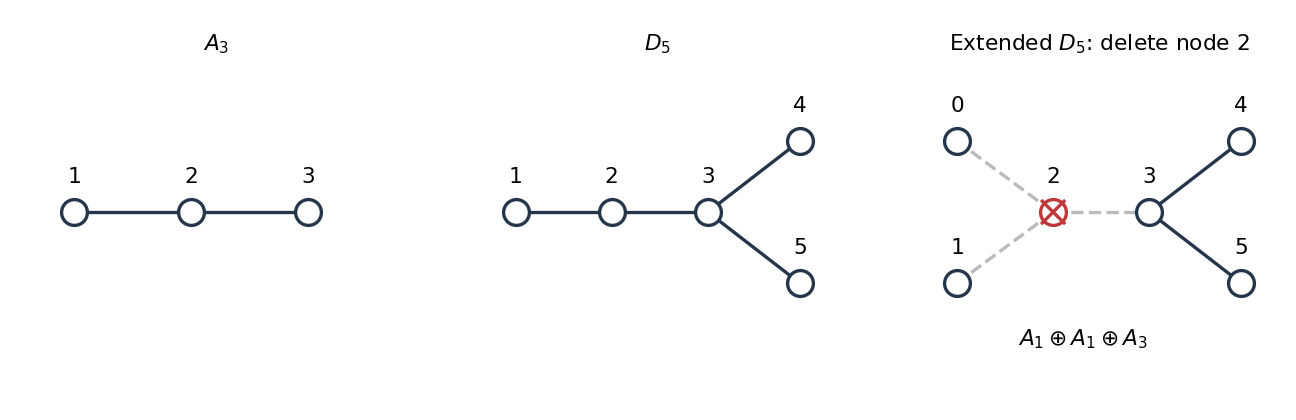
Numbered Dynkin diagrams for the A3 root system and D5 root system, with deletion from the Extended Dynkin diagram
. All bonds are single. In the Extended Dynkin diagram of the D5 root system, deleting node 2 separates nodes 0 and 1 and leaves the three-node chain 4-3-5, giving the root subsystem . Details.
For the D5 root system, take an orthonormal basis and simple roots for , together with . The Dynkin diagram has single bonds , , , , with the fork at node . Thus its Cartan matrix isThe fundamental weight has Dynkin labels . Its pairing with every positive coroot , , is zero or one. Hence its half-spin representation is a minuscule representation, so its weight system is a single Weyl group orbit with multiplicity one. The Weyl group of the D5 root system permutes coordinates and changes an even number of signs. Consequently its complete weight system isThere are such weights. Their Dynkin labels are , explicitlyHere the Lie algebra is , or its compact real form when discussing compact groups. Globally the half-spin representation is a representation of , and does not descend to ; the question only specifies the Lie algebra.
The highest root of the D5 root system in our numbering is . Adjoin . The Extended Dynkin diagram has an extra bond . Deleting node leaves the two isolated nodes and the chain , hence the root subsystem .
This is a maximal Lie subalgebra, not merely a full-rank Lie subalgebra. In the orthogonal realization it is , acting on a decomposition. The remaining off-diagonal part transforms as the irreducible tensor product representation of dimension . Any intermediate Lie subalgebra containing one nonzero vector in that complement must contain the entire complement, because this representation is irreducible, and hence all dimensions. This proves maximality.
To apply the supplied projection, write a D5 root system weight as the column of Dynkin labels. ThenFor example, the highest weight maps to , and maps to . Applying the same expression to all sixteen weights in solution gives exactlywhere and are the four-element weight systems in solution. Each set has eight distinct weights, each of multiplicity one. Since an doublet has weights and an singlet has weight zero, the branching of a representation isThe highest weights of these two summands are and , and checks the dimensions. Here is the convenient covering group; its image inside has a common central identification. Both summands are trivial on .
Choose the first as and embed in the upper-left three-by-three block of . The fundamental representations then restrict as and . Thus the representation in solution, forgetting hypercharge, restricts toThis contains every required representation, with one extra singlet.
For the hypercharge embedding, let in the fundamental representation, and in the second . These commute with . The integer normalization in the paper isExplicitly, this circle group embeds in the covering group byBoth nontrivial blocks have determinant one, and the map is injective since the first three entries of the block recover .
On , , so the branching of a representation gives . On , the U(1) charges under are on and on , while takes values . HenceCombining the two summands givesThis is the Pati-Salam charge embedding, with . In terms of the common Standard Model convention , the paper's integer hypercharge is .
The extra neutral singlet can be interpreted as the left-handed charge conjugate of a right-handed neutrino. It is a sterile neutrino under the Standard Model gauge group, and completes the sixteen Weyl fermions of one family in this half-spin representation. Its neutrality permits a Majorana mass term without violating the remaining Standard Model gauge group.
Articles by others on the same topic
There are currently no matching articles.