Source PDF: mmathphys.physics.ox.ac.uk/sites/g/files/vzsiac2991/files/mmathphys/documents/media/a15090h1.pdf
These solutions cover every part of the held paper. Numbered headings identify the corresponding source parts; the question statements are not reproduced.
A group representation on a vector space is a group homomorphism , so and . A nonzero group representation is an irreducible representation if its only invariant subspaces are and . Here the representations and characters are finite-dimensional over the complex numbers.
- It is a class function: , by the cyclic property of the trace.
- It is additive on a direct sum and multiplicative on a tensor product of group representations: and .
- The irreducible characters obey character orthogonality:
In particular, and , the latter following from unitarization of a finite-group representation. The character inner product counts the multiplicity of an irreducible representation in .
For any , left multiplication permutes the elements of the finite group. Consequently averaging over a finite group givesThus belongs to the fixed-point subspace of a group action ; any nonzero such vector spans a trivial representation, or singlet. The zero vector is included in the invariance statement.
Conversely for every , soThis is a projection operator onto all singlets, rather than necessarily onto a one-dimensional vector subspace. Its trace is the singlet multiplicity .
Put and . Direct matrix multiplication givesMoving every to the right shows that every word in these generators of a group has the form , with and . The three are distinct diagonal matrices, and the three are distinct off-diagonal matrices. HenceSince , this is a non-abelian group. Its group presentation identifies it with the dihedral group of an equilateral triangle, equivalently the symmetric group .
The conjugacy classes areIndeed interchanges and by conjugation, while runs through all three reflections. No reflection is conjugate to a rotation, since conjugation preserves order of a group element.
There are three inequivalent complex irreducible representations, one for each conjugacy class. The sum of squares of irreducible representation dimensions gives . One representation is trivial, and the only possible positive integer dimensions are
Write for the trivial representation, for the sign representation, and for the given two-dimensional group representation. Their matrix representations on the generators of a group arewith . The two eigenvalues of in are distinct, and exchanges its two eigenlines; no line is invariant under both. Thus is an irreducible representation. The dimensions already exhaust the sum of squares of irreducible representation dimensions, so this is the complete list.
Since , the character table isMultiplying characters and using character orthogonality gives every tensor product of group representations:For example . Explicit Clebsch-Gordan coefficients can be read from two doublets , :The first two combinations are invariant under and respectively even and odd under ; the last transforms by the displayed doublet matrices.
Choose the doublet bases so that the column of barred fields and both transform by the doublet matrices in d. This choice follows the source's assignment of the barred doublet itself. Since transforms in , its Yukawa coupling must multiply a fermion bilinear in .
There is exactly one such bilinear in : the Clebsch-Gordan coefficients in d give . Equivalently, writing the upper block of the Yukawa matrix as , invariance requiresThe first equation sets , because ; the second sets .
A mixed doublet-singlet bilinear remains a doublet after multiplication by , so all four mixed entries vanish. Finally transforms in , and multiplication by makes it invariant. ThereforeThe allowed Yukawa interaction is , together with its Hermitian conjugate when forming a real Lagrangian density.
The displayed texture depends on basis. If instead the unbarred left doublet is assigned in the same ordering as the right doublet, its barred doublet has the dual representation and the equivalent upper block is . Exchanging the two barred components converts between these descriptions. In either convention there are exactly two independent complex Yukawa couplings.
For a curve in the special orthogonal group, differentiate at the identity. This gives . Conversely, the matrix exponential of any real skew-symmetric matrix is orthogonal and has determinant . HenceA basis is for , where is a matrix unit. If and , their Lie brackets areThere are independent off-diagonal entries. A maximal torus rotates independently in mutually orthogonal two-planes, generated by . ThusThe maximality follows by simultaneously decomposing commuting real skew-symmetric matrices into rotation two-planes, with at most one remaining fixed axis.
The unbroken group is the stabilizer subgroup of the vacuum expectation value. For a nonzero vector vacuum expectation value, an orthogonal transformation puts . A special orthogonal transformation fixing it has the block form with . ConsequentlyThe zero vacuum expectation value leaves the entire special orthogonal group unbroken.
For a real symmetric tensor write its vacuum expectation value as a real symmetric matrix . The transformation is . The spectral theorem for real symmetric matrices gives an orthonormal basis in whichBecause is equivalent to , an unbroken transformation preserves each eigenspace. The complete unbroken group is thereforeIts identity component is . This symmetric tensor vacuum stabilizer shows why the representation alone does not determine a unique breaking pattern:
- If , all of survives, even when .
- If all eigenvalues are distinct, , consisting of diagonal sign changes with total sign ; no continuous symmetry survives.
- If the two eigenvalue multiplicities are and , then , with identity component .
For example a rank-one tensor preserves embedded by . Its continuous unbroken group is , but it also allows reversal of the distinguished axis. Restricting to a traceless symmetric tensor imposes and otherwise leaves the same classification.
The complexification of a Lie algebra gives of type Dn root system and of type Bn root system. For , the simple roots for and give a chain with two terminal nodes joined to . All edges are single. For , use for and . The Bn Dynkin diagram is a chain with a double final edge and an arrow pointing to the short node .
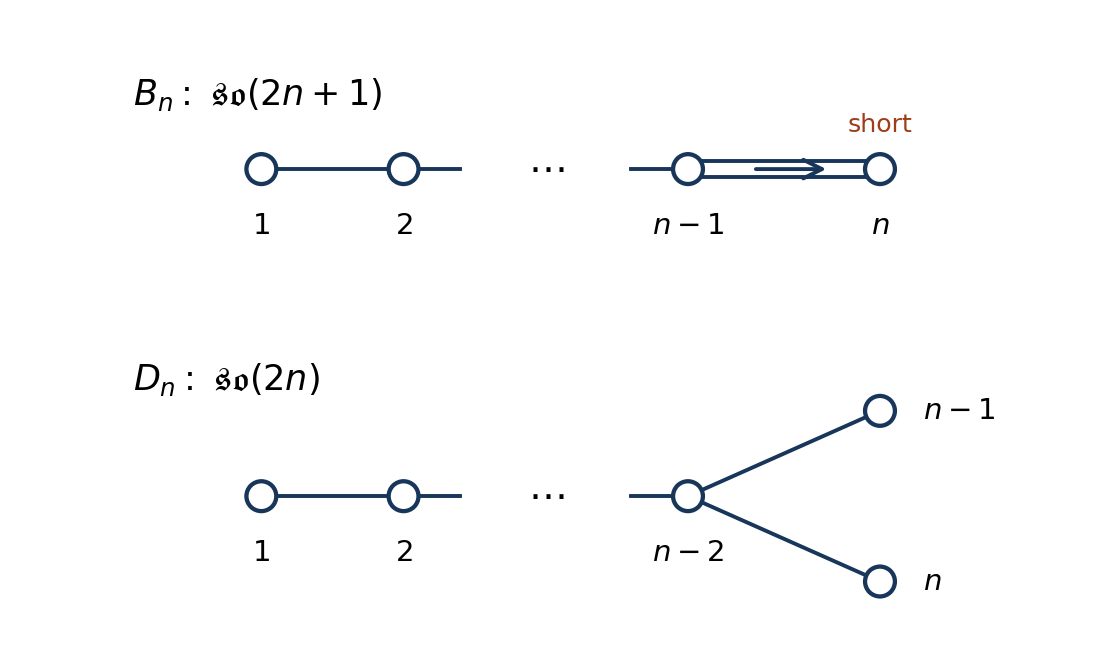
Dynkin diagrams of the odd and even orthogonal Lie algebras, with the final arrow pointing toward the short root
. Details. 
The usual family diagrams apply to for and for . The small cases are , , ; is one-dimensional and Abelian.
To fix Casimir normalization for orthogonal vector representations, use Hermitian Lie algebra generators , so the defining representation has Dynkin index . With long roots of squared length two, the quadratic Casimir operator has Casimir eigenvaluewhere is the Weyl vector and in the final expression is the column of Dynkin labels. The defining fundamental representation has highest weight in the stated family conventions.
For , the row supplied in the source has sum and first entry one, soFor , the supplied row has sum , givingTaking the trace of gives the relation between the Dynkin index and Casimir eigenvalue, . ThereforeThere is also a direct check: each coordinate appears in planes and , so .
If the Casimir operator is instead defined by , every Lie algebra generator is larger by and the corresponding answers are and . These are the same Lie algebra in a different normalization. At the exceptional small ranks the family Dynkin labels of the vector change, but the direct matrix computation remains valid.
In the normalization of c, the Adjoint representation of has highest weight , the highest root. The supplied Gram matrix has second row , whose sum is five. HenceThe Adjoint representation has the same dimension as the Lie algebra, so its Dynkin index is also . The Weyl fermions form a direct sum of vector representations; additivity of the trace gives .
Substitution into the given one-loop renormalization-group beta function yieldsFor positive , asymptotic freedom at this order requires a negative beta function, equivalentlyIndeed, if , integrating givesso the gauge coupling decreases towards zero as the energy scale increases. At the one-loop coefficient vanishes and the given equation cannot decide asymptotic freedom; has the opposite one-loop running.
With the alternative convention described in c, , , and the same source formula reads . Rescaling the gauge coupling together with the Lie algebra generators relates the conventions; the bound is identical.
Adopt the Minkowski metric and the Clifford algebra convention . The source's Pauli matrices giveThey satisfy , and , which verifies the required Clifford algebra. Raising the indices gives and .
Fix the sign of the rapidity by taking the Lorentz boostThe corresponding Spinor representation of the Lorentz group isFor example and , establishing Lorentz covariance by .
Thus the Dirac spinor transforms as , with infinitesimal lawThese variations compare the fields at corresponding spacetime points. At a fixed coordinate one adds the usual orbital term . Reversing the rapidity convention reverses both boost signs consistently. Infinitesimal transformations describe the proper orthochronous Lorentz group.
Choose the chirality operatorA Weyl spinor is a Dirac spinor restricted to one eigenspace of . The chiral projectors are and . ConsequentlyThe two independent Weyl spinors each contain one complex component. Since , each chirality is preserved by every connected Lorentz transformation, with and . A spatial reflection exchanges the two chiralities.
The left/right names depend on the sign convention for . Choosing as the chirality operator exchanges the labels and ; the two invariant one-component representations are the same.
All gamma matrices in this basis are real, and the Lorentz transformation is real. Therefore complex conjugation commutes with the connected Spinor representation of the Lorentz group. With a suitable phase convention, charge conjugation is simply . The Majorana spinor condition becomesThe reality constraint is preserved by Lorentz transformations because . For fermion fields, real components mean self-conjugate Grassmann variables or self-adjoint field components, rather than ordinary commuting real numbers.
Moreover, is real, so charge conjugation commutes with the chiral projectors. The Majorana spinor and Weyl spinor conditions can therefore be imposed simultaneously. The Majorana-Weyl spinors areThe independent real component counts areThese are component counts before imposing an equation of motion. In particular the simultaneous reality and chirality constraints are compatible in this spacetime dimension, unlike the familiar four-dimensional case.
Because the present is anti-Hermitian, choose the Dirac adjoint with Hermitian intertwining matrix :This convention makes the Dirac scalar bilinear Hermitian. For real , a Lorentz invariant mass term isTo check infinitesimal Lorentz invariance, put . Then and . Using a,Equivalently, , and similarly for its complex conjugate. Exponentiation gives and therefore .
At fixed coordinates has only the orbital variation of a Lorentz scalar; the spacetime measure is invariant under the connected Lorentz group, so the integrated action is invariant. The mass term pairs the two opposite chiralities; retaining only one Weyl spinor removes this Dirac mass. An equivalent spinor phase convention gives a real multiple of instead.
For the A5 root system, take simple roots , , in the hyperplane . Their squared lengths are two, adjacent simple roots have inner product , and all other pairs are orthogonal. Hence the An Dynkin diagram is the five-node single-edge chainIts Cartan matrix isThe complex Lie algebra is ; the corresponding compact special unitary group is , whose Lie algebra is its compact real form.
Let be the defining fundamental representation of . Its weights are . Pairing with the simple coroots gives Dynkin labels . Thus the complete list isSuccessive lowering operators subtract the corresponding rows of the Cartan matrix in a. Each weight multiplicity is one.
The complex-conjugate representation is the dual representation and has the negatives of these weights. Its highest weight is , and its entire weight decomposition isEvery entry has weight multiplicity one.
The two-index antisymmetric representation is , of dimension and highest weight . A weight basis is for , carrying weight . The fifteen sums, all distinct and all of weight multiplicity one, areThe exclusion of comes from the exterior square, where .
For the standard A4 root system inside the A5 root system, let delete the fifth Dynkin label. Put for . These are precisely the five weights of the defining fundamental representation:Since , the six projected weights of are . The first five form the dual representation , with highest weight ; the last is a singlet. ThusFor , split the fifteen weights in b into the ten pairs with and the five pairs . The former project to , the complete weight decomposition of , with highest weight . The latter project to , the complete weight decomposition of . ThereforeThis restriction of a representation can also be checked without a table: , so its dual representation is , while its exterior square is . The dimensions match and .
One generation of left-handed Standard Model fermions fits into of an SU(5) grand unified theory. With hypercharge defined by , their restriction of a representation to isHere in the multiplet list denotes the left-handed quark doublet, and the superscript labels left-handed charge-conjugate fields of the corresponding right-handed fermions.
The results of c therefore giveThus the required matter representations are present. The extra singlet has Standard Model representation and can describe the left-handed charge-conjugate field of a right-handed neutrino. Its gauge singlet character permits a Majorana mass term; a Yukawa interaction with a lepton doublet and a suitable Higgs field can then supply neutrino masses. The branching alone does not fix those interactions or their scales.
The extra hasIf it describes Weyl fermions, these are additional coloured and electroweak fermions in the conjugate Standard Model representations to the ordinary . With an additional , they can form a vectorlike gauge spectrum and acquire invariant masses. Pairing them with the only ordinary would also remove that generation's fields, so a realistic heavy pairing needs extra matter. If the instead describes a scalar field, it has the quantum numbers of the usual Higgs field: a weak doublet and a coloured triplet. A single fermionic does not turn its extra fermions into a scalar Higgs field merely by branching.
There is a further consistency condition if these are the entire chiral matter content of an gauge theory. Normalize the cubic anomaly coefficient by . The dual representation has , and the two-index antisymmetric representation has . Thus one copy of each has nonzero gauge anomaly, . Their inclusion of the desired multiplets is therefore not, by itself, a complete consistent chiral unified theory.
For example, anomaly cancellation holds for , whose restriction of a representation isThis leaves one ordinary generation, a potentially massive vectorlike gauge spectrum, and two possible singlet neutrinos. This anomaly-free matter choice is also used in explicit model constructions.[ref]
Number of fermion generations from a novel grand unified model by Pritibhajan Byakti and others. Section 3, equations (14)–(16) and following discussion: the fifteen-dimensional antisymmetric representation has anomaly coefficient 2, and the conjugate fundamental has coefficient −1
These interpretations require additional choices of matter statistics, spontaneous symmetry breaking, and interactions; the weight systems determine the multiplet content.Source PDF: mmathphys.physics.ox.ac.uk/sites/g/files/vzsiac2991/files/mmathphys/documents/media/a15090w1.pdf
A group representation on a vector space is a group homomorphism : and . A reducible representation has a nonzero proper invariant subspace , meaning for every . Over the complex numbers, a finite-dimensional representation of a finite group is a direct sum of irreducible representations, by Maschke's theorem.
The character of a representation is . The cyclic property of the trace makes it a class function:Thus a character is specified by one number per conjugacy class, much less information than all the representation matrices. Moreover,Here character orthogonality says that is the multiplicity of the irreducible representation . Consequently characters determine finite-dimensional complex representations up to equivalence of group representations and compute tensor product of group representations decompositions without constructing a new basis explicitly.
Compose permutations from right to left. The three transpositions are , and . In cycle notation, direct composition givesThe complete symmetric group is thereforeConjugation relabels the entries of a cycle, so the conjugacy classes are preciselyTheir sizes are , respectively. The differing orders of group elements also show that these three sets cannot merge under conjugation.
There is one complex irreducible representation for each conjugacy class, hence three. The trivial representation and sign representation are distinct and one-dimensional. The sum of squares of irreducible representation dimensions leavesCall the remaining irreducible representation . The permutation representation on has character equal to the number of fixed objects, namely on the ordered conjugacy classes . Removing its constant-vector trivial representation gives , whose character inner product with itself is one. This constructs and gives the character tableTo obtain every Clebsch-Gordan decomposition of group representations, multiply the characters pointwise. In particular, , andThus all ordered pairs of irreducible representations are covered by
All three displayed transposition matrices have trace zero. Multiplying two of them givessince . Their traces are , whereas . ThereforeBy character orthogonality, is the irreducible representation from c.
There is also a direct invariant subspace argument. The two distinct eigenvalues of force any invariant line to be one of the two coordinate lines. But exchanges those lines. Neither is invariant under the whole group, so this two-dimensional representation is irreducible.
The scalar fields commute, so a degree- expression in one doublet belongs to a symmetric power, rather than an arbitrary tensor product. Put , . The generators of a group and act byA monomial is fixed by precisely when is divisible by three. Imposing then pairs the exponents. Through degree four the resulting holomorphic polynomial invariants areIn particular, two explicit invariant terms are and . Their invariance follows directly from and the interchange of the two components. A quartic example is .
For a physical real scalar potential, complex conjugate fields are allowed as well. The Hermitian inner product and its square are also invariant, while a holomorphic term can enter with its complex conjugate, for example . There is still no invariant linear term, because neither the doublet nor its conjugate representation contains a trivial representation. Thus the possible nonconstant total degrees areThe constant term is unrestricted.
For the fundamental representation of the special unitary group , its central element sends and . Every odd-degree polynomial changes sign, excluding degrees one and three. Further, acts transitively on the unit sphere in : a unit vector is the first column ofAn invariant polynomial must therefore depend only on . Through quartic order the general real scalar potential isHence the possible nonconstant degrees are ; the cubic term permitted by is excluded by .
If the notation is instead read as restricting to holomorphic polynomials alone, the distinction matters: a single commuting doublet has no nonconstant holomorphic polynomial invariant. The candidate contraction vanishes identically. The quadratic and quartic terms above require complex conjugate fields. This also explains why counting a trivial representation in alone would give an incorrect holomorphic answer.
Use the mathematical Lie algebra convention . Differentiating and at gives and . Conversely, for such an , the matrix exponential is unitary and has determinant . ThusThe four diagonal entries are purely imaginary, and the six entries above the diagonal are arbitrary complex numbers determining the entries below it. This gives real parameters before imposing the one real trace constraint, so .
A Cartan subalgebra of this compact Lie algebra is a maximal commuting Lie subalgebra; chooseA simple basis is , whereAny matrix commuting with every diagonal element is itself diagonal, which proves maximality. Commuting skew-Hermitian matrices can also be simultaneously diagonalized, so no larger commuting Lie subalgebra is possible. ConsequentlyThe Hermitian quantum generator convention instead uses the Hermitian and . The two conventions describe the same Lie algebra.
Use the Hermitian from a to record real weight coordinates: . Reading off the diagonal entries givesThese are weights in the simple-coroot coordinate system, not coordinates in an orthonormal basis. In the skew-Hermitian convention they mean . Intrinsically, the weight on is the functional , with .
The conjugate representation acts by , so a diagonal transformation with entries becomes one with entries . Thus its four weights areAll have multiplicity one. In both representations the sum of the weights is zero, consistent with the vanishing trace of every Lie algebra generator.
Write for a Young diagram with row lengths , and depict an empty box by . Appending the box of the fundamental representation to another single box gives a row or a column:The corresponding symmetric tensors and antisymmetric tensors have dimensions and , soFor the conjugate representation, the invariant volume tensor identifies , represented by a column of three boxes. Adding one box givesA column of four boxes is the determinant representation, which is trivial on . The remaining Young diagram has Dynkin labels and dimension fifteen. For example the hook-content formula givesEquivalently, a mixed tensor transforms by and splits into its trace and traceless matrix parts. Thereforewhere is the Adjoint representation.
The embedded acts on the first three coordinates and fixes the fourth. This immediately gives the branching rulesDistribute the tensor product of group representations over these direct sums and split by taking the trace:One can locate every summand using the block matrixThe traceless part of is , is , is , and are independent trivial representations. Removing the overall trace instead gives . The dimension check is .
A meson has quark model flavour content , so four quark flavours give sixteen flavour states inThis counts a flavour set for a specified spin and orbital assignment; it does not count every excited meson. Three quark flavours instead give the familiar nine states .
Taking the fourth quark to be the charm quark, the first nine combinations , with , are the light sector. The extra seven are in , in , and in under light-flavour . For the lowest pseudoscalar mesons, the open-charm states are the three D meson/Ds meson states and their antiparticles, and the hidden-charm state is the eta c meson. The two neutral trivial representation states can mix when the flavour symmetry is broken.
The intended limitation is the accuracy of flavour symmetry: the charm quark is much heavier than the three light quarks, so a quark mass term is far from invariant. Exact flavour would relate light and charmed states with the same spin, contrary to their large observed mass splittings. However, saying that a four-flavour quark model is never considered would be too strong: flavour is used as classification bookkeeping, with much stronger symmetry breaking than light-flavour .[ref]
Quark Model in the 2024 Review of Particle Physics. Section 15.5.2, printed p. 19: the large charm mass strongly breaks flavour SU(4), which remains useful for bookkeeping
This is a flavour special unitary group, distinct from the three-colour gauge group of Quantum chromodynamics.For a real linear change of coordinates , one has . The Euclidean metric therefore transforms toIt agrees with for every displacement precisely when . For example, equality of the associated quadratic forms determines their symmetric coefficient matrices by polarization identity. The orthogonal group is defined by this condition, soTaking determinants gives . Thus these matrices are invertible automatically; both signs of the determinant are allowed, since the metric alone does not specify an orientation.
Write , and . Here products of differentials in a metric tensor are symmetric products, unlike the wedge products used later. ThenIndeed . A transformation preserves this metric whenever , becauseThus the entire unitary group preserves it, including its special unitary group .
To obtain a real matrix embedding, write with real. ThenThe unitarity equations imply and , hence . Multiplication of the block matrices gives , and the blocks recover , proving injectivity. FinallyFor this last identity, over the complex numbers the change of basis from to conjugates to . This proves that the image lies in the special orthogonal group.
The change of variables in b diagonalizes the complexified action into and . Consequently the conventional complex branching rule isPrecisely, this is a statement about the complexification of a real vector space carrying the real defining representation. Over the real numbers, the six-dimensional space is the realification of a complex representation ; the conjugate summands above are not separate three-dimensional real invariant subspaces.
The block embedding fixes the seventh coordinate. It adds a trivial representation, givingThe dimensions are complex dimensions after complexification of a real vector space, or equivalently as real dimensions before it.
Let act on the alternating coefficient tensor , and setThe coefficient convention here is the one in the source's hint; using the usual covariant pullback gives the same stabilizer subgroup, since an invertible transformation preserves a differential form if and only if its inverse does. The identity matrix fixes . If fix it, then . Multiplying by shows that fixes it as well. Thus is a subgroup of . Its defining equations are polynomial, so it is closed and hence a Matrix Lie group.
For , differentiating gives . Differentiating the three factors in givesThe skew-symmetric matrix condition records the ambient special orthogonal group; it must be included when differentiating that group's definition.
These linear conditions are sufficient as well as necessary. On the tensor product, the infinitesimal action isIts three terms commute, so . If , every positive power of annihilates , giving . Also implies . Therefore , proving the asserted Lie algebra description. For the given positive three-form this is the compact G2 Lie algebra .
For each complex coordinate, exchanging the factors of a wedge product of differential forms reverses its sign, givingConsequently the Kähler form is , and . Expanding the holomorphic volume form givesThe sign of changes on exchanging , while reordering to requires two exchanges. This verifies every sign inUnder , unitarity preserves :The determinant is the factor by which a transformation acts on a top exterior power, so for . Extend the real embedding by fixing . It preserves , and , and therefore . ThusThe induced seven-dimensional representation is exactly the restriction already computed in c. In the conventional complex notation its branching rule isOver the real numbers, the six-dimensional summand is the underlying real space of the complex fundamental representation, and the last real line is the fixed axis.
The image is in the unitary group, since for and . The direct product of groups has multiplication . Scalar matrices commute with every matrix, soThus is a group homomorphism; in particular .
First prove surjectivity. For any , its determinant has modulus one. Choose with and define . Then and , so .
Next, is equivalent to . This lies in precisely when . Therefore the kernel of a group homomorphism is the central cyclic groupIts generator is , which has order . The inverse phases in the two factors are essential: this is an explicitly embedded subgroup, not a quotient by scalar matrices in just one factor. The first isomorphism theorem now givesThis also holds as a Lie group isomorphism: the induced map is smooth and a continuous bijection from a compact quotient space to the Hausdorff unitary group, and its differential is the Lie algebra isomorphism . For the kernel of a group homomorphism is trivial, consistently with .
Use the standard chain ordering of the five simple roots of . A Young diagram of row lengths has highest weight Dynkin labels . A full column of six boxes can be removed because it is the trivial determinant representation. The required data areIn the same order, the Young tableaux areEach upper index transforms by , and each lower index by . In particular is the complex Adjoint representation. The column of five boxes can be represented either by or by the totally antisymmetric tensor , using the invariant six-index alternating tensor:Thus it really is the conjugate representation, rather than a second independent six-dimensional choice. Similarly converting the lower index of into five alternating upper indices gives the displayed hook Young diagram; the removed trace would be its full six-box column component.
The dimension counts areThe first two count independent entries of symmetric tensors and antisymmetric tensors; the last removes one trace from a mixed tensor. The hook-content formula independently gives these dimensions from the Young diagrams.
Let index denote the first coordinate, which the embedded fixes, and let denote the remaining coordinates. The fundamental representation and its conjugate representation immediately giveFor a symmetric tensor, is a trivial representation, is a , and is the fifteen-dimensional symmetric square of a group representation of . For an antisymmetric tensor, , is a , and is the ten-dimensional exterior power . HenceHere the left-hand is the antisymmetric tensor of , while the right-hand in the first equation is the symmetric tensor of ; equal dimensions alone do not identify representations of different groups.
Finally decompose the traceless block matrixThe traceless part of is the Adjoint representation , the column is , the row is , and the one remaining diagonal trivial representation is generated by . ThusAll dimensions match: , , and .
Among the representations in c, the of occurs in the of , while the simplest source of is . Thus the economical direct sum containing the prescribed family isThe extra multiplets are one and one trivial representation. Calling a representation does not require it to be an irreducible representation; none of the five individual choices in c contains both required summands.
There is a further physical qualification if this is to be the entire chiral matter content of a consistent grand unified theory. Merely containing one Standard Model family does not guarantee cancellation of the cubic gauge anomaly. In the convention , one has and , so the displayed sum has . With these types of representations, the minimal anomaly-free completion is insteadBeyond one family this adds a vectorlike gauge spectrum and two trivial representations. The conjugate pair can receive a mass after the appropriate symmetry breaking, without removing the remaining family.[ref]
Number of fermion generations from a novel grand unified model by Pritibhajan Byakti and others. Section 3, equations (14)–(16) and the following discussion: the SU(6) anomaly coefficients are -1 and 2, requiring twice as many conjugate fundamentals as antisymmetric rank-two tensors
The first boxed answer addresses representation containment; the second includes the extra consistency condition for a chiral gauge theory.A subgroup of a group is a nonempty subset closed under the inherited multiplication and inverses; equivalently, whenever . A normal subgroup satisfies for every .
A group representation on a vector space is a group homomorphism , so and . An irreducible representation has and no invariant subspaces other than and : there is no proper nonzero with for every . We use finite-dimensional complex representations, with continuity for Lie groups, throughout.
Branching of a representation describes the irreducible representation content of a restriction of a representation:This direct decomposition applies when the restriction of a representation is a semisimple representation, as for finite groups or continuous finite-dimensional representations of compact groups. For an arbitrary group and subgroup, complete reducibility need not hold. A vector subspace preserved by every for need not be preserved by the additional for , so an irreducible representation can become reducible.
For a concrete example, take the defining representation of on and , a subgroup isomorphic to the circle group. The defining representation is irreducible: acts transitively on unit vectors, so no complex line is preserved by all its elements. Under , the two coordinate lines are invariant subspaces, andHere the two one-dimensional representations act by and .
Let . The group homomorphism given by is injective, identifying the finite cyclic group with the subgroup of th roots of unity in the circle group.
The continuous irreducible representations of the circle group are the one-dimensional representations with . One way to see this is to make the representation unitary by averaging, simultaneously diagonalize its commuting unitary matrices, and impose . Its restriction of a representation isThus each irreducible representation remains one-dimensional, and representations whose integer labels differ by a multiple of become equivalent. Every irreducible representation of the finite cyclic group occurs this way.
Choose a normalization in which the circle group has period and the U(1) charges of the complex scalar fields are integers. By restriction of a representation,Write . A vacuum expectation value is preserved by precisely when . Therefore the specified finite cyclic group survives spontaneous symmetry breaking exactly when every condensing complex scalar field obeysOnly U(1) charges of fields with nonzero vacuum expectation values enter this test; in the paper all fields condense.
Suppose at least one condensing U(1) charge is nonzero and put . Since each such U(1) charge is a multiple of , every th root of unity preserves the vacuum expectation values. Conversely, the Bezout identity expresses as an integer combination of these U(1) charges, so a common stabilizer obeys . The discrete remnant of a circle symmetry is consequentlyA nontrivial retained finite cyclic group exists exactly when , and its possible orders are the divisors of . For example, condensing U(1) charges and leave . If , the stabilizer is trivial. If all condensing U(1) charges vanish, the entire circle group is unbroken and there is no largest finite ; this case does not break the symmetry assumed in the question.
Normalize the circle group as in solution and count all Weyl fermions as left-handed; a right-handed Weyl fermion is replaced by its left-handed charge conjugate. The restriction of a representation givesThe triangle coefficient of the cubic U(1) gauge anomaly is proportional to . In a theory with this single gauge group, cancellation of its local pure gauge anomaly requiresIf absence of the mixed gauge-gravitational anomaly is also required, as when coupling to a general gravitational background, one additionally needs . Additional gauge group factors would require their mixed gauge anomalies to cancel as well.
Choose integer representatives and write . Expanding the cubic givesHence the inherited necessary congruence, and its gravitational counterpart when imposed, areThese statements concern the same complete fermion spectrum used in the parent theory. They are consequences of an anomaly-free integer lift, rather than a full classification of intrinsic discrete gauge anomalies or a sufficient test for such a lift. They also do not imply an ordinary equality for the chosen residues: for , the anomaly-free U(1) charges have residues , whose cubes sum to , rather than zero. Integrating out heavy fermions can require extra contributions to the effective discrete gauge anomaly accounting.
Conjugacy classes in the symmetric group are specified by cycle type, equivalently a partition of . If counts cycles of length , the number of permutations of that cycle type is : cyclic rotation of each cycle and interchange of equal-length cycles do not change the permutation. This givesThe sizes sum to . Since the number of complex irreducible representations of a finite group equals its number of conjugacy classes, has inequivalent complex irreducible representations.
Articles were limited to the first 100 out of 347 total.
Articles by others on the same topic
There are currently no matching articles.